
All lessons
Lessons
Every short we post, in order, with a written guide, a quick quiz and sources.
Network Bytes
119 lessons · swipe for moreNetworking from zero, one minute at a time. Follows the Cisco CCNA 200-301 exam topics.
 Network Bytes · EP01
What is a network?
Two devices and one cable is all it takes. From your home Wi-Fi to the whole internet, it's networks all the way up. Network Bytes · EP02
Router vs switch vs modem
That "router" on your shelf is usually three devices in a trench coat. Here's what each one does.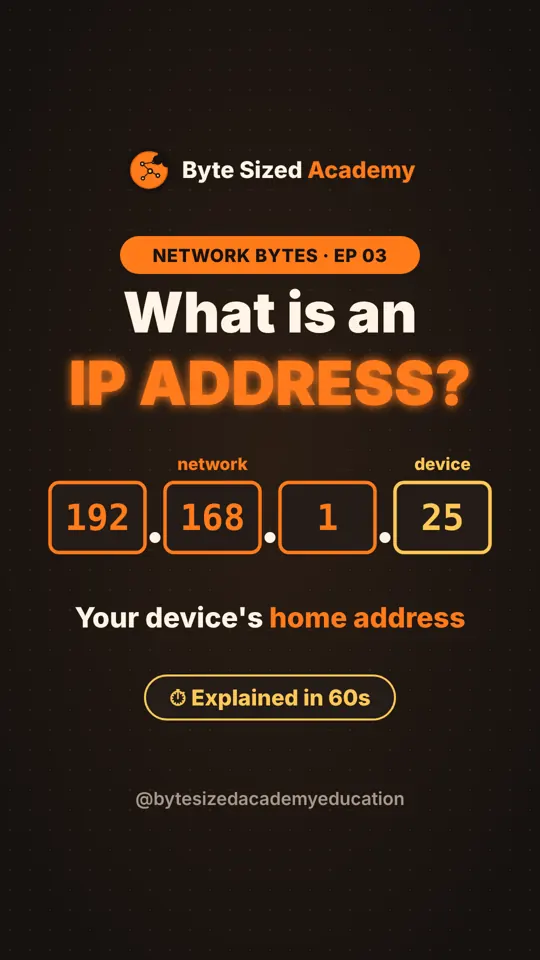 Network Bytes · EP03
What is an IP address?
Every device online has an address, just like your house. Here's how to read one.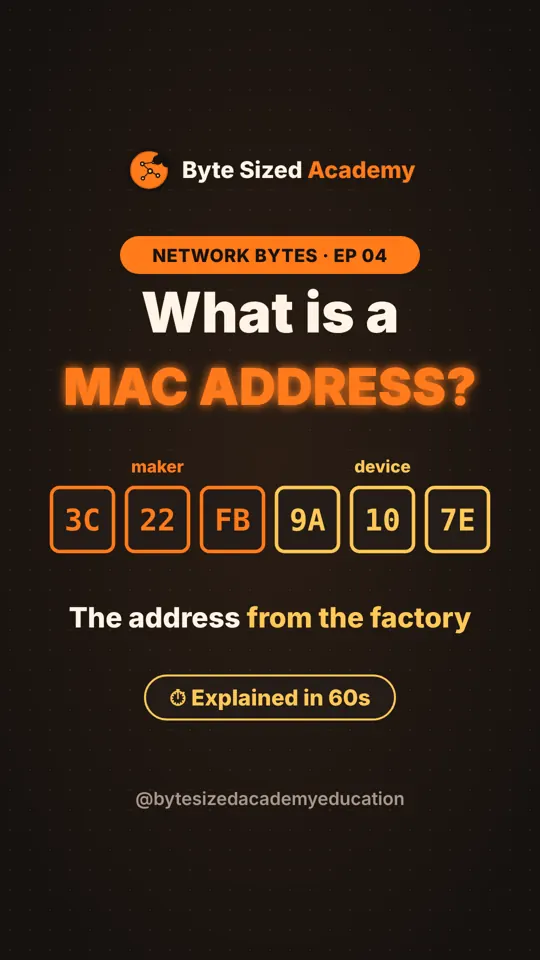 Network Bytes · EP04
What is a MAC address?
Your phone has two addresses, and one of them came from the factory. Here's what it is and how it works with your IP address. Network Bytes · EP05
Public vs private IP
Google has never seen your laptop's IP address. Here's the difference between private addresses inside your home and the one public address the internet sees. Network Bytes · EP06
What is DNS?
Your computer has no idea what "google.com" means. DNS, the internet's contacts app, turns the names you type into the IP addresses computers use.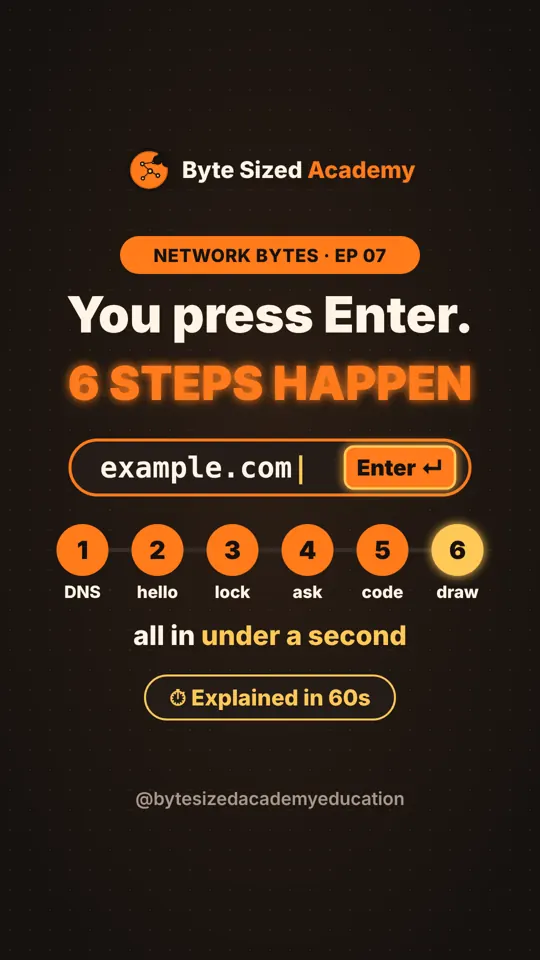 Network Bytes · EP07
What happens when you type a URL?
You type a web address and press Enter. Here are the six steps that happen before the page appears, often in well under a second. Network Bytes · EP08
What is a packet?
Your streaming movie doesn't arrive in one piece. It arrives as thousands of small packets, each labeled with where it's from, where it's going and which piece it is. Network Bytes · EP09
LAN vs WAN
Your house is a LAN. The internet is a WAN. Here's the difference between a local area network and a wide area network, and where your router fits. Network Bytes · EP10
Network topologies
Every network picked a shape. Here's how star, mesh and spine-leaf networks are wired, and what each one is good at.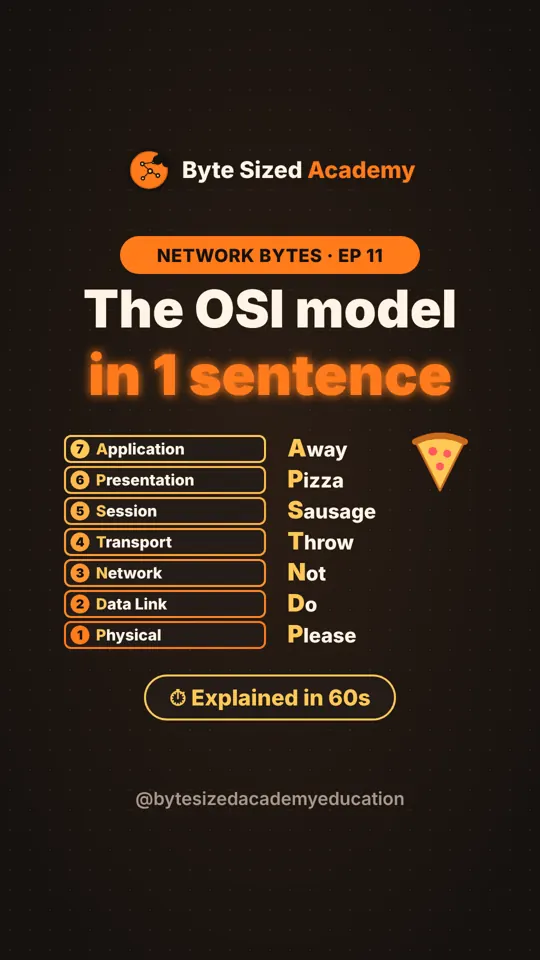 Network Bytes · EP11
The OSI model: 7 layers
Every message you send goes down seven layers and back up seven on the other side. Here's what each OSI layer does, and one silly sentence to remember them all.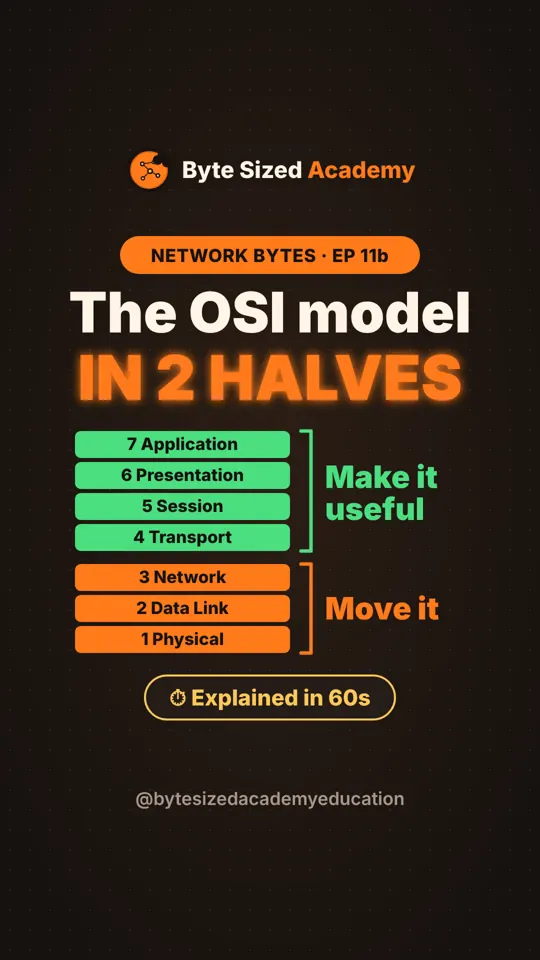 Network Bytes · EP11b
OSI: the two halves
The bottom three OSI layers move your data across the network. The top four only run on the two ends, your device and the server, and make that data useful.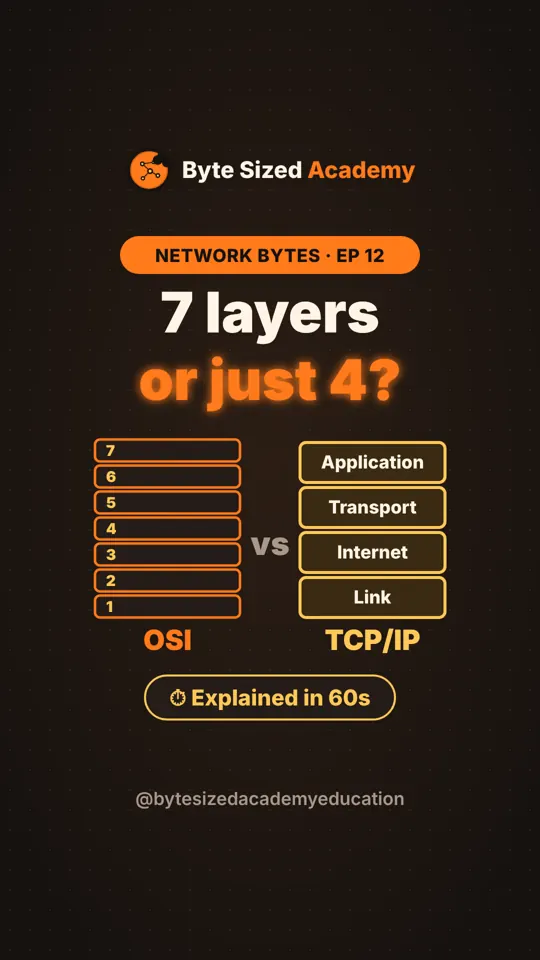 Network Bytes · EP12
TCP/IP vs OSI
There's the networking model you learn, with seven layers, and the one the internet actually runs on, with four. Here's how the TCP/IP model maps onto OSI.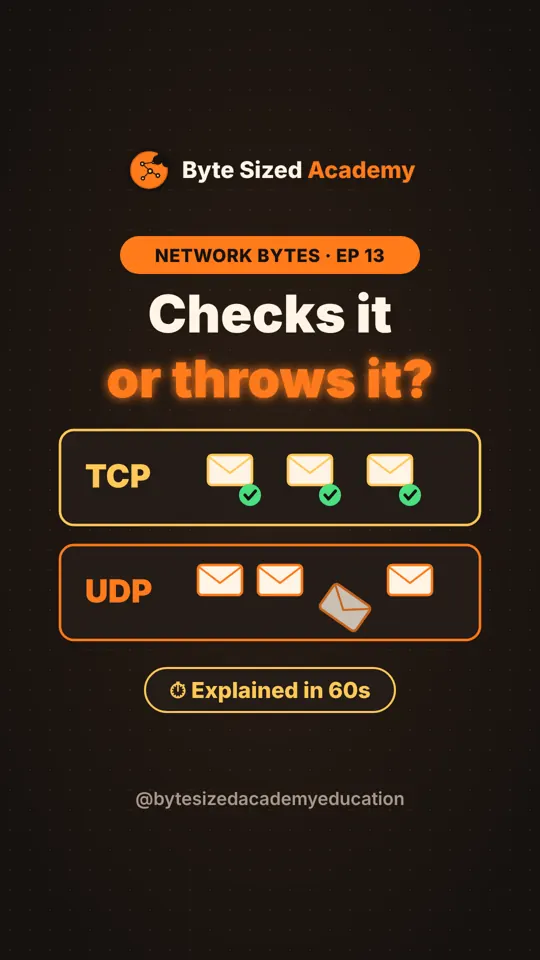 Network Bytes · EP13
TCP vs UDP
Both carry your data across the internet. TCP checks every delivery and resends what's lost; UDP just fires packets and keeps going. Here's when each one wins.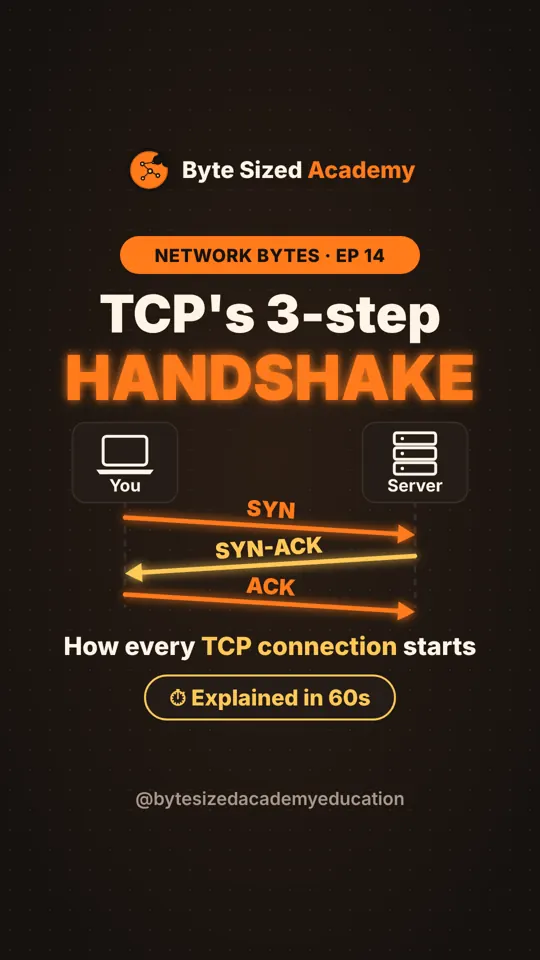 Network Bytes · EP14
The TCP three-way handshake
Almost every website you open starts with a three-step greeting. Here's how TCP's SYN, SYN-ACK and ACK set up a connection, and how TCP resends anything that gets lost.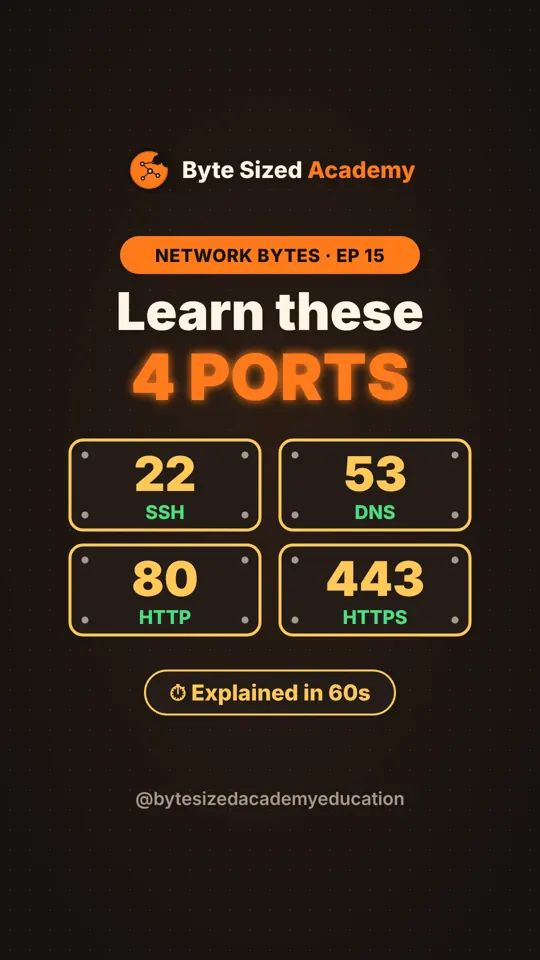 Network Bytes · EP15
Ports and common port numbers
An IP address gets data to the right device; a port number gets it to the right app. Here are the four port numbers to learn first. Network Bytes · EP16
Ethernet cables: copper vs fiber
Most network cables carry electricity over twisted copper wires. Fiber carries flashes of light through a hair-thin strand of glass, so it goes much farther and ignores electrical noise. Network Bytes · EP17
Duplex and speed mismatch
Your link is up, but everything crawls. Here's how full and half duplex work, why setting one end by hand causes a duplex mismatch, and the simple fix. Network Bytes · EP18
Collisions and why switches killed hubs
Hubs copied every message to every device, so signals crashed into each other. Here's what a collision is and how switches made them history.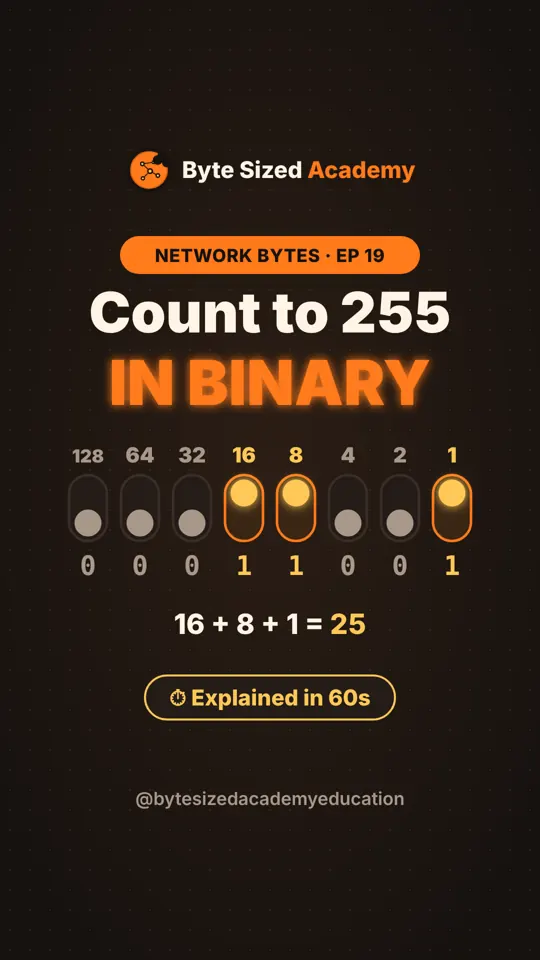 Network Bytes · EP19
Binary in 60 seconds
To read an IP address like a router, you only need to count to 255 in binary. Here's how eight bits make one byte, and why every part of an IP address is between 0 and 255.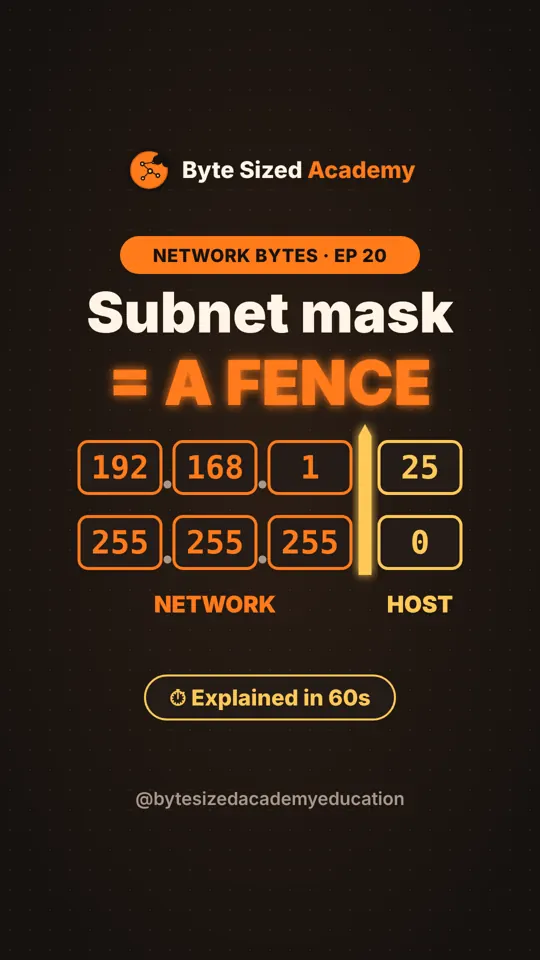 Network Bytes · EP20
What a subnet mask does
Every IP address has a network part and a host part. The subnet mask is the fence that shows where one ends and the other begins, like a street and a house number.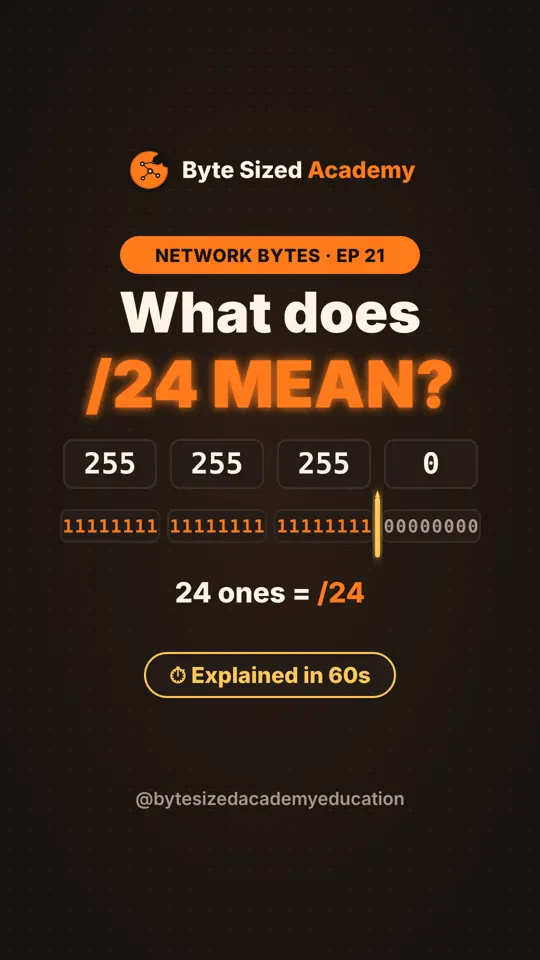 Network Bytes · EP21
CIDR notation (/24, /26)
The slash in /24 is just a count of the ones in the subnet mask. Here's how 255.255.255.0 becomes /24, and why /26 means 255.255.255.192.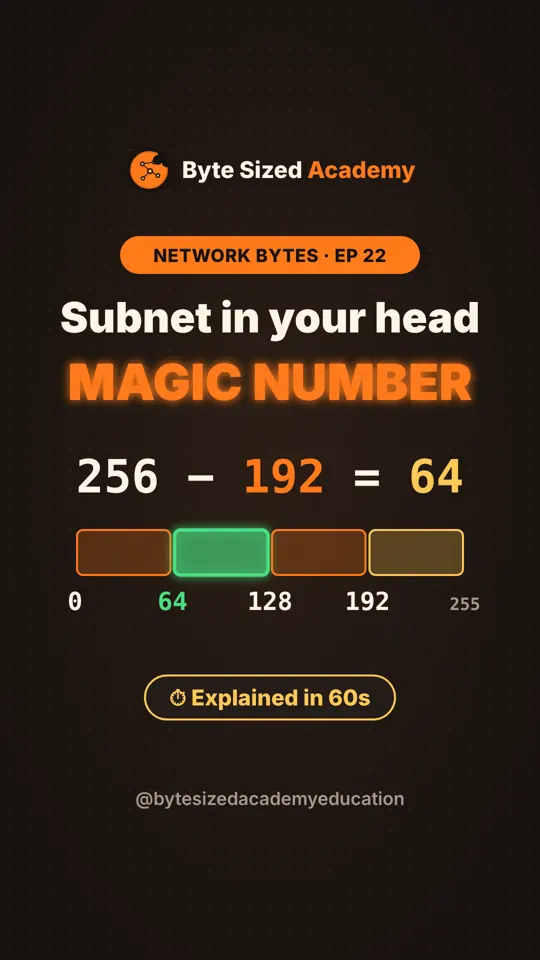 Network Bytes · EP22
Subnetting trick: the magic number
You can find any subnet in your head with one subtraction. Take the part of the mask that isn't 255 or 0, subtract it from 256, and count up by the answer.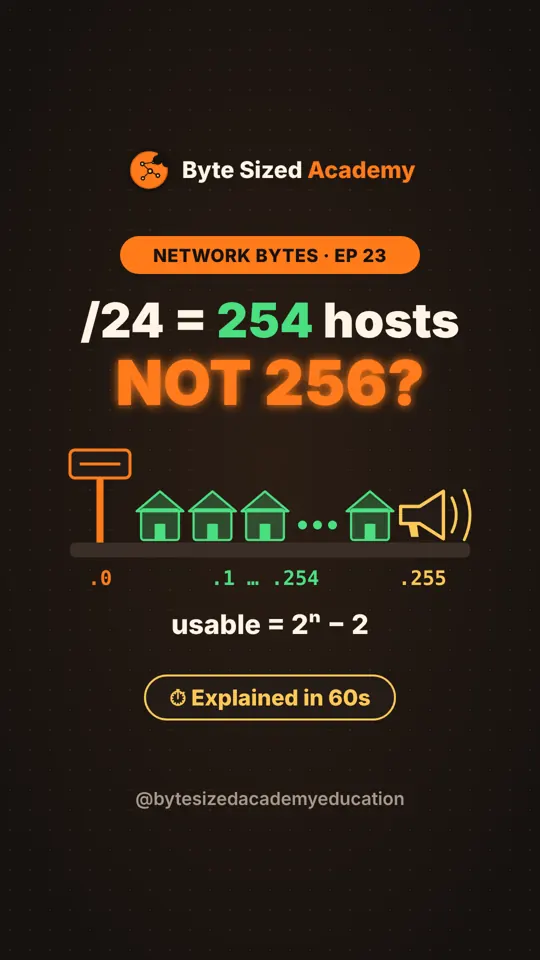 Network Bytes · EP23
Network, broadcast and usable hosts
A /24 has 256 addresses but only 254 usable hosts. The first address names the subnet and the last one reaches everyone, so usable hosts are 2 to the power of the host bits, minus 2.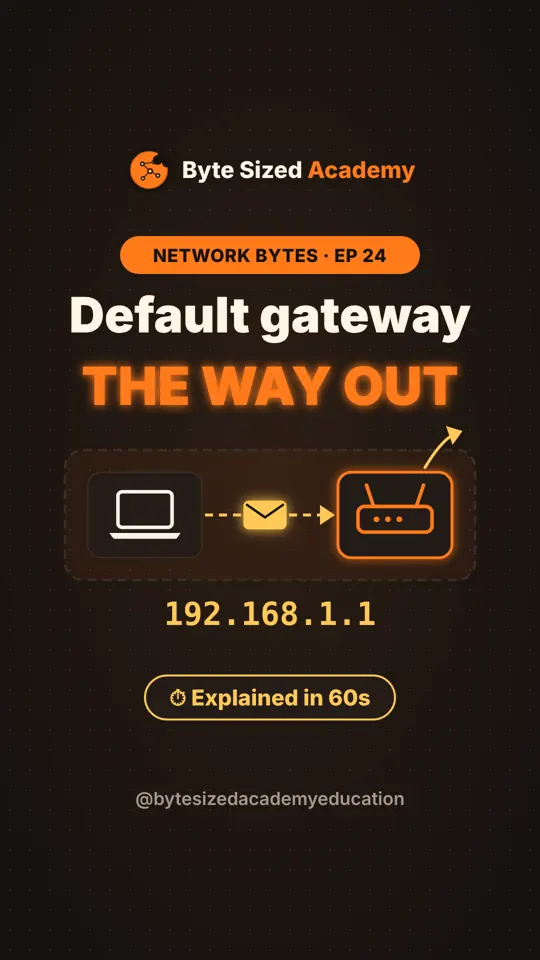 Network Bytes · EP24
Default gateway
Your computer sends straight to devices on its own subnet, and hands everything else to one router. That router's address is your default gateway, and if it's wrong, the internet stops working.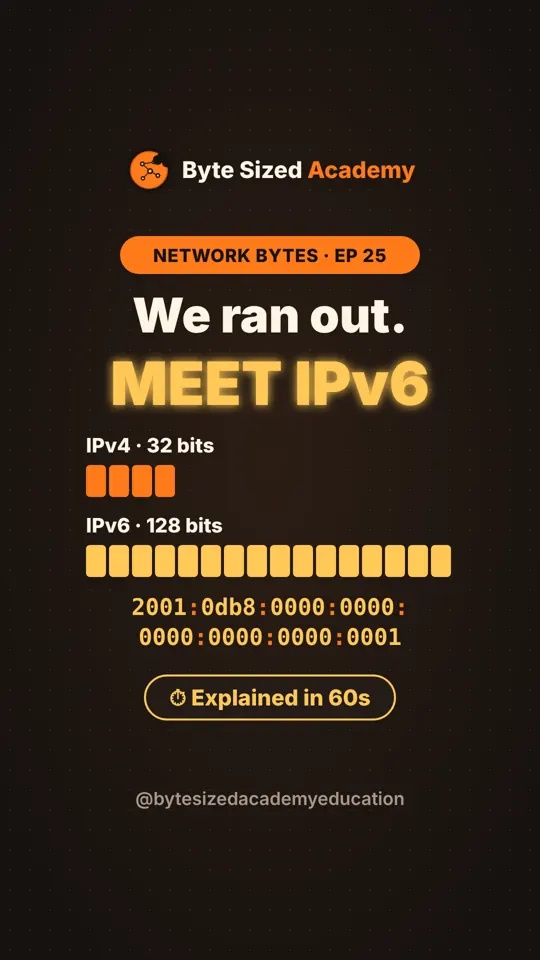 Network Bytes · EP25
IPv6 in 60 seconds
IPv4's 32-bit addresses give about 4.3 billion addresses, and the central pool ran out in 2011. IPv6 uses 128-bit addresses, written as eight groups of hex digits split by colons.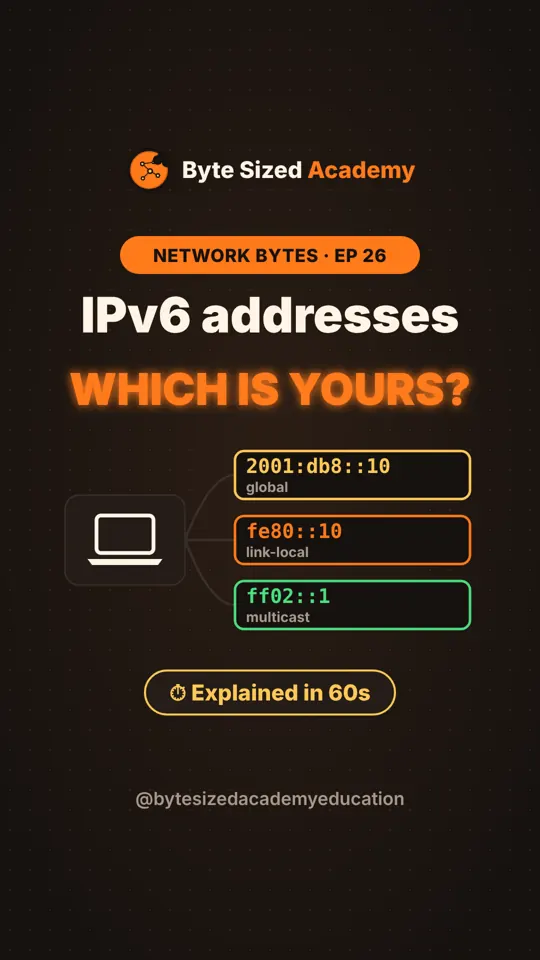 Network Bytes · EP26
IPv6 address types
An IPv6 device usually has several addresses at once. Global unicast reaches the whole internet, link-local stays on your own link, and multicast reaches a group. There's no broadcast.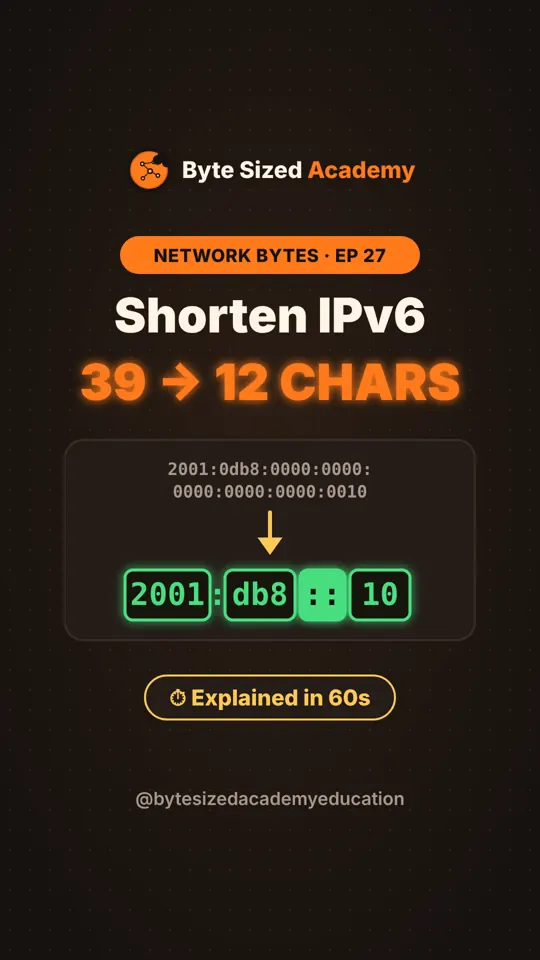 Network Bytes · EP27
How to shorten an IPv6 address
A full IPv6 address is 39 characters long. Two rules, dropping leading zeros and swapping one run of zero groups for a double colon, turn 2001:0db8:0000:0000:0000:0000:0000:0010 into 2001:db8::10.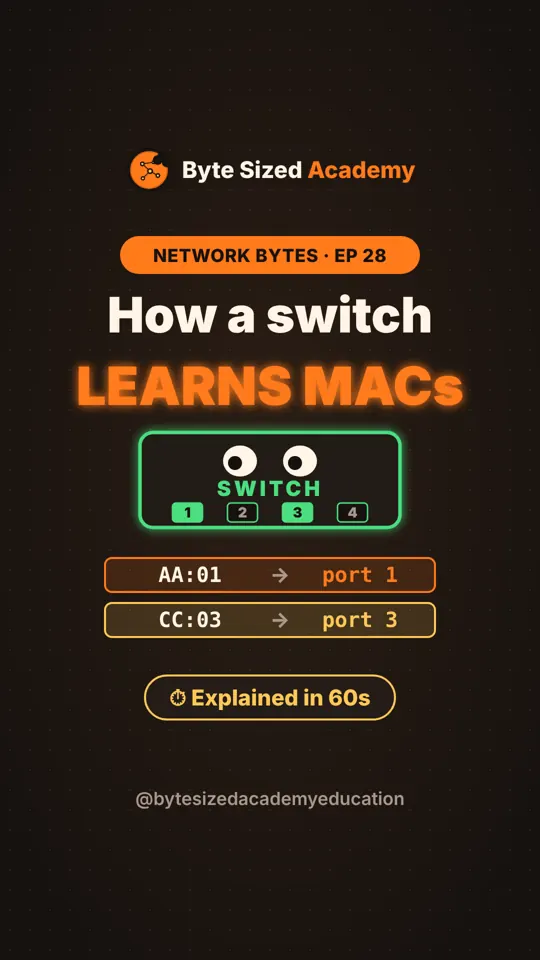 Network Bytes · EP28
How a switch learns MAC addresses
A switch starts with an empty MAC address table and fills it by reading the source MAC of every frame. Unknown destinations get flooded; known ones go straight to the right port.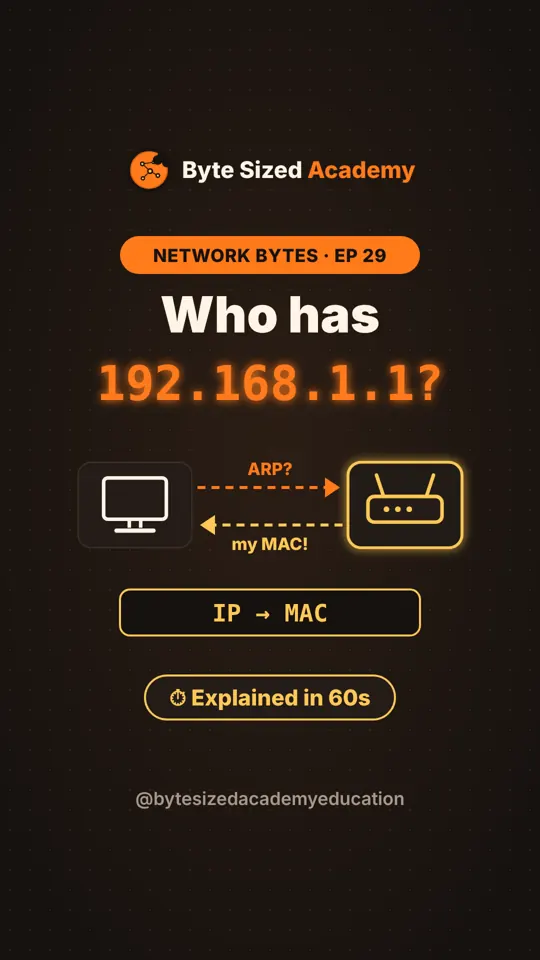 Network Bytes · EP29
ARP: finding a MAC from an IP
Your computer knows the IP address it wants to reach, but on the local network it needs a MAC address. ARP asks the whole subnet, and only the owner of that IP answers.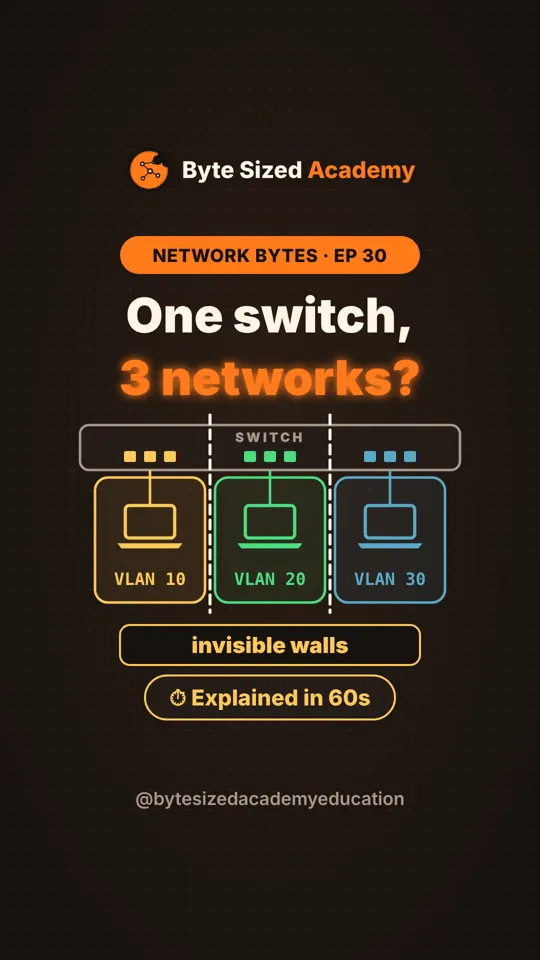 Network Bytes · EP30
What is a VLAN?
One office switch can run several separate networks. A VLAN groups the switch's ports so each group gets its own broadcast domain, with no new cables.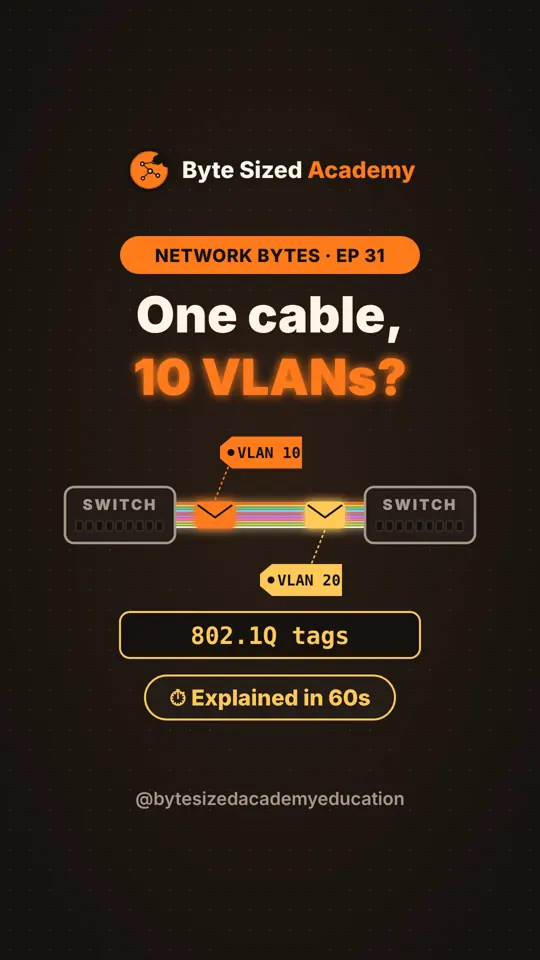 Network Bytes · EP31
Trunk ports and 802.1Q tags
One cable between two switches can carry many VLANs. A trunk port tags each frame with a 4-byte 802.1Q tag that says which VLAN it belongs to.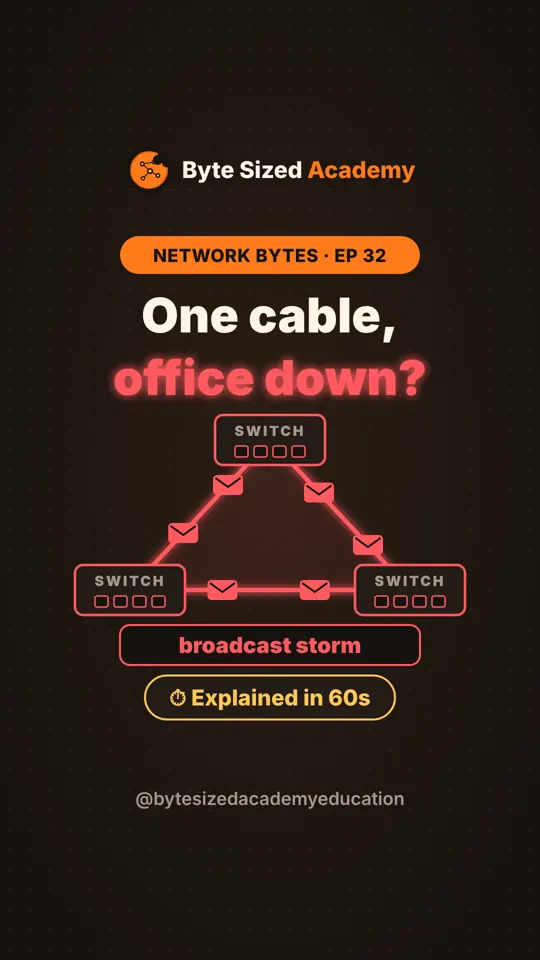 Network Bytes · EP32
"Spanning Tree: why loops kill networks"
A backup link between switches creates a loop, and a single broadcast can circle it forever until the network freezes. Spanning Tree Protocol blocks redundant ports so the loop can't form, and unblocks them if the main path fails.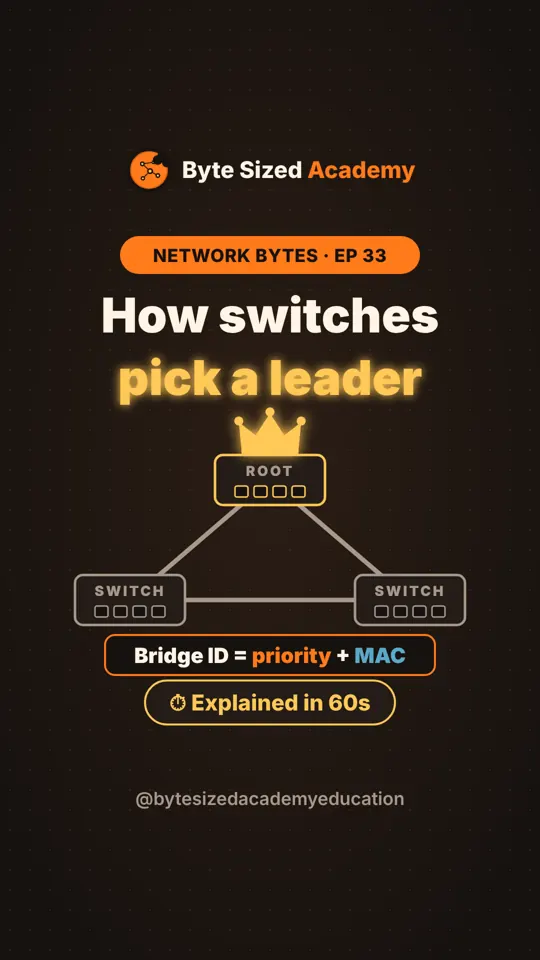 Network Bytes · EP33
Root bridge election
Spanning Tree needs one switch at the center, the root bridge. Switches compare bridge IDs (a priority plus a MAC address), the lowest one wins, and engineers set the priority so the right switch wins on purpose.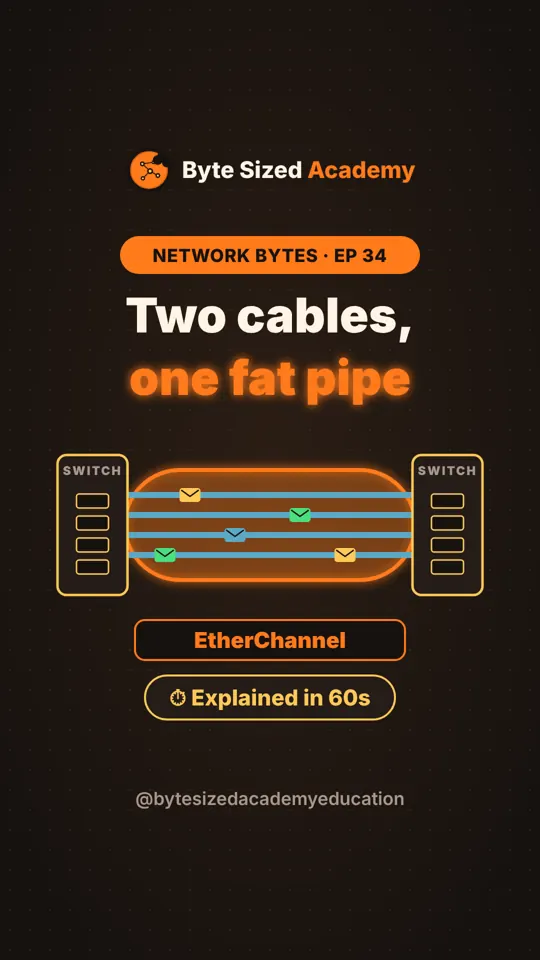 Network Bytes · EP34
EtherChannel
Two links between switches make a loop, so Spanning Tree blocks one and half the bandwidth sits idle. EtherChannel bundles up to eight links into one logical link, shares traffic across them and keeps running if a cable fails.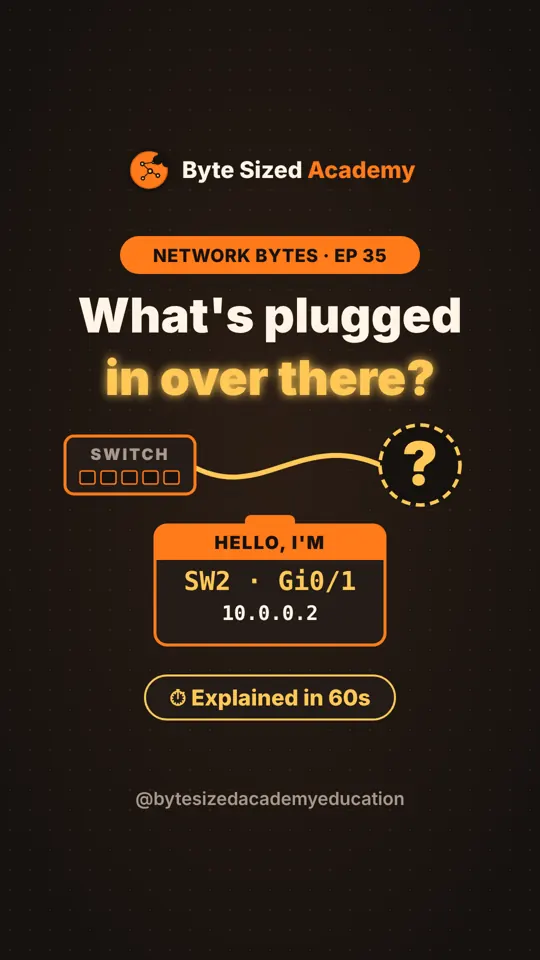 Network Bytes · EP35
CDP and LLDP
Switches learn what's plugged into each port from short hello messages their neighbors send. CDP is Cisco's version; LLDP is the open standard any brand can use. Network Bytes · EP36
2.4 GHz vs 5 GHz vs 6 GHz
Wi-Fi uses three radio bands. Lower frequencies reach farther and through more walls; higher ones have more room and speed but a shorter reach.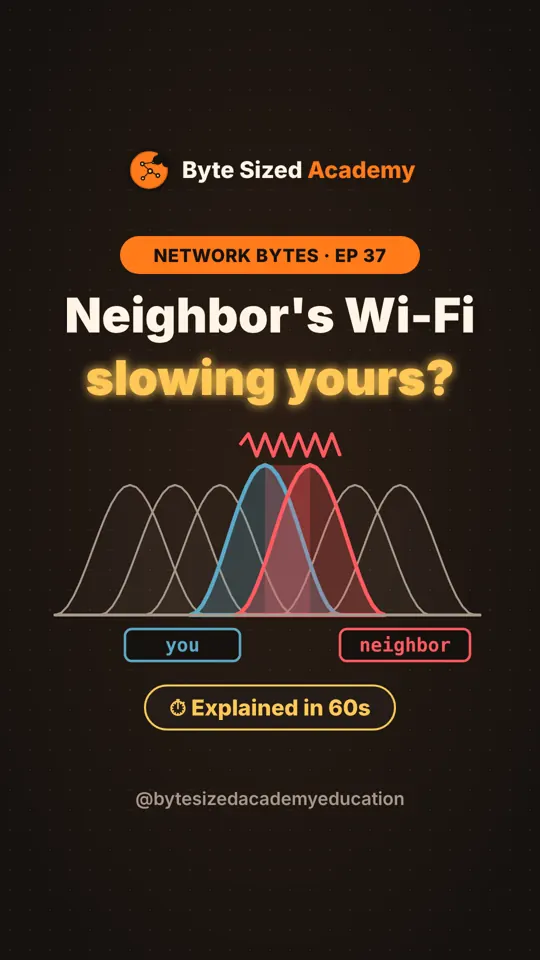 Network Bytes · EP37
Wi-Fi channels and interference
Wi-Fi networks on the same channel take turns on the air, and in 2.4 GHz neighboring channels overlap and add noise. Picking a non-overlapping channel, or moving to 5 or 6 GHz, dodges both problems.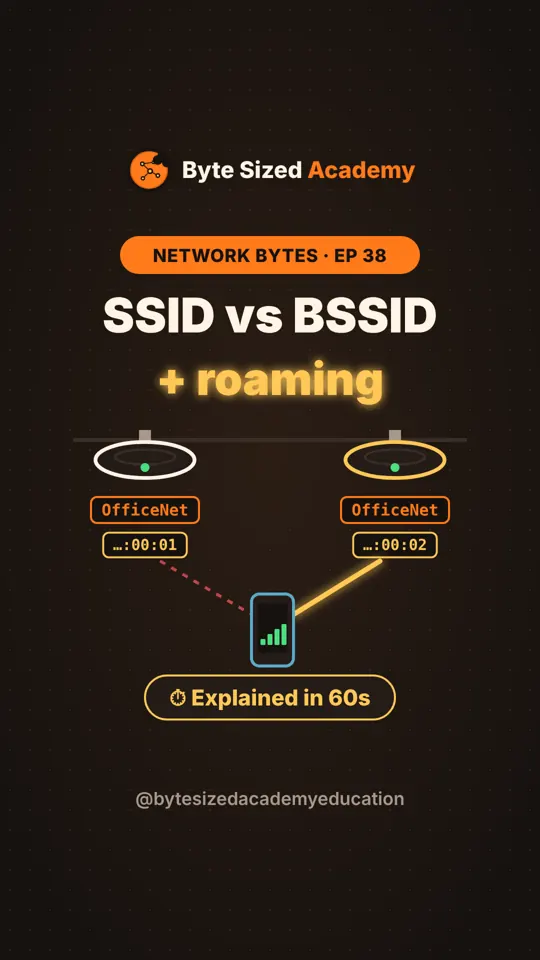 Network Bytes · EP38
SSID, BSSID and roaming
The SSID is the Wi-Fi name many access points share; the BSSID is each access point radio's own MAC-style address. Roaming is your phone switching to a stronger access point with the same name.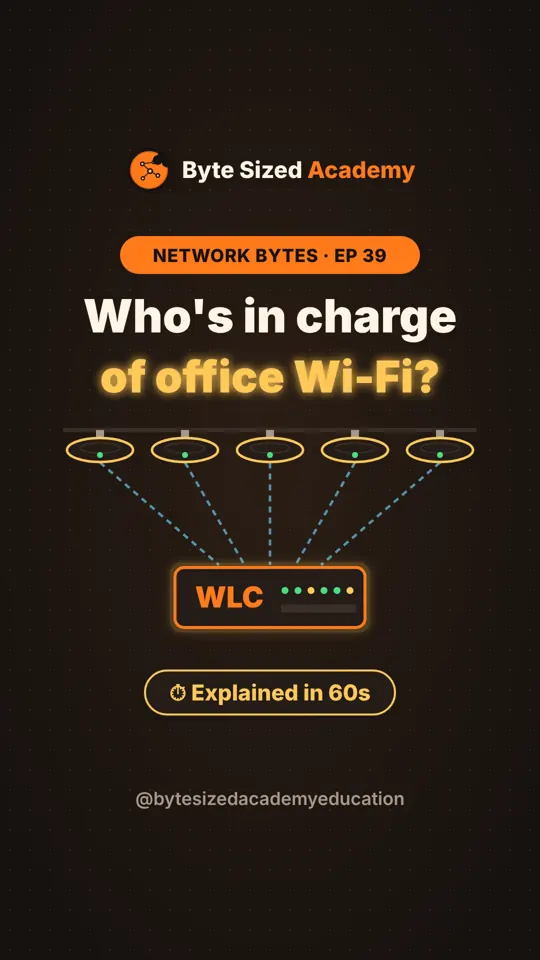 Network Bytes · EP39
Autonomous vs controller-based APs
An autonomous access point is configured and managed on its own, like a freelancer. In a controller-based network, lightweight access points do the radio work and a wireless LAN controller holds everyone's settings. Network Bytes · EP40
WPA2 vs WPA3
With WPA2-Personal, anyone nearby can record the handshake and guess your Wi-Fi password offline. WPA3-Personal's SAE handshake makes every guess a live one, and mixed mode keeps older devices on the old handshake. Network Bytes · EP41
What a router actually does
A router reads a packet's destination IP address, looks it up in its routing table and sends the packet to the next hop. Router by router, hop by hop, the packet reaches its destination's network.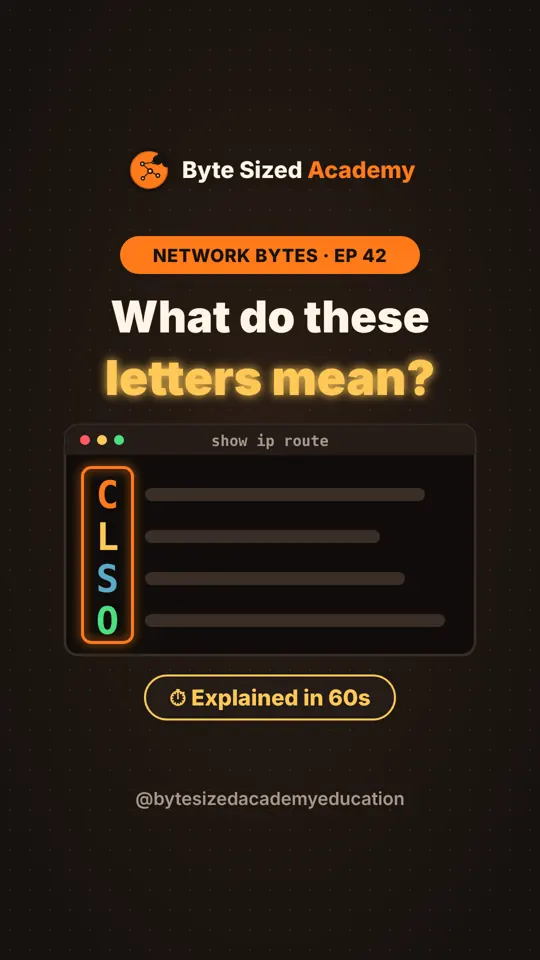 Network Bytes · EP42
Reading a routing table
Every line of show ip route is a map entry. The letter on the left says how the router learned the route (C connected, L local, S static, O OSPF), and the rest of the line gives the destination network, the next hop and the exit port.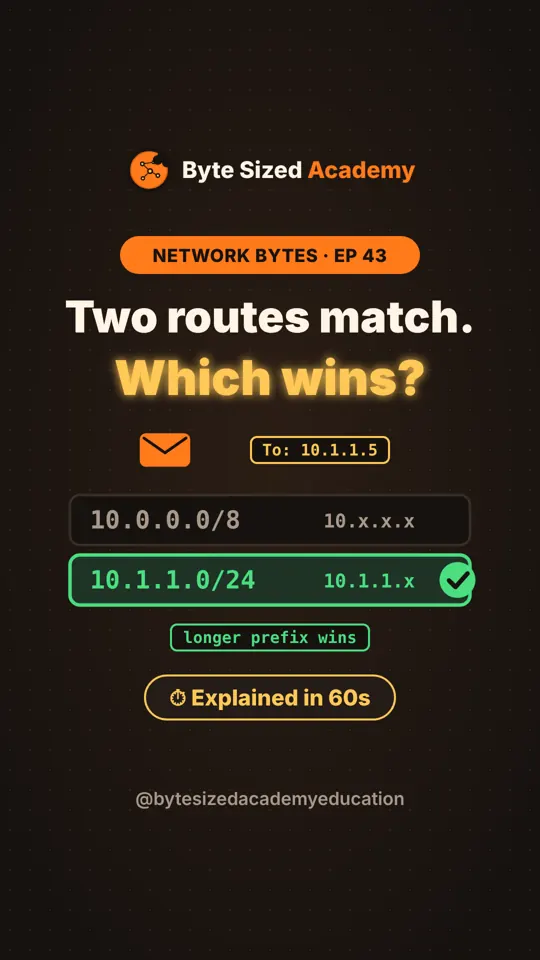 Network Bytes · EP43
Longest prefix match
When two routes both contain a packet's destination, the router uses the more specific one, the route with the longest prefix. A route only counts if it contains the address, and the default route 0.0.0.0/0 is the last resort.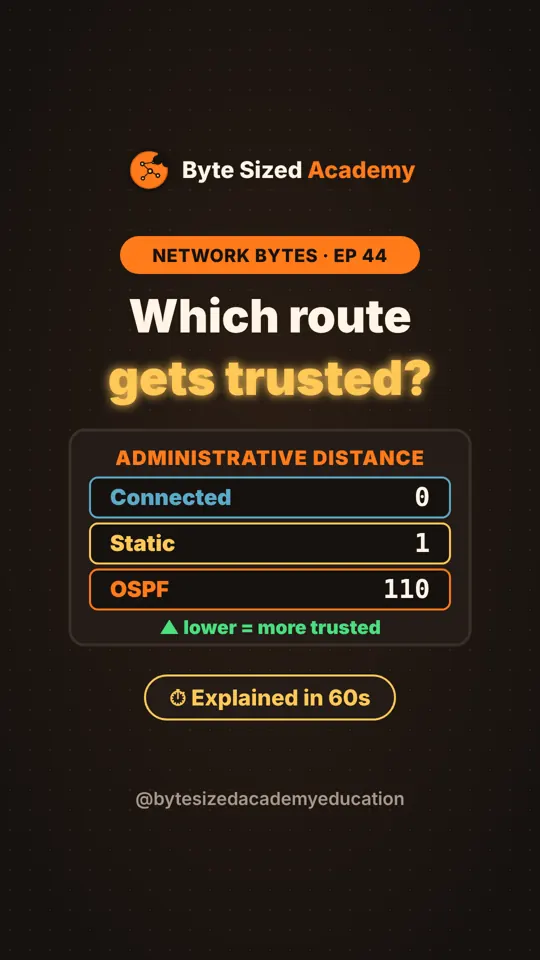 Network Bytes · EP44
Administrative distance
When a router learns the same network from more than one source, it trusts the one with the lowest administrative distance and puts that route in its routing table. The other route waits as a backup.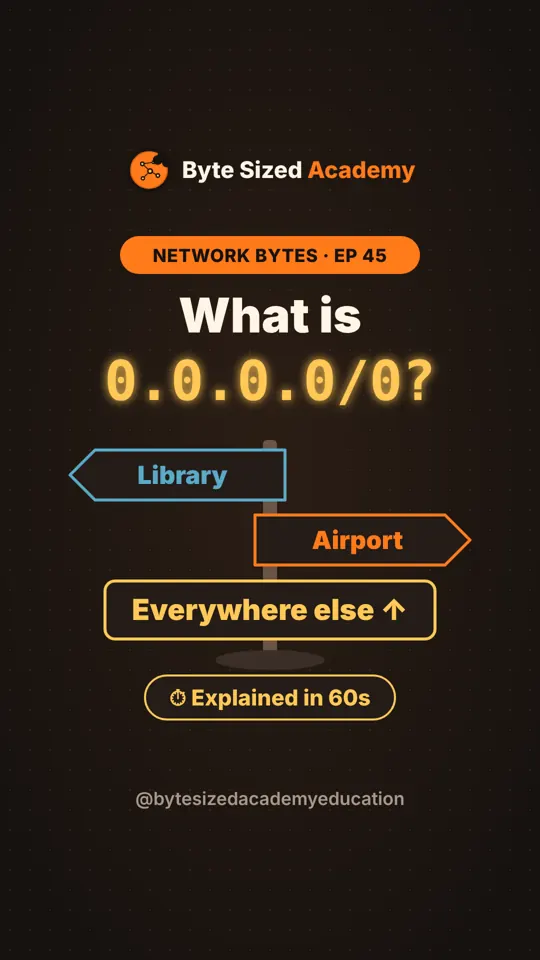 Network Bytes · EP45
Static and default routes
A static route is a route an engineer types into a router by hand. The default route, 0.0.0.0/0, matches every address and is used only when no more specific route matches.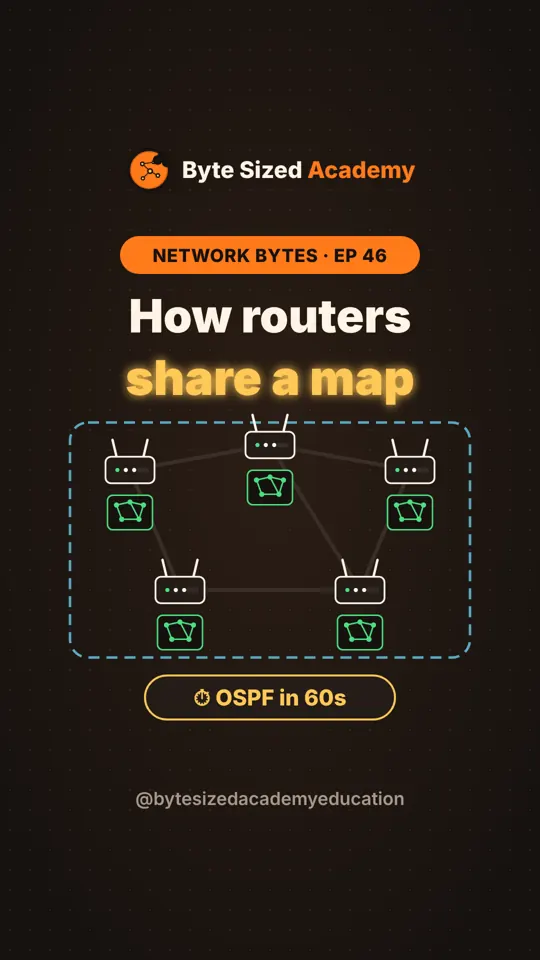 Network Bytes · EP46
OSPF in 60 seconds
OSPF lets routers learn the whole network on their own. They say hello to their neighbors, share their links, pass that news along until every router in the area has the same map, then each one picks the path with the lowest total cost.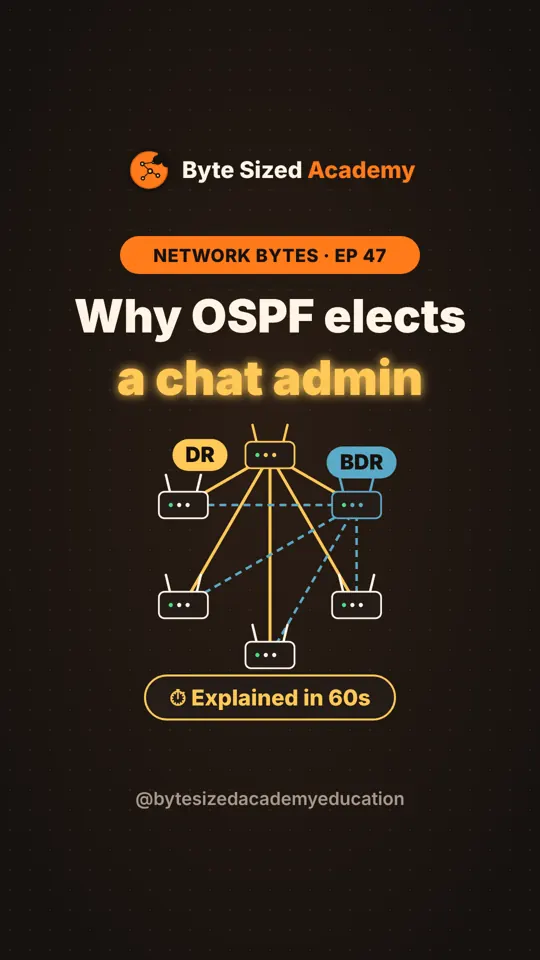 Network Bytes · EP47
OSPF neighbors and DR/BDR
OSPF routers become neighbors by trading hellos with matching settings. On a shared Ethernet segment they elect a designated router (DR) and a backup (BDR), so updates go through one router instead of every pair syncing with every other.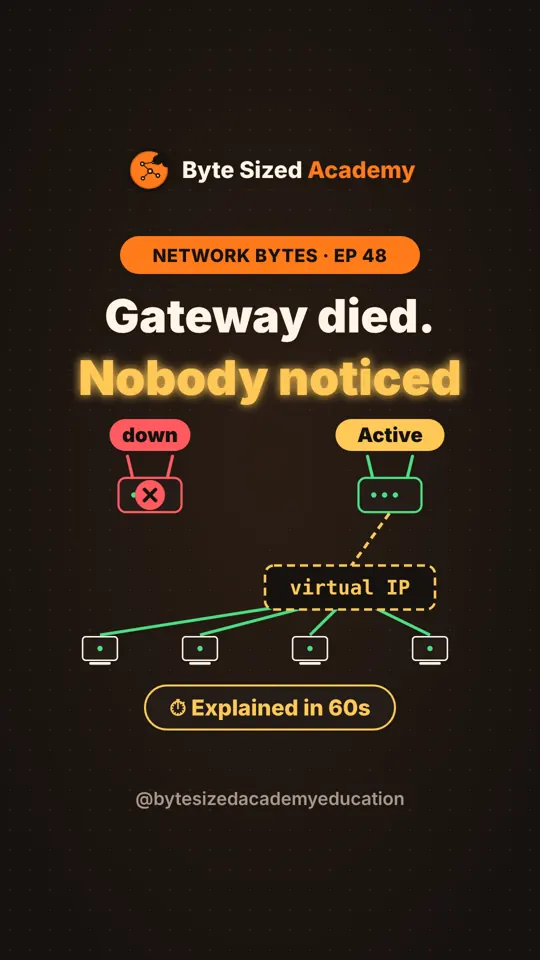 Network Bytes · EP48
HSRP / first-hop redundancy
Every PC depends on one default gateway, so one router failure can cut off a whole office. HSRP lets two routers share a virtual IP gateway; the active router forwards traffic and the standby takes over when the hellos stop.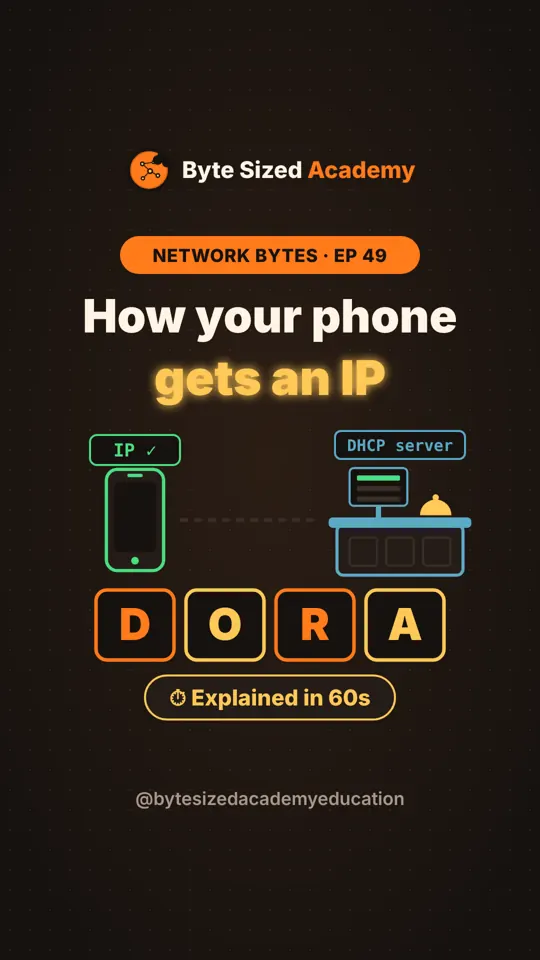 Network Bytes · EP49
DHCP and DORA
When a device joins a network it gets its IP address from DHCP in four steps nicknamed DORA (Discover, Offer, Request, Acknowledge), and keeps it for a set time called a lease.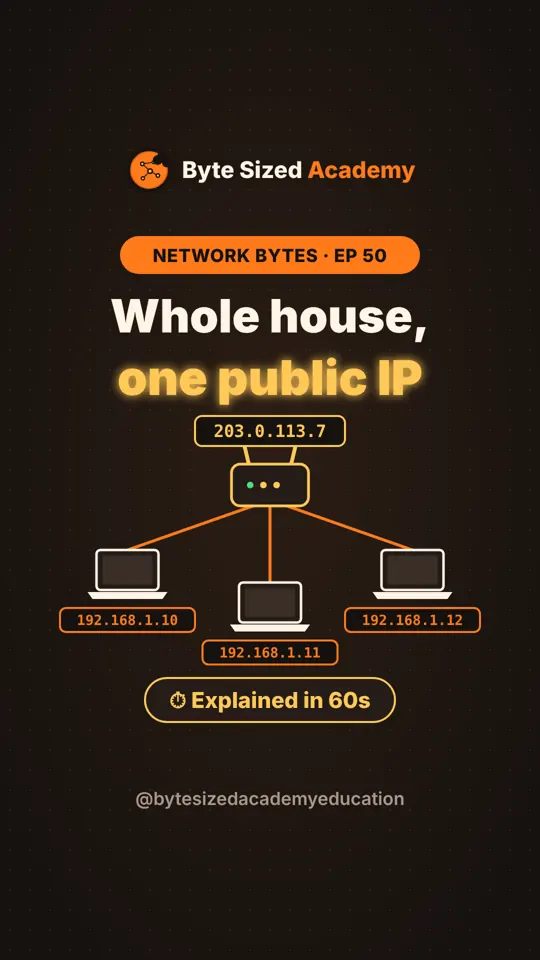 Network Bytes · EP50
NAT and PAT
Your home devices use private addresses that can't go out on the internet. NAT swaps them for the router's one public address, and PAT adds a port number per conversation so replies find the right device.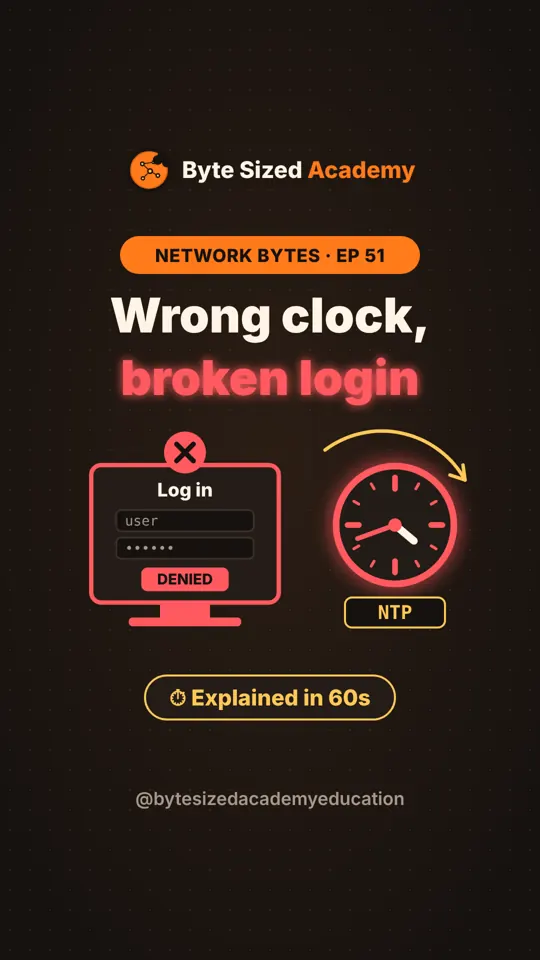 Network Bytes · EP51
"NTP: why time matters"
Logins, certificates and logs all depend on correct clocks. NTP, the Network Time Protocol, keeps devices in sync by asking a time server and correcting for the delay, with time flowing down in layers called strata.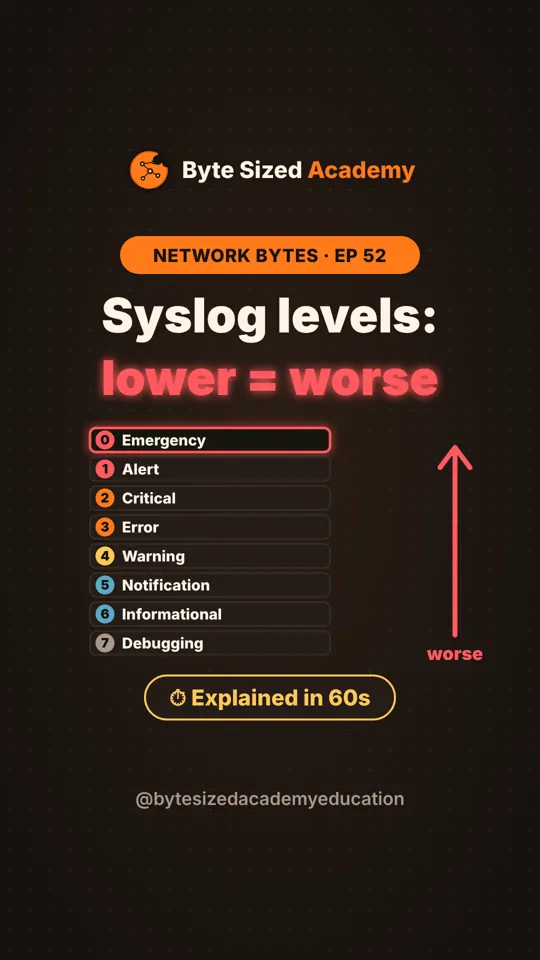 Network Bytes · EP52
"Syslog severity levels"
Every syslog message carries a severity level from 0 to 7, and lower numbers are worse. Learn the eight levels in order, a mnemonic to remember them, and what happens when you pick a logging level.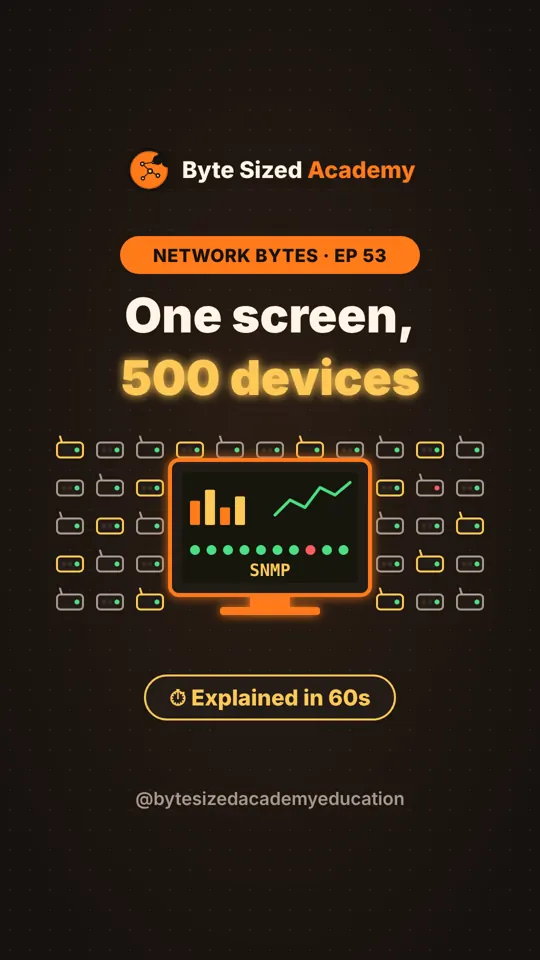 Network Bytes · EP53
"SNMP"
SNMP, the Simple Network Management Protocol, lets one monitoring program watch hundreds of devices. A manager polls an agent on each device for values stored in its MIB, and agents send traps when something goes wrong.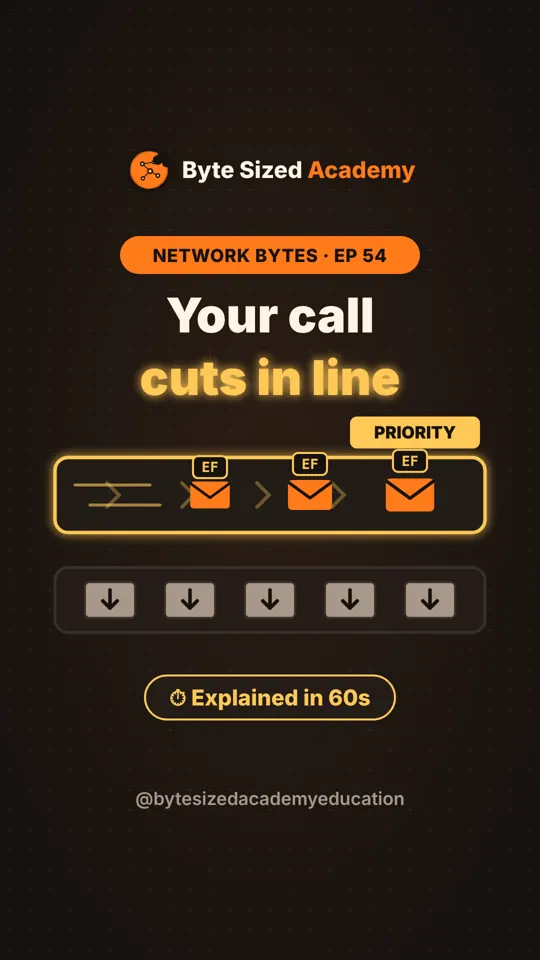 Network Bytes · EP54
"QoS: why your video call wins"
Quality of Service (QoS) lets a busy network decide which packets go first. Traffic is classified and marked with DSCP in the IP header, voice gets Expedited Forwarding, and routers send the priority queue first when the link is congested.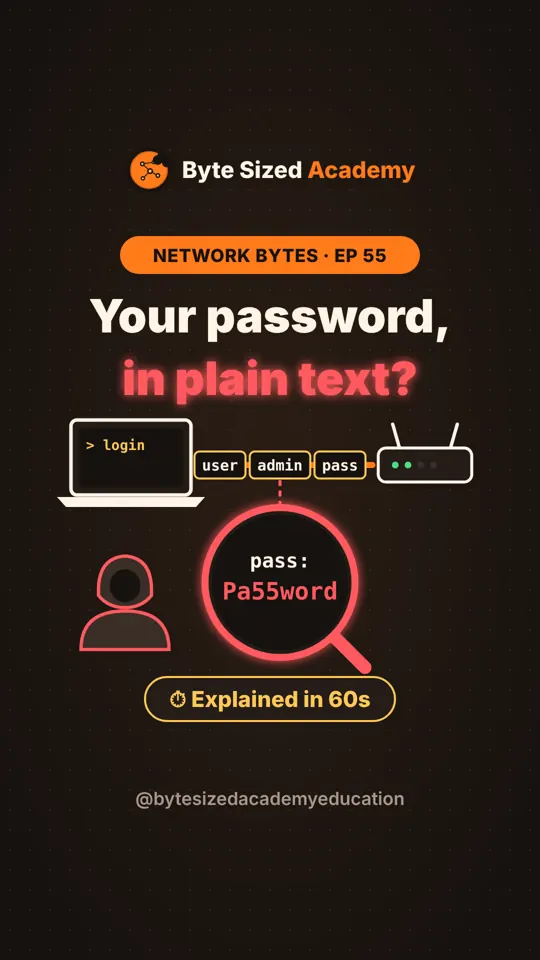 Network Bytes · EP55
"SSH vs Telnet"
Telnet and SSH both give you a remote command line on a router or switch, but Telnet sends everything, including your password, in plain text. SSH encrypts the session on TCP port 22. Learn why, and the Cisco steps to set it up. Network Bytes · EP56
"Threat, vulnerability, exploit"
A vulnerability is a weakness, a threat is anyone or anything that could cause harm, and an exploit is the actual method or code that takes advantage of one specific weakness. Defense means closing the weak spots. Network Bytes · EP57
"ACLs: the network bouncer"
An access control list is a router's list of permit and deny rules, read from the top. The first rule that matches wins, anything that matches nothing hits an invisible deny at the end, standard ACLs check only the source address and extended ACLs can also check destination, protocol and port.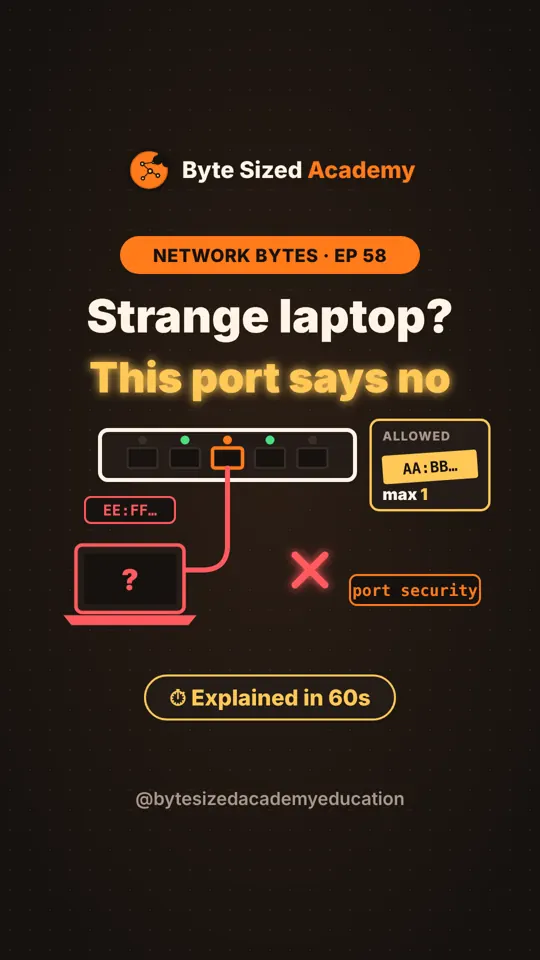 Network Bytes · EP58
"Port security"
Port security lets a switch port remember which MAC addresses are allowed and how many. Learn the default limit of one, sticky learning, and the three violation modes: shutdown, restrict and protect.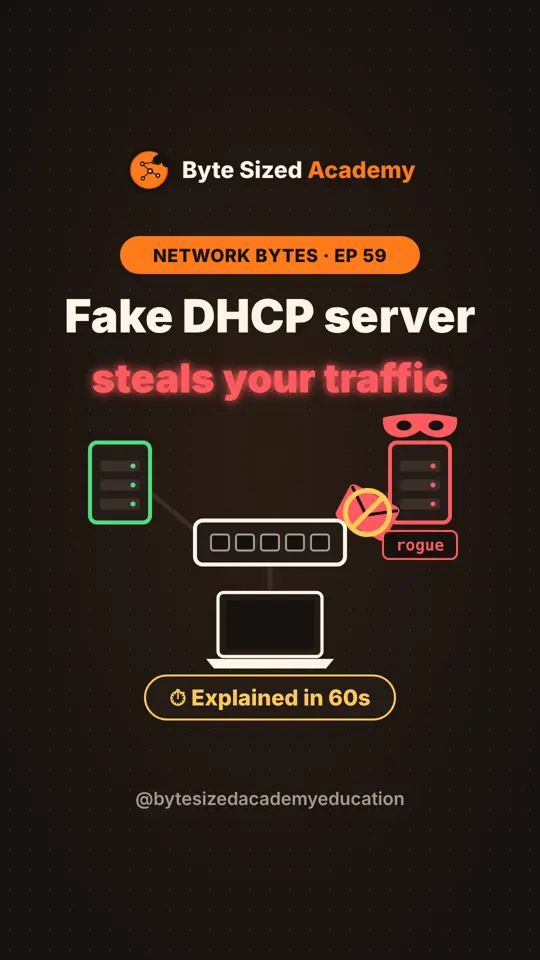 Network Bytes · EP59
"DHCP snooping and rogue DHCP"
A rogue DHCP server that answers first can make itself every victim's default gateway and sit in the middle of their traffic. DHCP snooping stops it on the switch by trusting only the ports toward the real server and dropping server messages everywhere else.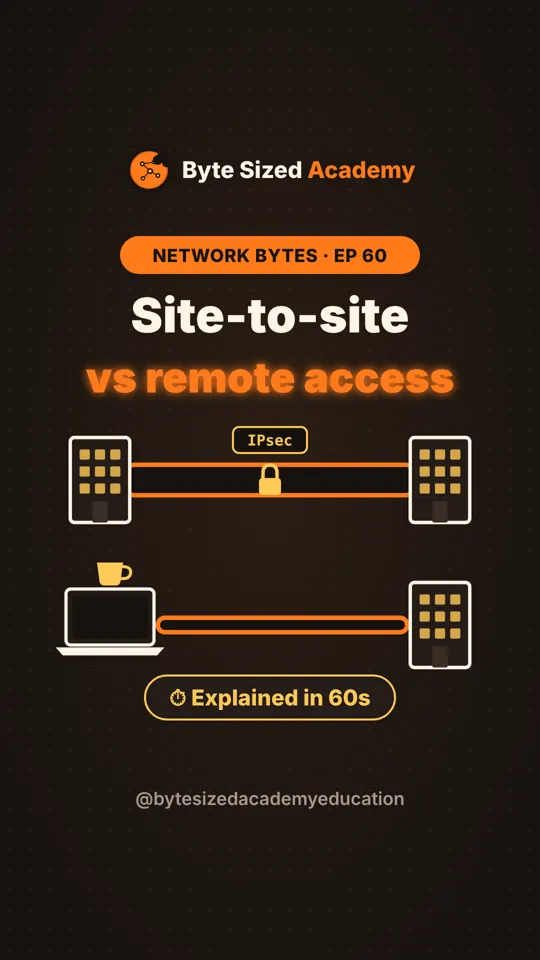 Network Bytes · EP60
"VPNs: site-to-site vs remote access"
A VPN encrypts each packet and wraps it inside a new one, so it can cross the public internet privately. Site-to-site VPNs join whole offices through their routers or firewalls; remote access VPNs connect one person's device back to the office.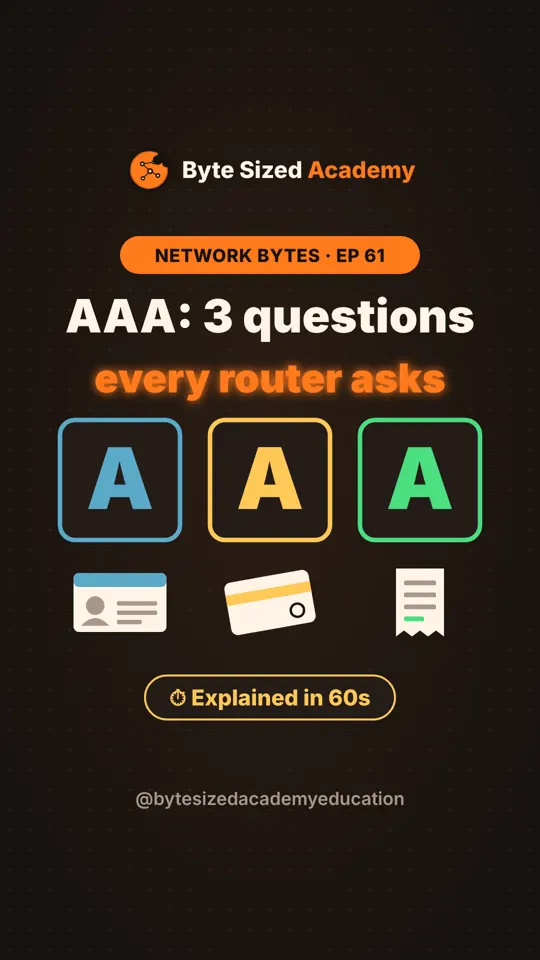 Network Bytes · EP61
"AAA: authentication, authorization and accounting"
AAA answers three questions about everyone who logs in to a network device: who are you, what can you do, and what did you do? A central RADIUS or TACACS+ server usually handles all three.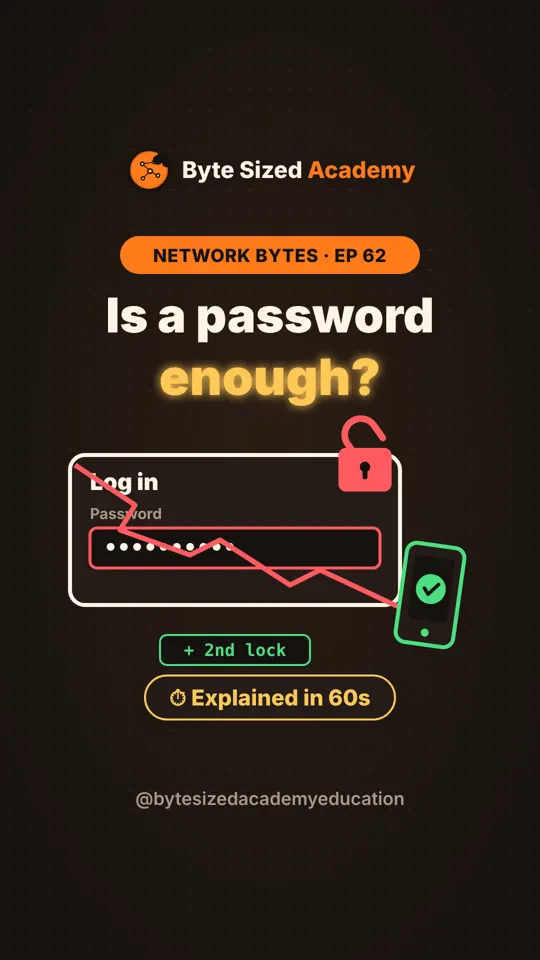 Network Bytes · EP62
"MFA and password policy"
Passwords leak through guessing, phishing and reuse, so multi-factor authentication asks for proof from two different factor groups. Security keys and app prompts beat text codes, and for the password itself, length beats symbol rules.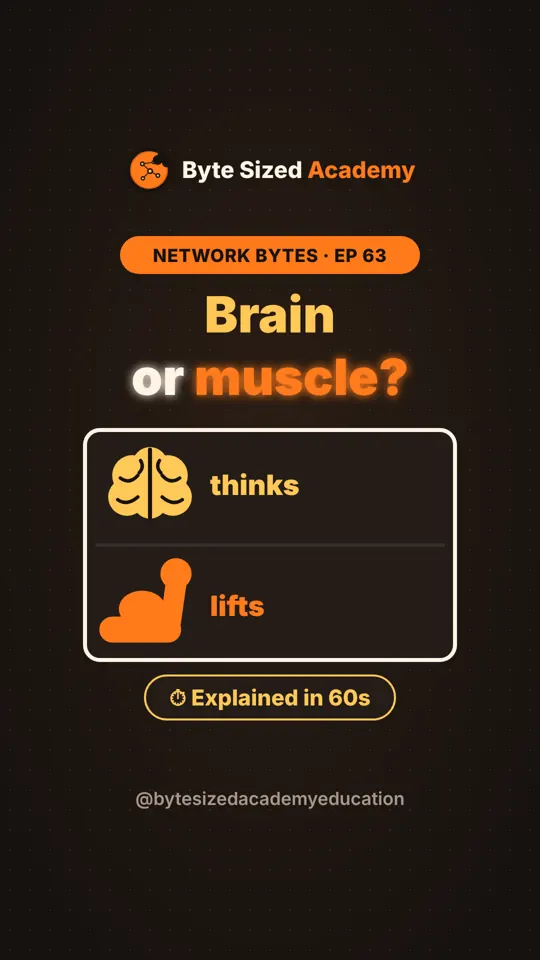 Network Bytes · EP63
"Control plane vs data plane"
Every router and switch does two jobs. The control plane thinks, learning routes and building the tables; the data plane lifts, using those tables to forward every packet out the right port, fast.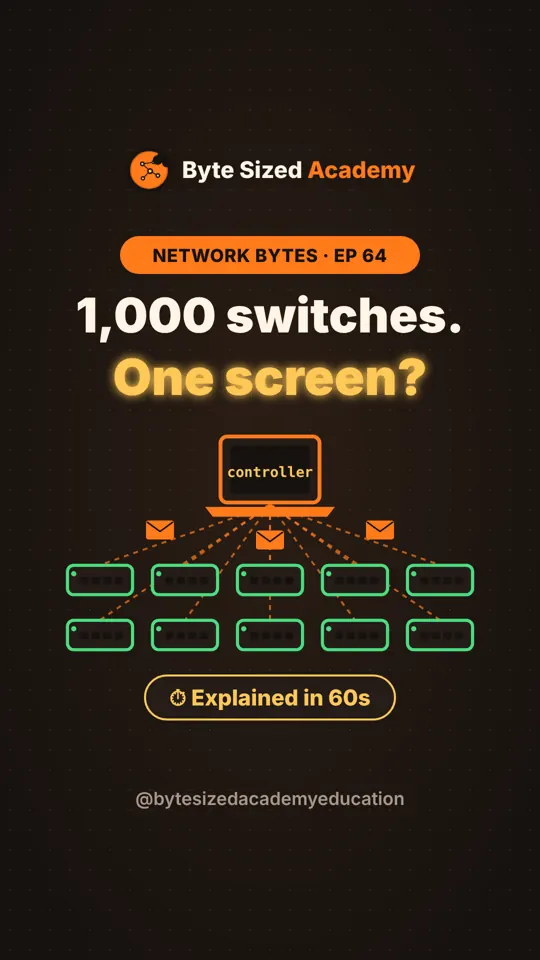 Network Bytes · EP64
"What is SDN?"
Software-defined networking moves the brains of the network to one place, a controller. You tell the controller what you want, and it works out the commands and pushes them to every switch at once.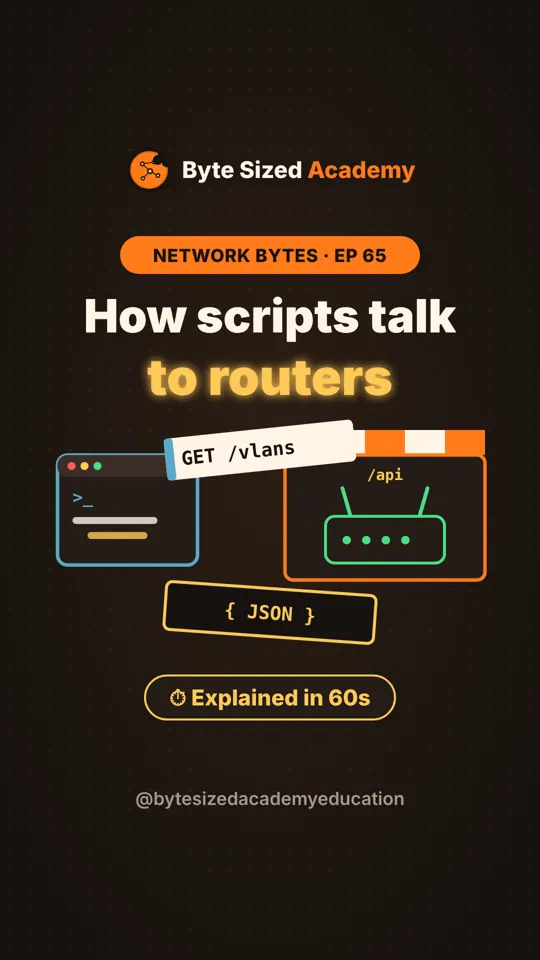 Network Bytes · EP65
"REST APIs for network engineers"
A REST API lets a script send a short request to a web address on a network device and get a reply back, usually as JSON. Each request starts with an HTTP verb, and four verbs cover create, read, update and delete (CRUD).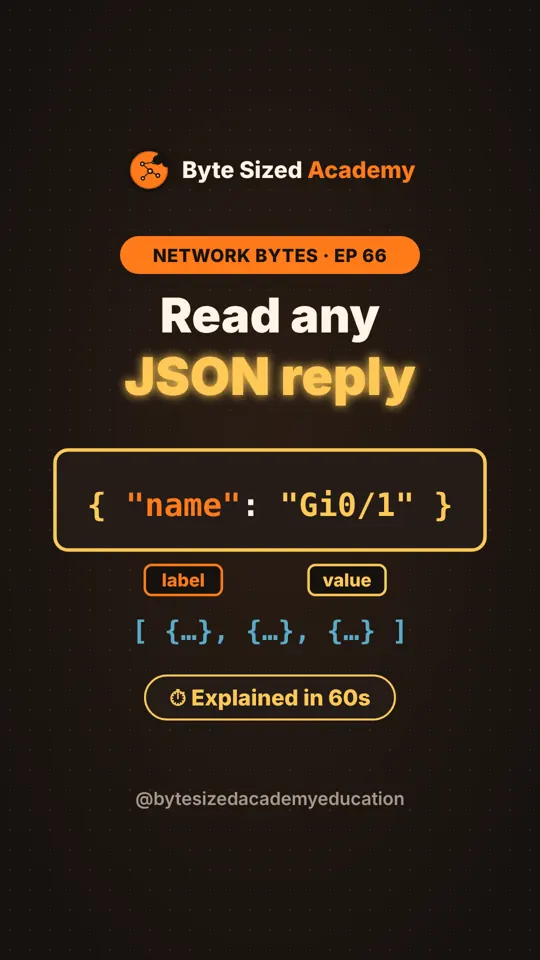 Network Bytes · EP66
"Reading JSON in 60 seconds"
JSON is the text format most network APIs reply in. Curly braces hold an object of labels and values, square brackets hold an ordered list, and values are text, numbers, true, false, null, or more objects and lists. Network Bytes · EP67
"Ansible vs Terraform"
Terraform builds infrastructure from a file that describes what should exist, and Ansible logs in to existing devices and runs a playbook of tasks on them. Each can do some of the other's job, and many teams use both. Network Bytes · EP68
"AI and ML in network operations"
Machine learning learns a baseline, the normal range for things like link use and Wi-Fi login time, and predictive AI raises an alert when readings drift away from it. Generative AI answers plain-English questions and drafts fixes, while engineers still review the big changes. Network Bytes · EP69
"Ping: testing reachability"
Ping sends a small ICMP echo request to an address and waits for an echo reply, showing the round-trip time in milliseconds. No reply means the request timed out, so you test close first, then work outward to find where the replies stop.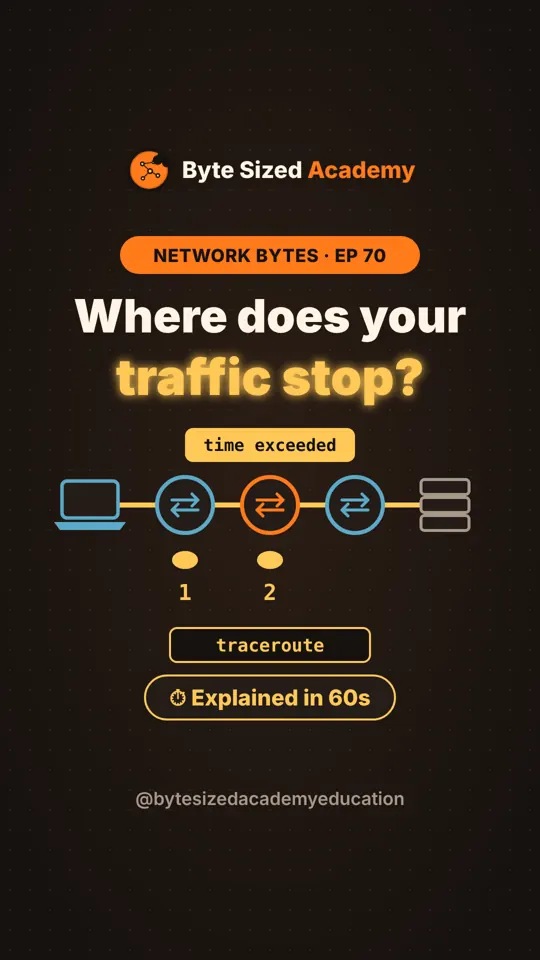 Network Bytes · EP70
"Traceroute: mapping the path"
Every IP packet carries a time to live (TTL) that each router lowers by one, and a router that takes it to zero drops the packet and sends back ICMP time exceeded. Traceroute uses that on purpose, sending probes with a TTL of 1, then 2, and so on, to list every hop on the path and its delay.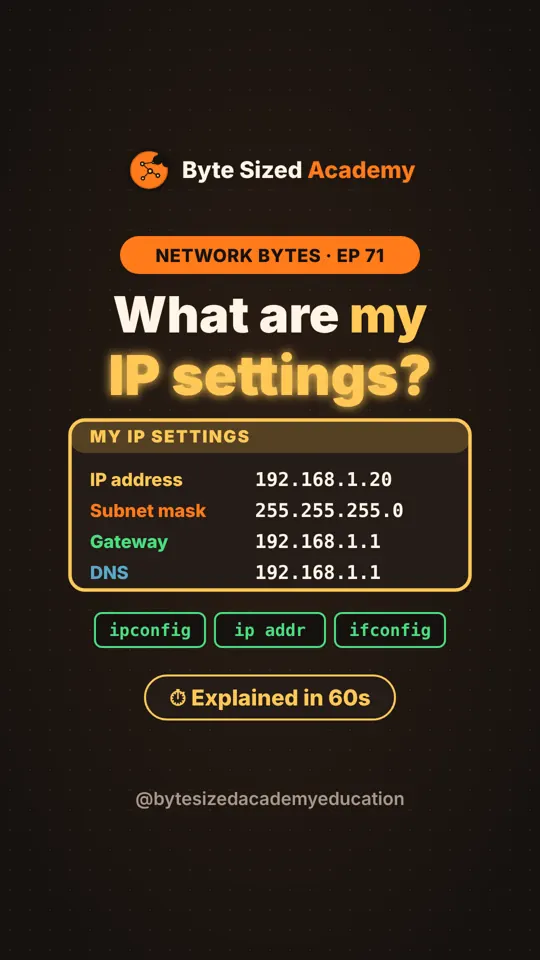 Network Bytes · EP71
"ipconfig / ip addr: check your IP settings"
Before blaming the network, check your own device's IP settings with one command, ipconfig on Windows, ip address on Linux or ifconfig on a Mac. Look at four things, the IP address, subnet mask, default gateway and DNS servers, because a blank or wrong one is your first clue.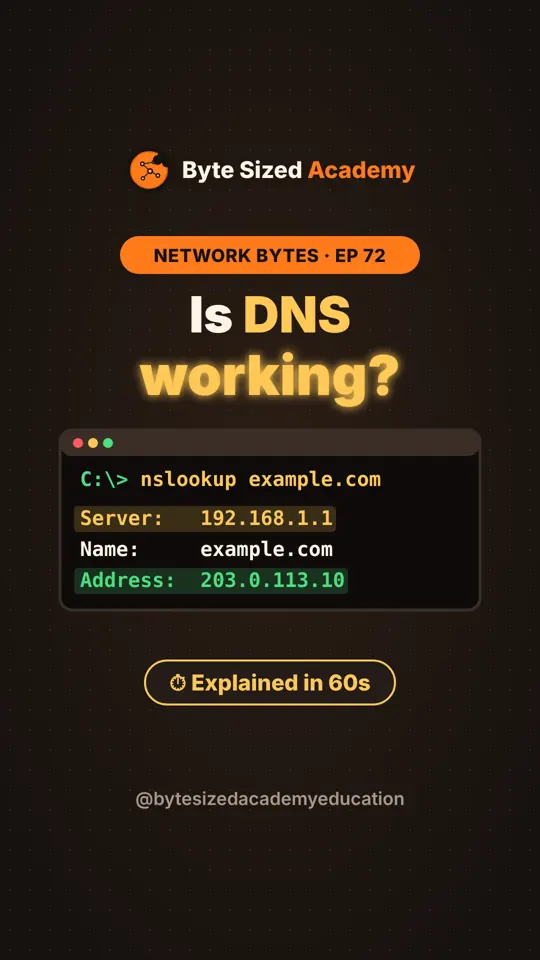 Network Bytes · EP72
"nslookup and DNS troubleshooting"
DNS turns names into addresses, and when it breaks, websites look dead even though your connection is fine. With nslookup you can ask a DNS server yourself, read which server answered and the address it found, and try a different server to see whether your usual one is the problem.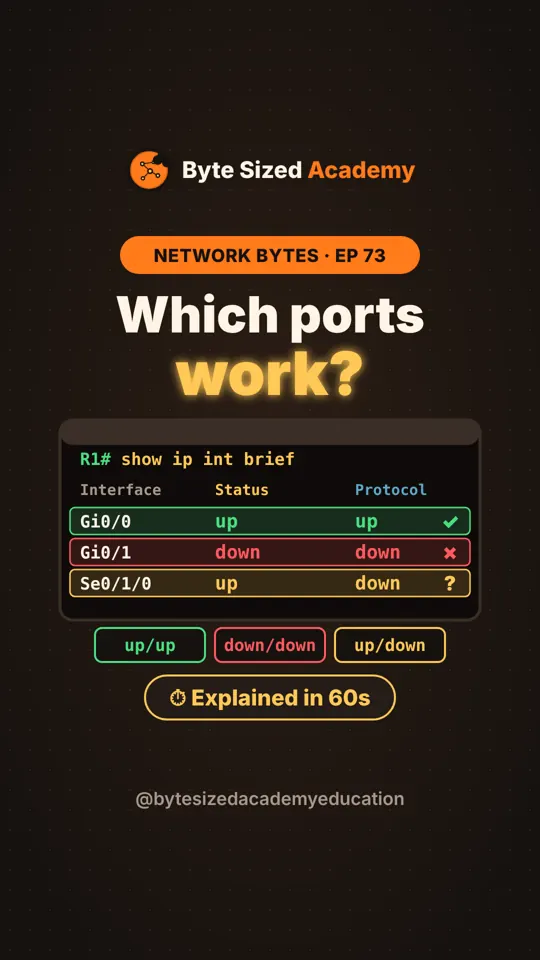 Network Bytes · EP73
"show ip interface brief: up/down states"
One Cisco command, show ip interface brief, lists every interface on one line each. Two columns matter, Status for the physical link (layer 1) and Protocol for whether the link is talking (layer 2), and together they tell you whether a port works, has no cable, has mismatched settings or was turned off on purpose.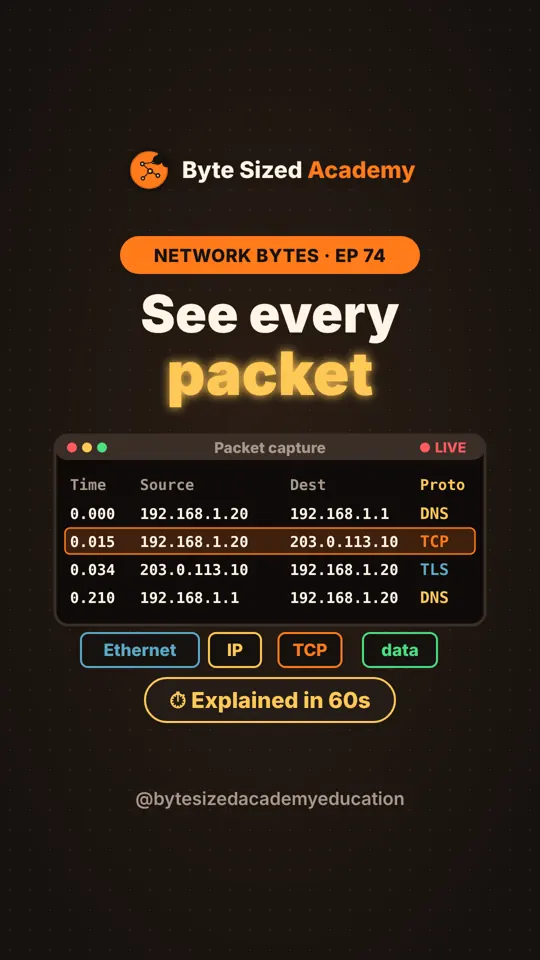 Network Bytes · EP74
"Packet capture basics (Wireshark)"
A packet capture records every packet that crosses your network interface, like a security camera for your network. With the free tool Wireshark you pick an interface, press start, read one row per packet, open any packet layer by layer and use a filter such as dns to keep only what you need, always on networks you own or have permission to test.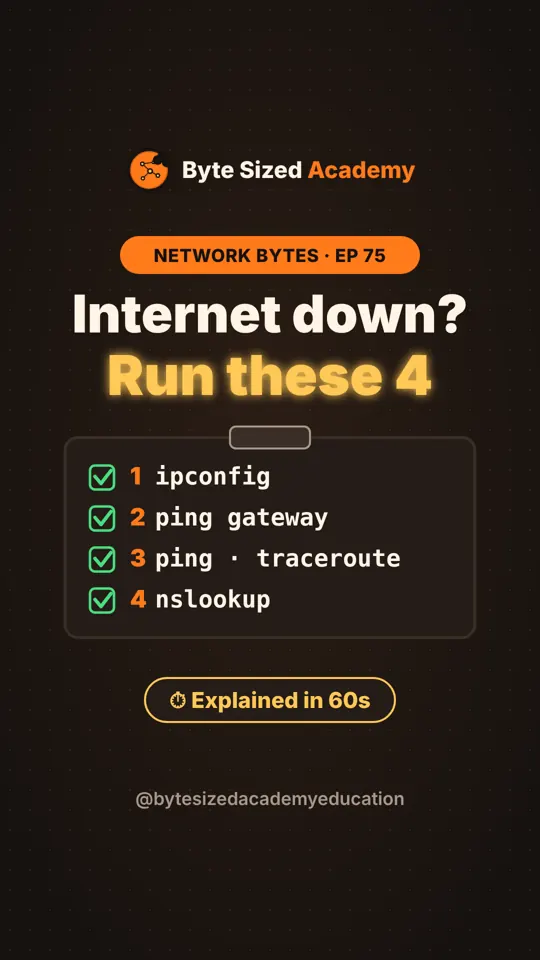 Network Bytes · EP75
"Network Bytes recap: what's next"
Season 10 built a troubleshooting toolkit. Use it like a doctor, checking your own device first and working outward: ipconfig, ping your gateway, ping an internet address and traceroute, then nslookup for DNS, with show ip interface brief and packet captures as extra tools. Next season covers CCNA pieces we skipped, such as firewalls, virtual machines and the cloud.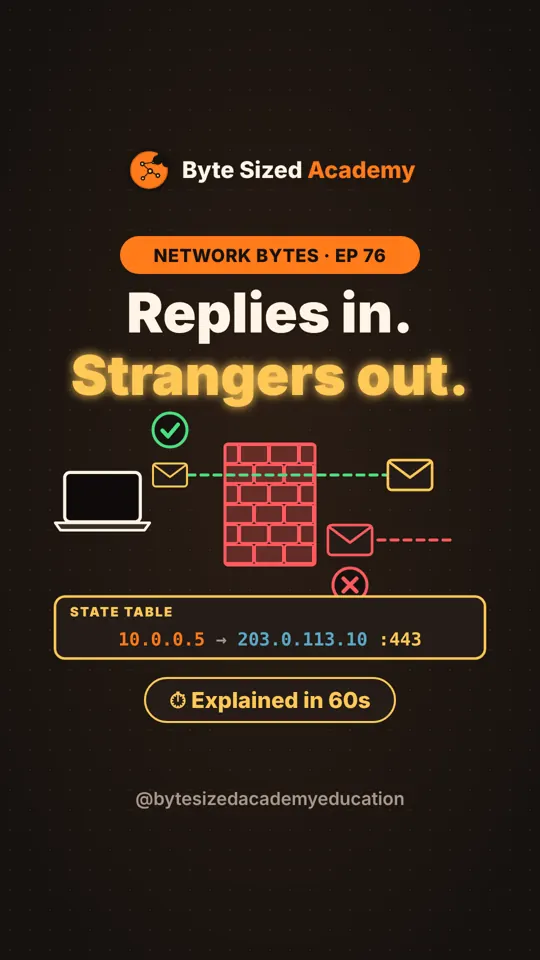 Network Bytes · EP76
"Stateful firewalls: who gets in"
A firewall sits between your network and the internet and checks every packet against its rules. A stateful firewall also writes each conversation you start into a state table, so replies that match walk right in, while unsolicited packets with no match are dropped unless a rule allows them.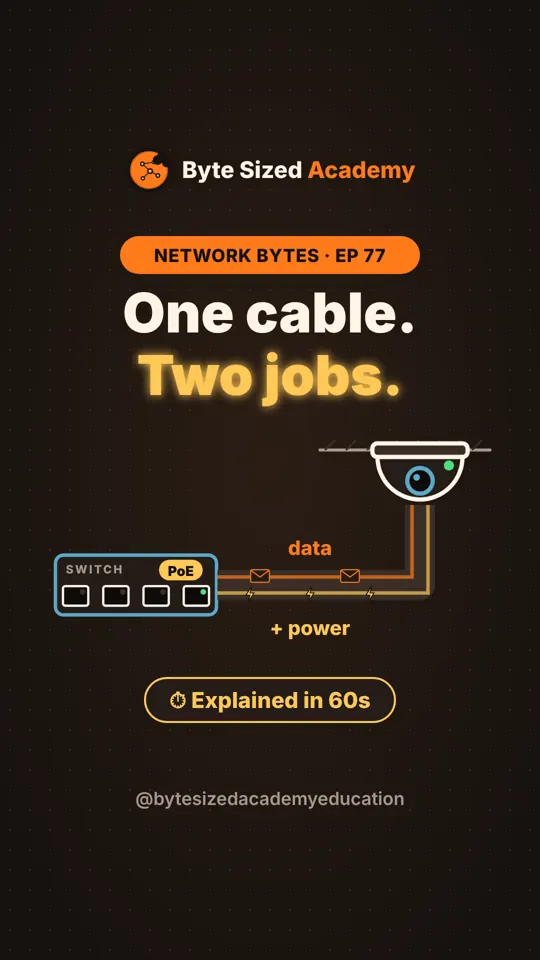 Network Bytes · EP77
"PoE: power over the cable"
Power over Ethernet (PoE) lets one network cable carry both data and electrical power, so the switch can run cameras, desk phones and Wi-Fi access points with no power outlet nearby. The switch first checks that a device wants power, so a normal laptop gets data only, and every PoE switch has a power budget, the total watts it can share out across its ports.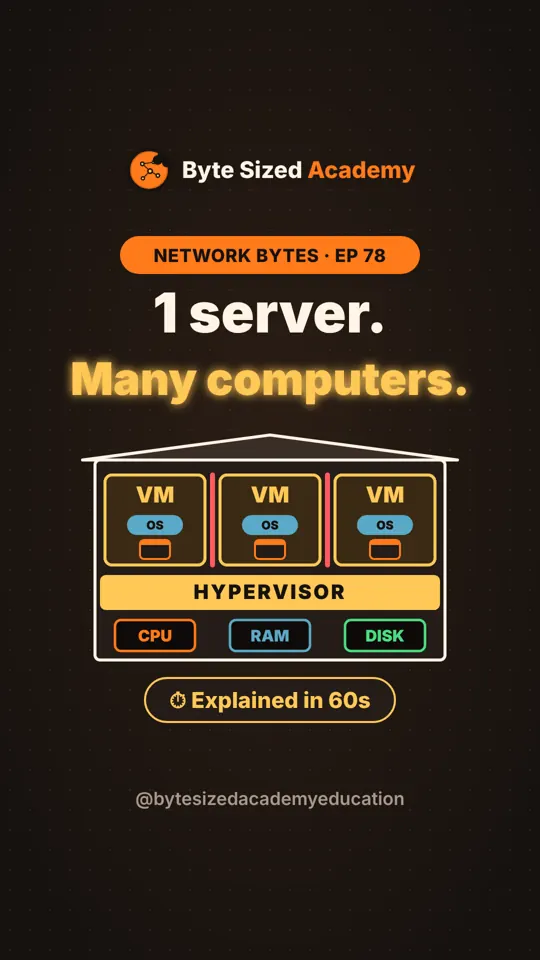 Network Bytes · EP78
"Virtual machines and hypervisors"
A virtual machine (VM) is a software computer with its own operating system, apps and IP address, running on a shared physical server. The hypervisor shares out the server's real processor, memory and storage between the VMs and keeps them isolated, and a virtual switch connects the VMs to each other and to the physical network.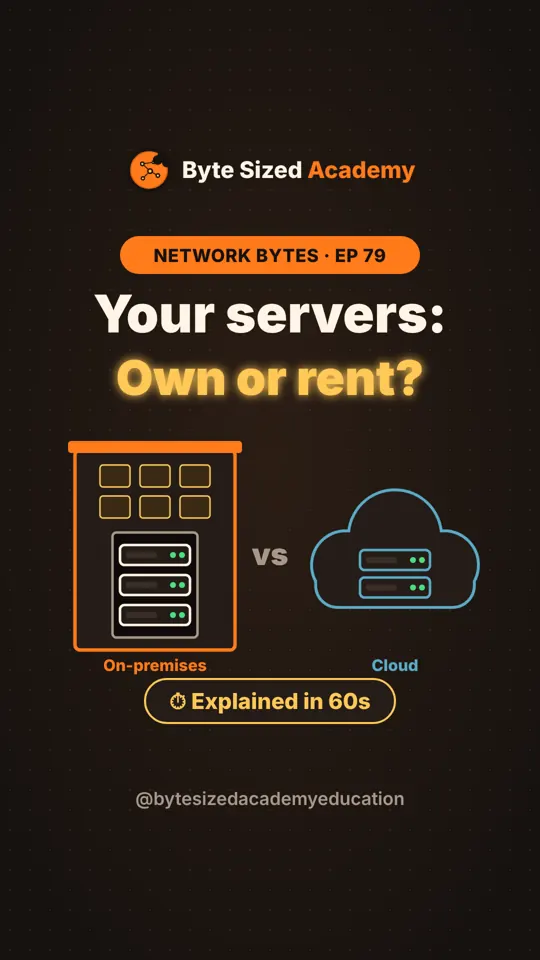 Network Bytes · EP79
"On-premises vs cloud"
On-premises means a company owns its servers, keeps them in its own building and buys, powers and fixes them itself. Cloud means renting servers in a provider's data center over the internet and paying for what you use. Cloud adds capacity in minutes; owning can cost less for steady work and keeps data on site, so many companies use both.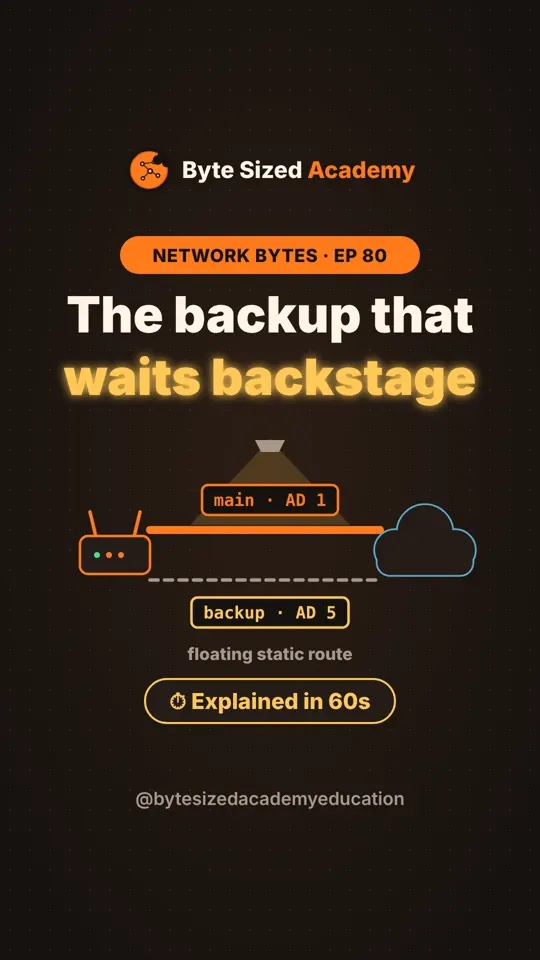 Network Bytes · EP80
"Floating static routes"
A floating static route is a backup static route with a higher administrative distance than the route it backs up. It stays out of the routing table until the main route disappears, then takes over, and steps back when the main route returns.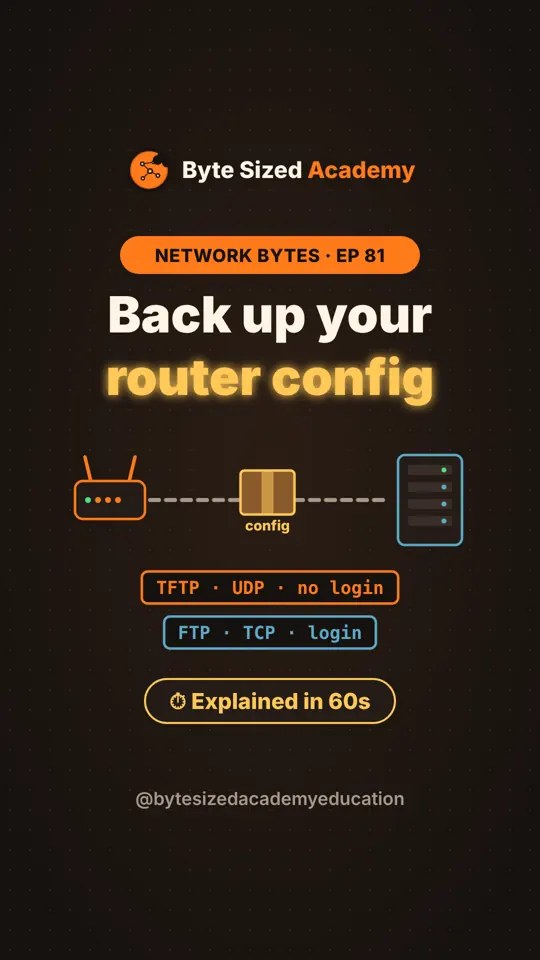 Network Bytes · EP81
"TFTP and FTP: backing up configs"
Before you change a router, copy its configuration file to a server. TFTP is the simple self-serve way (no login, UDP, small acknowledged chunks); FTP adds a login, runs over TCP and lets you manage files. Neither is encrypted, so SCP or SFTP is the safer choice on untrusted networks.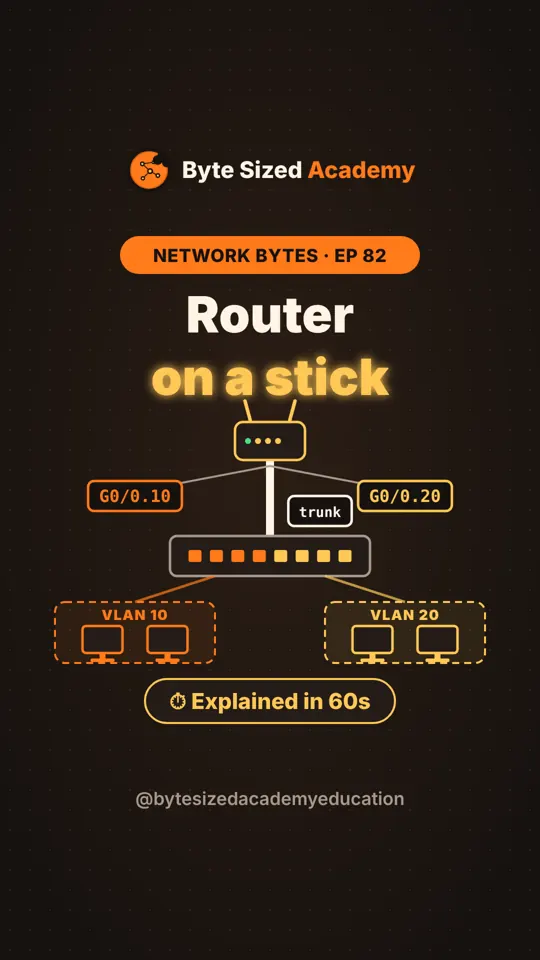 Network Bytes · EP82
"Inter-VLAN routing: router on a stick"
Each VLAN is its own network, so traffic between VLANs needs a router. Router on a stick connects one router port to a switch trunk and splits it into subinterfaces, one per VLAN, each tagged with its VLAN and holding the default gateway address for that VLAN.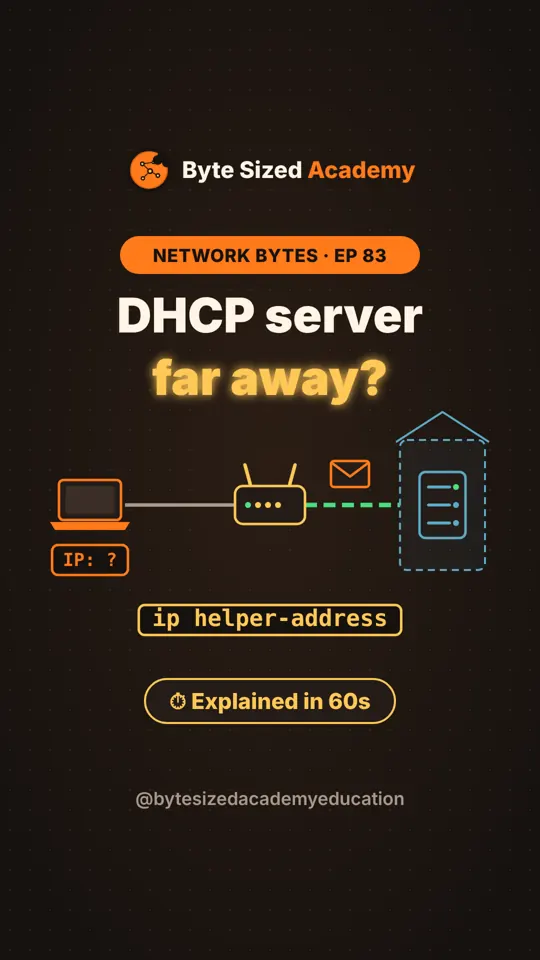 Network Bytes · EP83
"DHCP relay: ip helper-address"
A new client finds a DHCP server with a broadcast, and routers don't forward broadcasts. A DHCP relay on the router turns that broadcast into a unicast message to a server on another subnet, set on Cisco with ip helper-address on the interface facing the clients.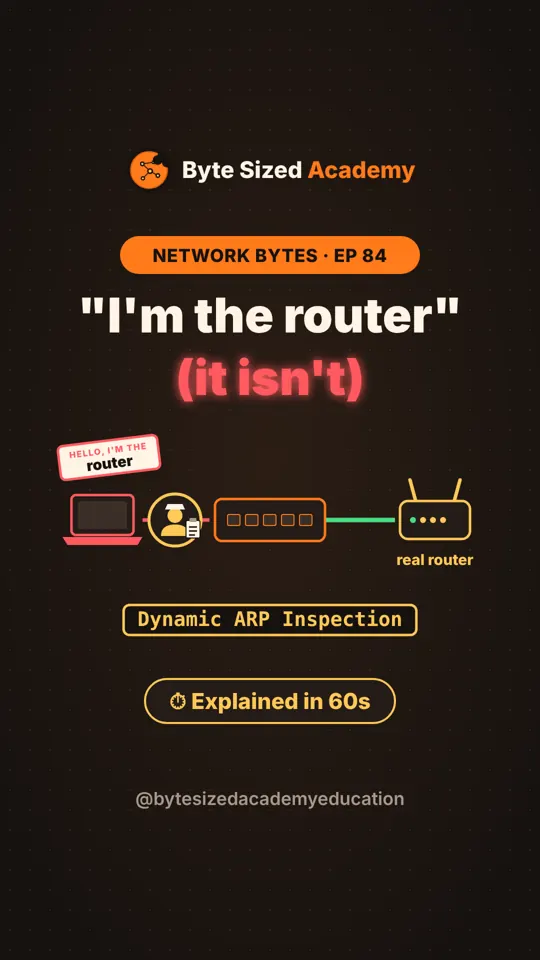 Network Bytes · EP84
"Dynamic ARP Inspection"
An attacker can send a fake ARP reply that says the gateway's IP address is at their MAC address and pull other people's traffic to their laptop. Dynamic ARP Inspection on the switch checks ARP messages on untrusted ports against the DHCP snooping table, and trusted uplinks skip the check.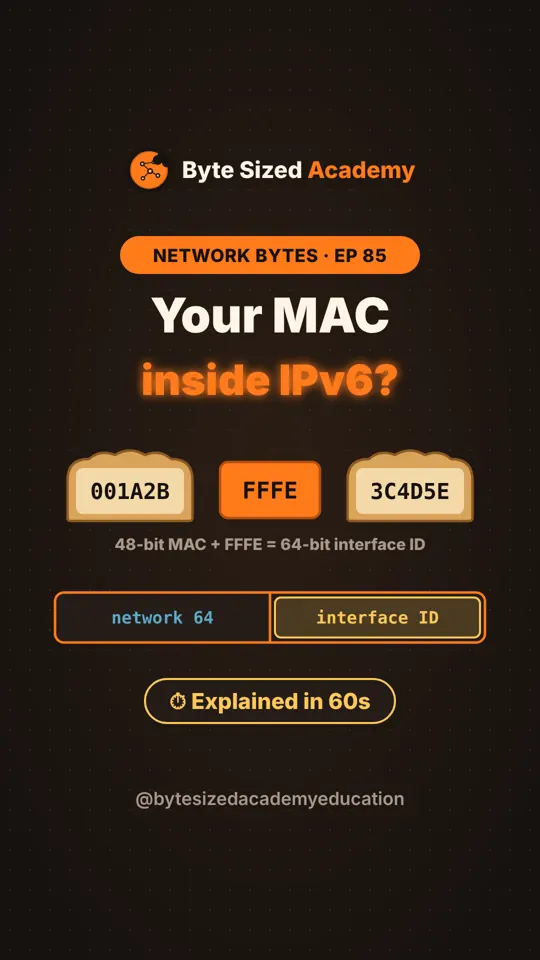 Network Bytes · EP85
"IPv6 EUI-64: an address from your MAC"
An IPv6 address is a 64-bit network half plus a 64-bit interface ID. Modified EUI-64 builds that interface ID from a 48-bit MAC address by putting FFFE in the middle and flipping the seventh bit of the first byte.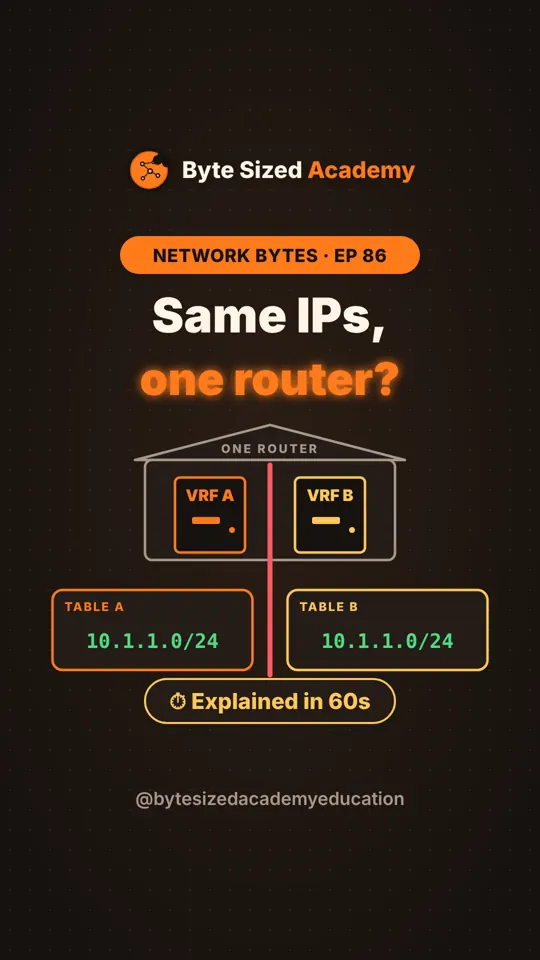 Network Bytes · EP86
"VRFs: one router, separate routing tables"
A router normally keeps one routing table, so two networks with the same addresses would clash. A VRF (virtual routing and forwarding) gives one router separate routing tables, and each interface is put into one of them, so overlapping addresses can live side by side.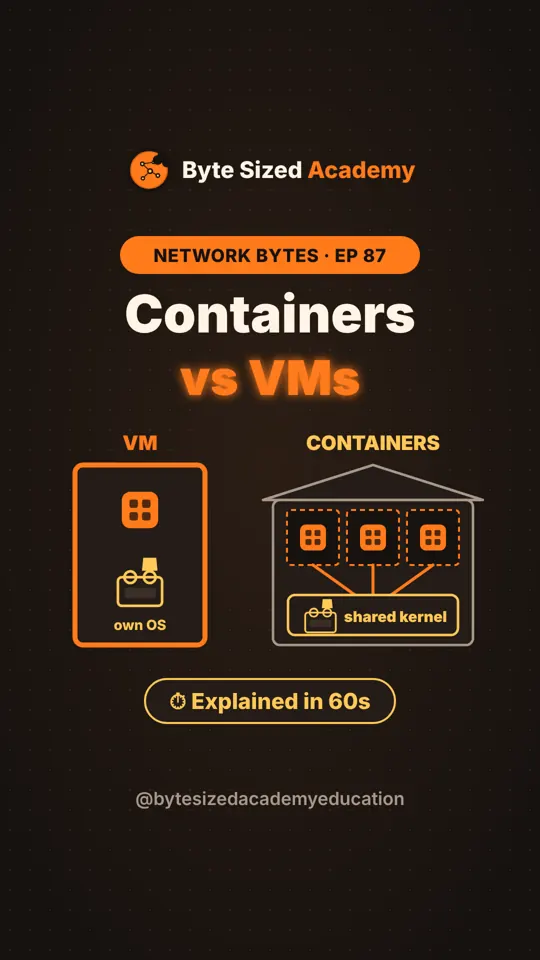 Network Bytes · EP87
"Containers vs virtual machines"
A virtual machine carries a complete operating system on top of a hypervisor. A container shares the host's operating system kernel and holds just its app and files, so it is smaller and starts faster, but it is less isolated.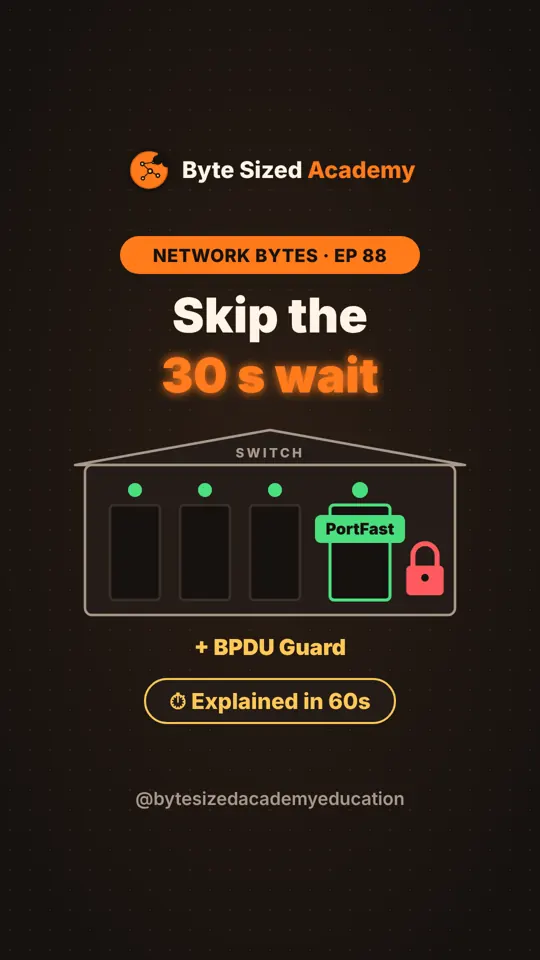 Network Bytes · EP88
"PortFast and BPDU Guard"
Spanning Tree makes a new switch port wait about 30 seconds before it forwards, in case the link creates a loop. PortFast skips that wait on ports to end devices, and BPDU Guard shuts a PortFast port down if a switch is plugged into it.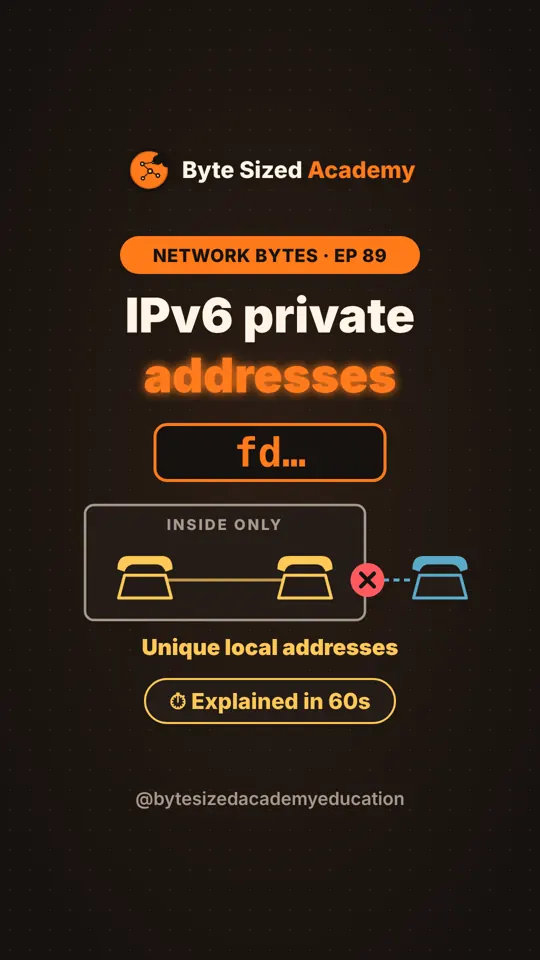 Network Bytes · EP89
"IPv6 unique local addresses"
IPv6 has its own private addresses, called unique local addresses, and in practice they all start with fd. They work inside a site but are not carried on the internet, and a random 40-bit number after fd keeps two sites from clashing.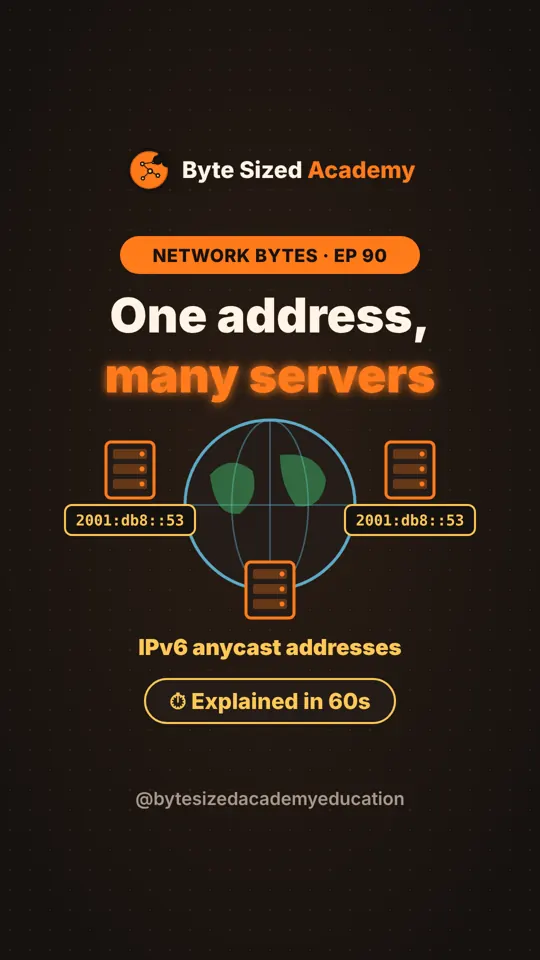 Network Bytes · EP90
"IPv6 anycast addresses"
An IPv6 anycast address is one address shared by several servers in different places. Each packet sent to it goes to only one of them, the nearest by the routers' own measure of distance, which is how big DNS services stay close and keep working when a site goes down.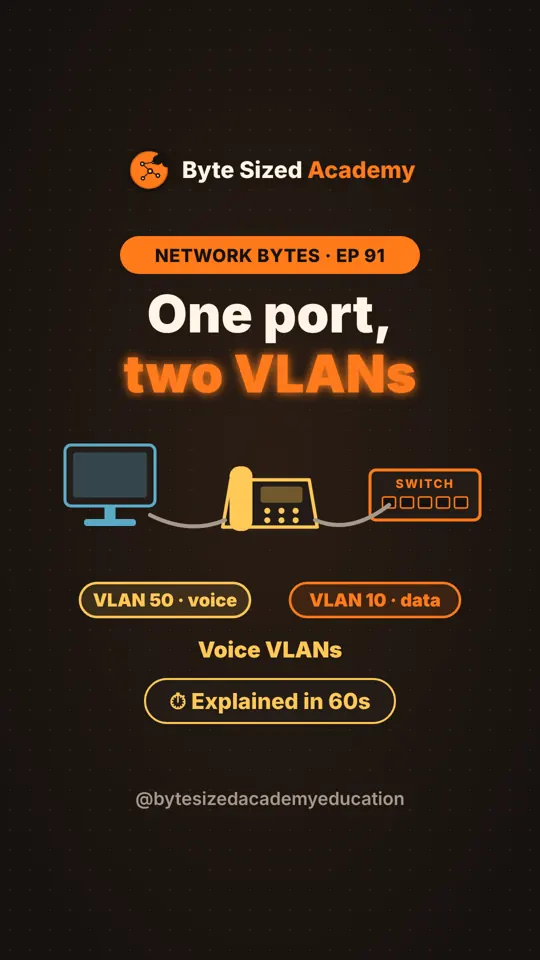 Network Bytes · EP91
"Voice VLANs: a phone and a PC on one port"
A voice VLAN lets an IP phone and the PC plugged into it share one switch port while staying in separate VLANs. The phone tags its voice frames for the voice VLAN, the PC's frames stay untagged in the data VLAN, and the switch tells the phone its voice VLAN with CDP or LLDP.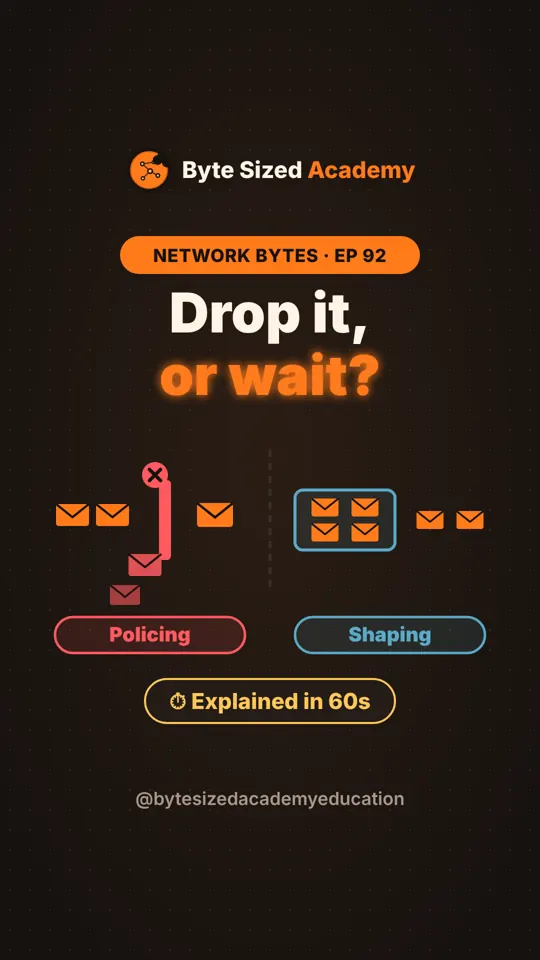 Network Bytes · EP92
"QoS policing vs shaping"
Policing and shaping both hold traffic to a configured rate. Policing drops or remarks the extra packets right away, while shaping holds them in a buffer and sends them later at a steady rate, so nothing is lost but traffic is delayed.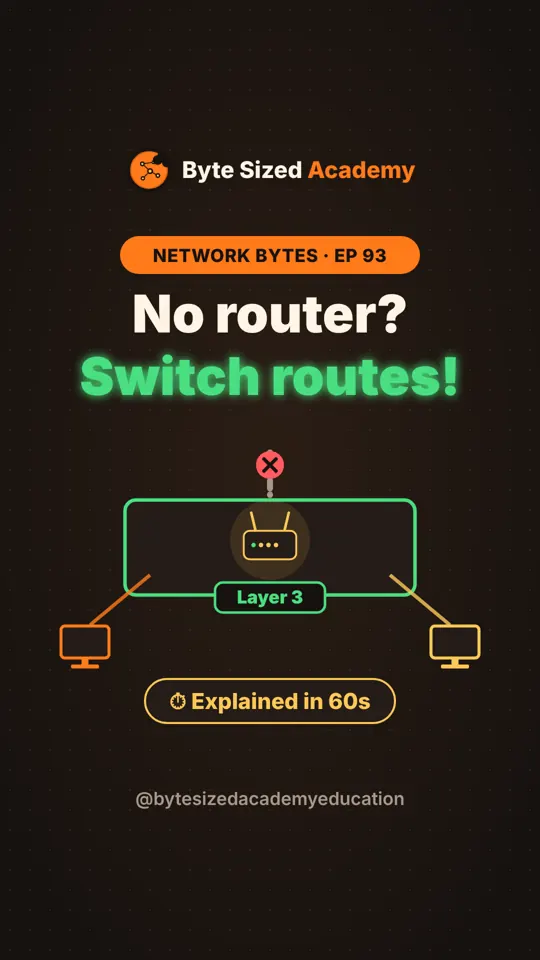 Network Bytes · EP93
"Layer 3 switches and SVIs"
A Layer 3 switch routes between VLANs itself, with no separate router. Each routed VLAN gets a switched virtual interface (SVI) whose IP address is that VLAN's default gateway, and with ip routing turned on the switch forwards between VLANs in hardware.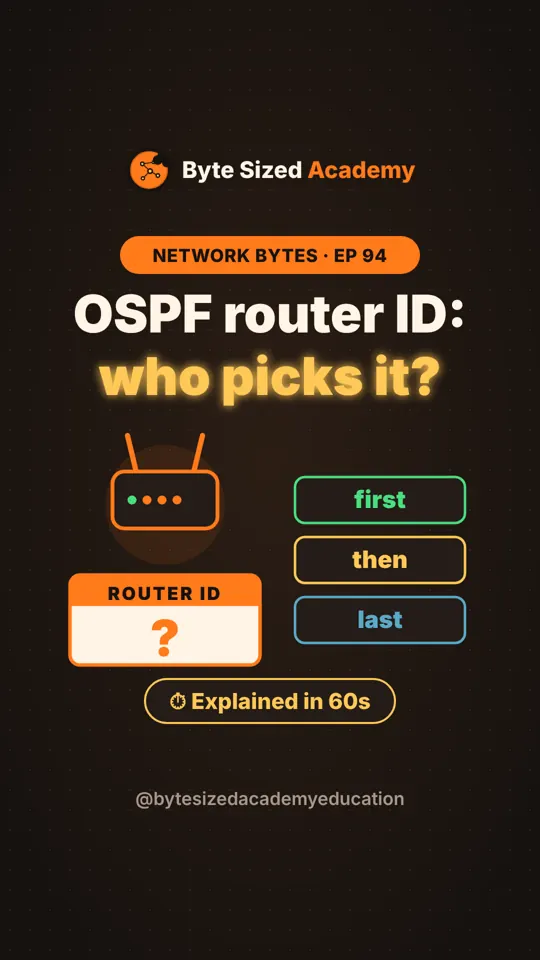 Network Bytes · EP94
"OSPF router ID: how it's chosen"
Every OSPF router needs a unique router ID written like an IPv4 address. Cisco IOS takes it from the router-id command first, then the highest loopback address, then the highest active physical interface address.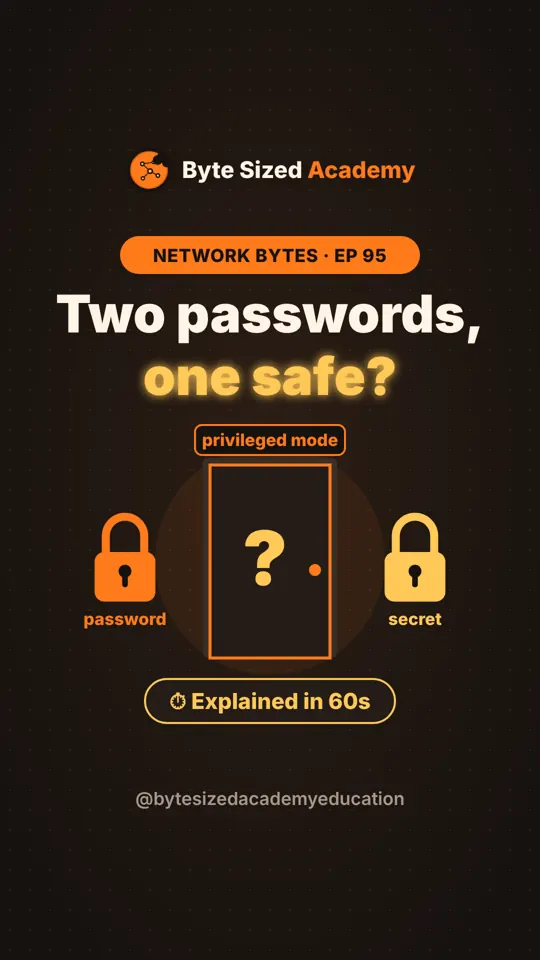 Network Bytes · EP95
"enable secret vs enable password"
Both enable password and enable secret guard a Cisco router's privileged mode. Enable password sits in the config in plain text; enable secret is stored as a one-way hash, and when both are set, only the secret is used. Network Bytes · EP96
"Wildcard masks"
Cisco ACLs and OSPF network commands use wildcard masks. A 0 bit means the address bit must match and a 1 bit means anything goes, so a wildcard looks like a subnet mask flipped upside down. Network Bytes · EP97
"The native VLAN"
On an 802.1Q trunk, frames in the native VLAN cross without a tag, and untagged frames that arrive are placed in it. It is VLAN 1 by default, both ends must match, and best practice is an unused VLAN. Network Bytes · EP98
"OSPF cost"
OSPF adds up link costs along each path and picks the lowest total. Each link's cost is the reference bandwidth divided by the interface bandwidth, with a 100 Mbps default reference, so fast links need a higher reference set with auto-cost reference-bandwidth. Network Bytes · EP99
"STP port roles: root, designated, blocked"
After spanning tree elects a root bridge, every other switch picks one root port, every link gets one designated port, and any leftover port is blocked so no loop can form.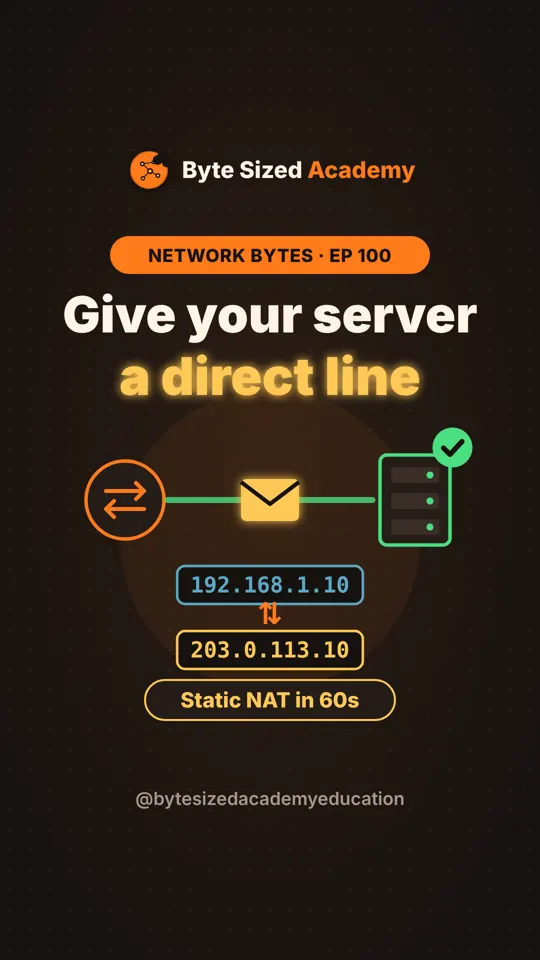 Network Bytes · EP100
"Static NAT"
Normal NAT, or PAT, lets many devices share one public address but blocks connections that start outside. Static NAT permanently maps one private address to one public address, both ways, so the internet can reach a server, configured on Cisco with ip nat inside source static.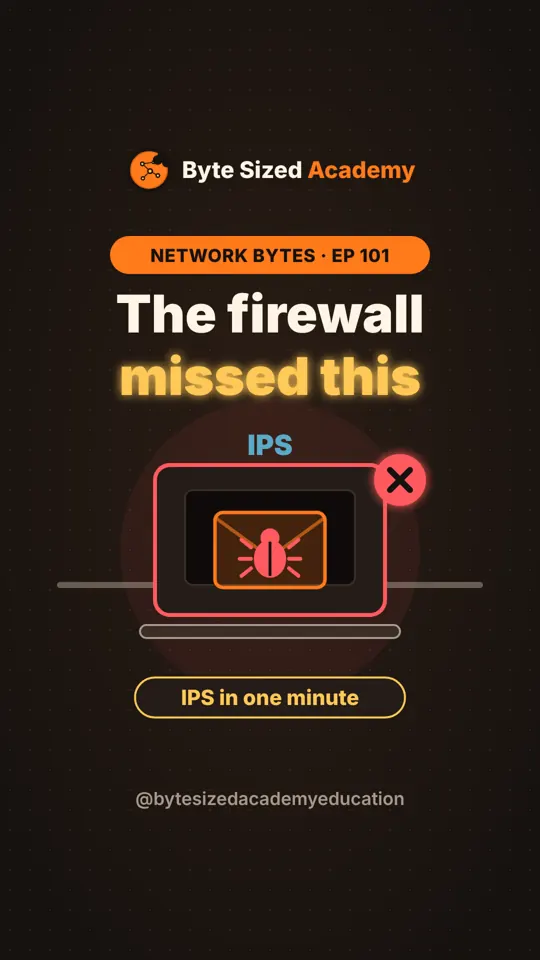 Network Bytes · EP101
"IPS: intrusion prevention"
A firewall mostly checks addresses and ports, so attacks can hide inside allowed traffic. An intrusion prevention system sits inline, matches traffic against signatures of known attacks and strange behavior, drops what matches and logs an alert, while an IDS only watches a copy and alerts.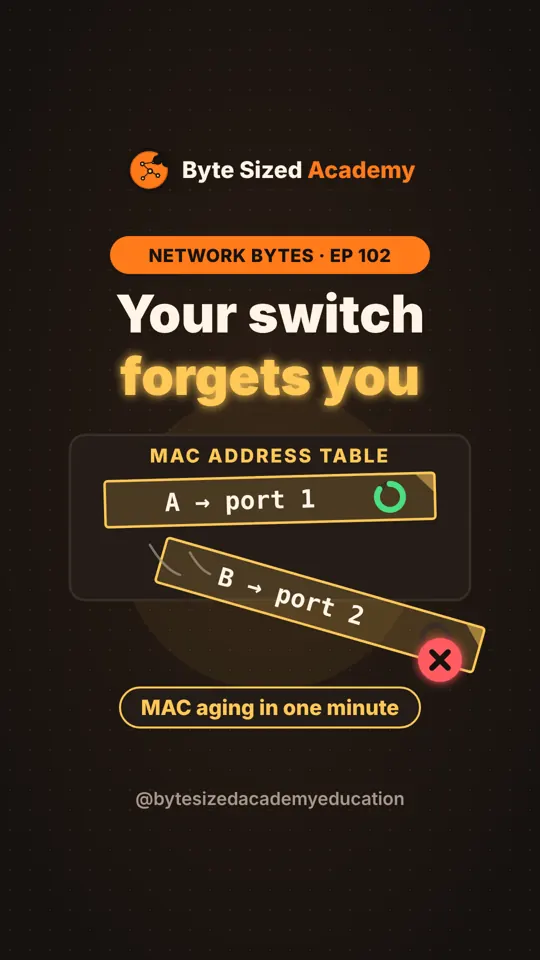 Network Bytes · EP102
"MAC address aging"
A switch writes each MAC address it learns into its MAC address table with the port it came in on. Every dynamic entry has an aging timer that resets with each frame from that device; if the device stays quiet longer than the aging time (300 seconds by default on Cisco switches), the entry is deleted and frames to it are flooded until it talks again.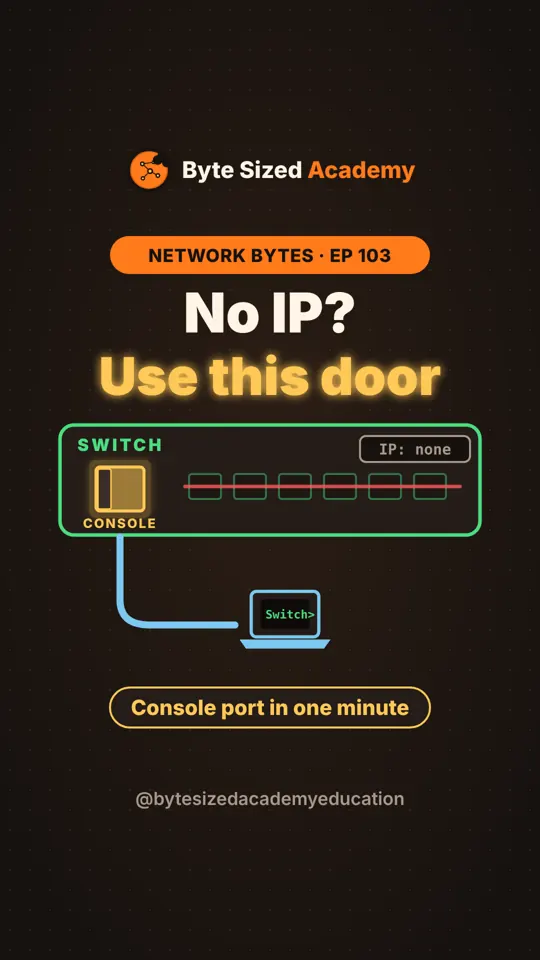 Network Bytes · EP103
"The console port: managing a switch with no IP"
A brand-new switch has no IP address, so you can't reach it over the network. The console port is a private, out-of-band management port: connect a rollover or USB console cable, open a terminal program at 9600 bits per second (the Cisco default), press Enter and the command line appears. It is also the way in when the network is broken, so protect it with a password under line console 0.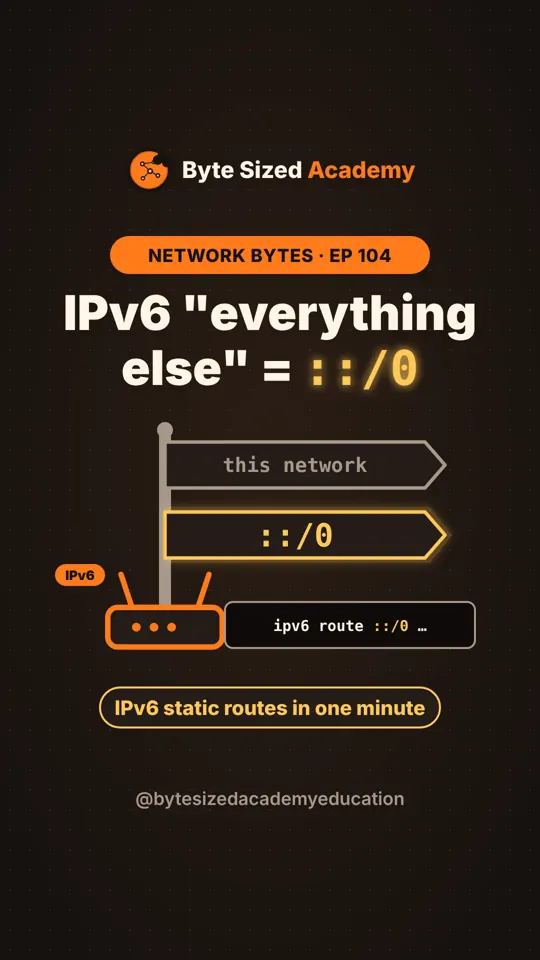 Network Bytes · EP104
"IPv6 static and default routes"
An IPv6 static route works just like an IPv4 one, a sign you put up on a router that says "to reach this network, send packets to that next router." On a Cisco router you first turn on IPv6 routing with ipv6 unicast-routing, then add routes with ipv6 route, the prefix and its length, then the next hop. The default route is ::/0, which has zero network bits and so matches every IPv6 address.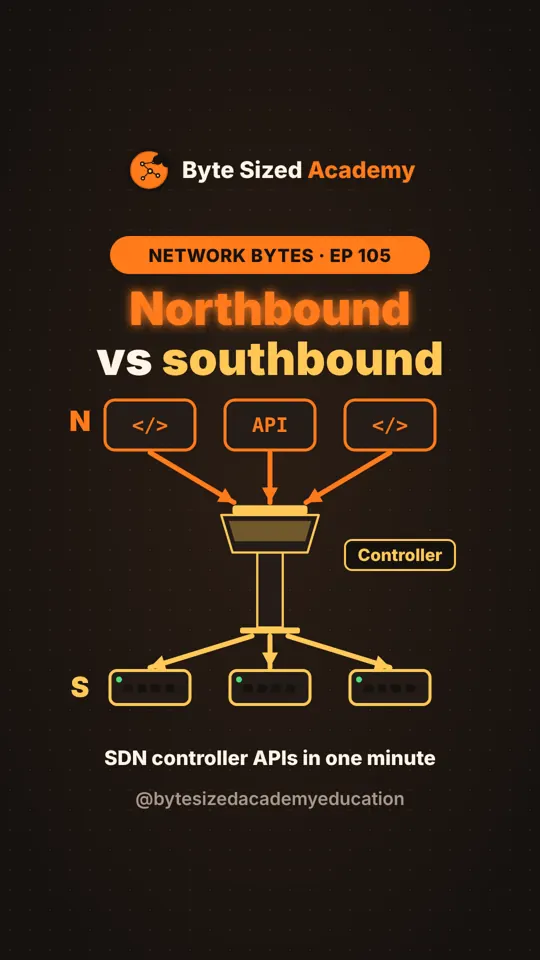 Network Bytes · EP105
"Northbound vs southbound APIs"
In controller-based networking, the controller sits in the middle. Apps above it, like dashboards and automation scripts, talk to it through a northbound API, usually REST. The controller talks to the switches and routers below it through southbound APIs such as NETCONF or OpenFlow, so one request can configure every device.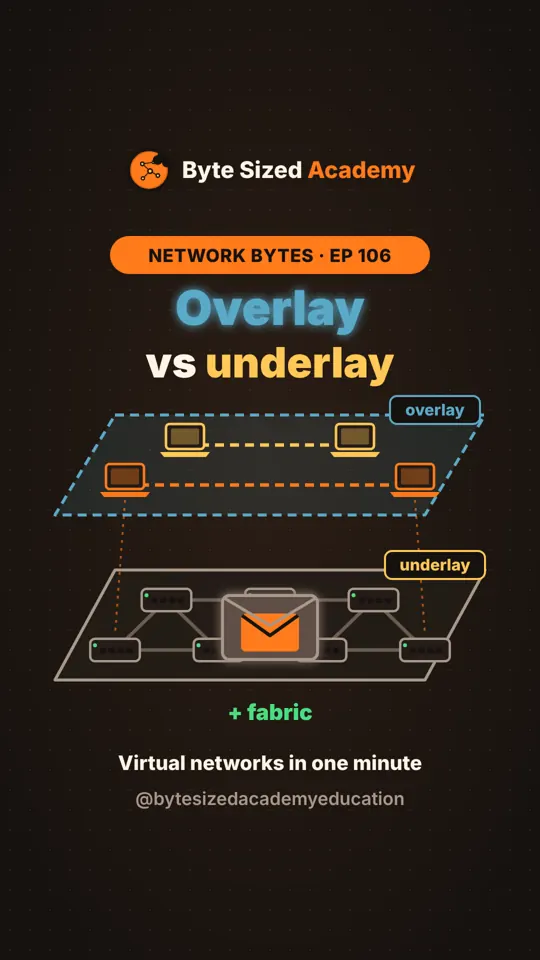 Network Bytes · EP106
"Overlay, underlay and fabric"
The underlay is the physical network of switches, cables and routing. The overlay is a set of virtual networks, like staff and guests, that ride on top of it through tunnels. Underlay plus overlay, managed together, is a fabric, such as Cisco SD-Access.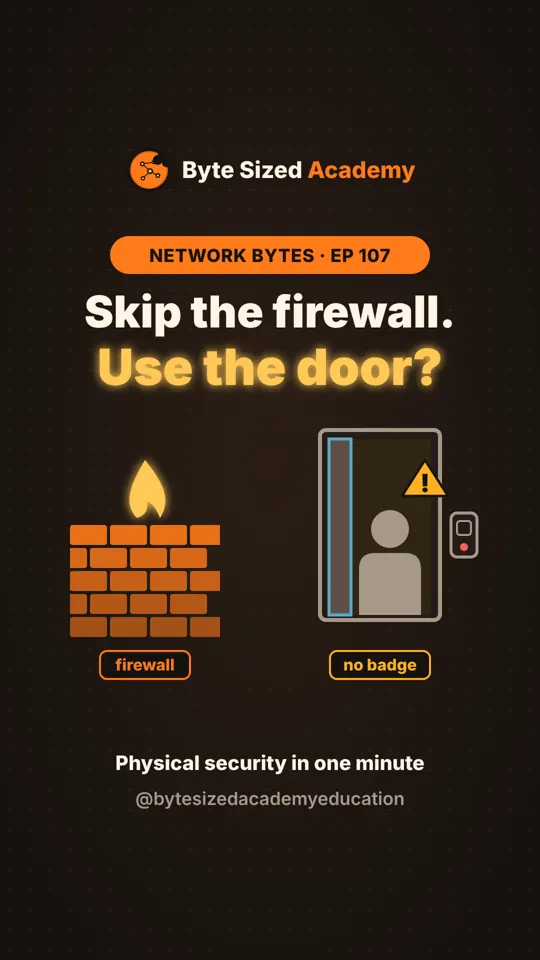 Network Bytes · EP107
"Security awareness and physical access control"
Firewalls and passwords protect the network, but buildings and people are part of security too. Physical access control (badge readers, locked server rooms, cameras) keeps strangers away from the equipment, and security awareness training teaches staff to spot phishing, lock their screens and ask strangers to show a badge, often with fake phishing emails as practice. Network Bytes · EP108
"Root Guard"
In spanning tree, the switch with the lowest bridge ID becomes the root. Root Guard goes on ports where the root should never appear; if a better root claim arrives there, the switch blocks the port instead of following it, and the port recovers by itself once the claims stop.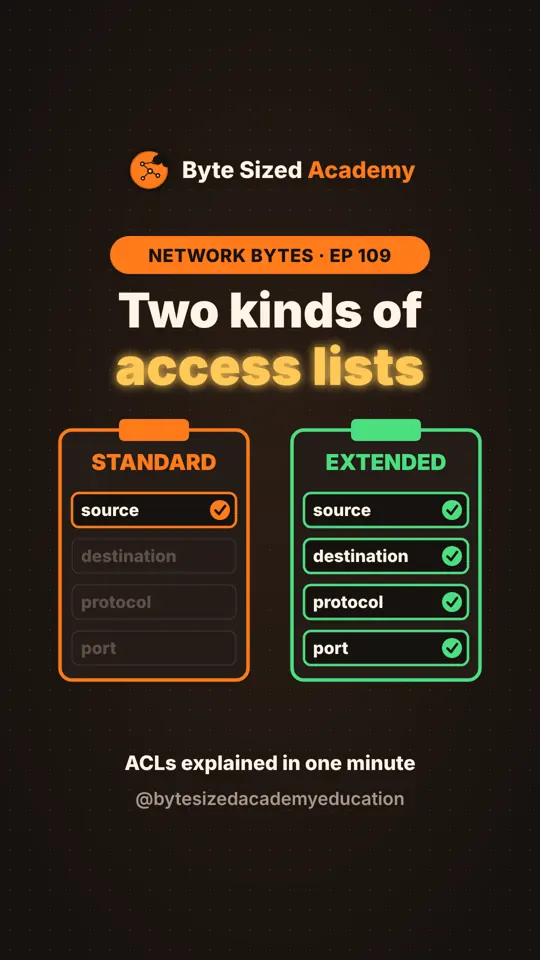 Network Bytes · EP109
"Standard vs extended ACLs"
A standard access list checks only the source IP address of each packet. An extended access list can also check the destination, the protocol and the port, so it can block one path instead of a whole PC. Put extended lists near the source and standard lists near the destination.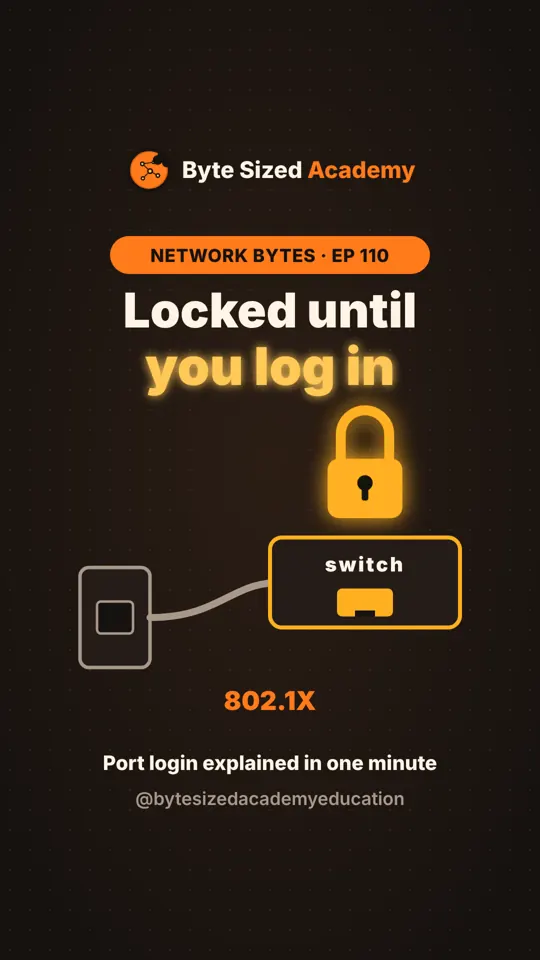 Network Bytes · EP110
"802.1X: logging in at the switch port"
With 802.1X, a switch port stays locked and passes only login messages until you log in. Your device asks to join, the switch acts as the guard, and a login server checks your password or certificate. If the server says yes, the port unlocks; if not, it stays shut.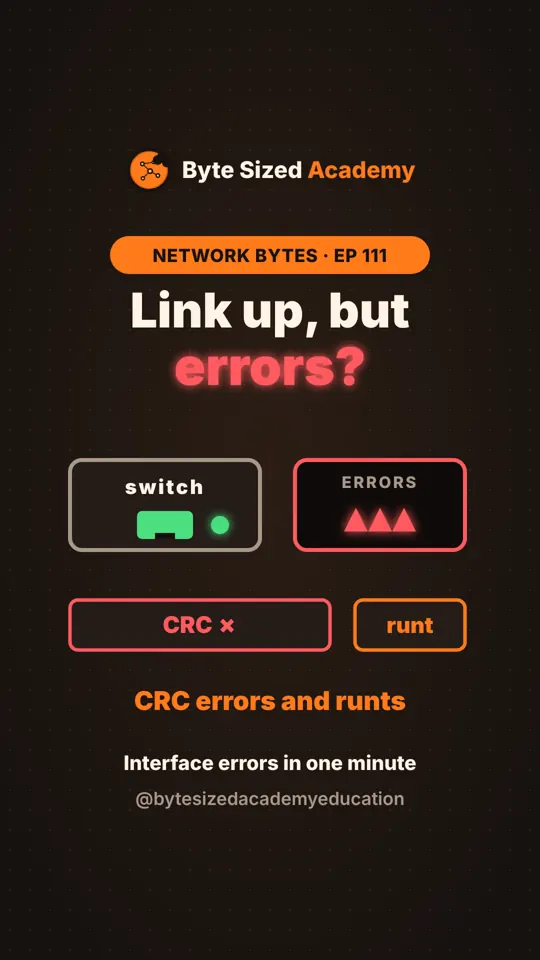 Network Bytes · EP111
"Interface errors: CRC and runts"
Every Ethernet frame ends with a check number. If the receiving port's math doesn't match, the frame was damaged and is dropped as a CRC error. A runt is a frame that's too short. Together they often point to a duplex mismatch, and show interfaces is where you read the counters.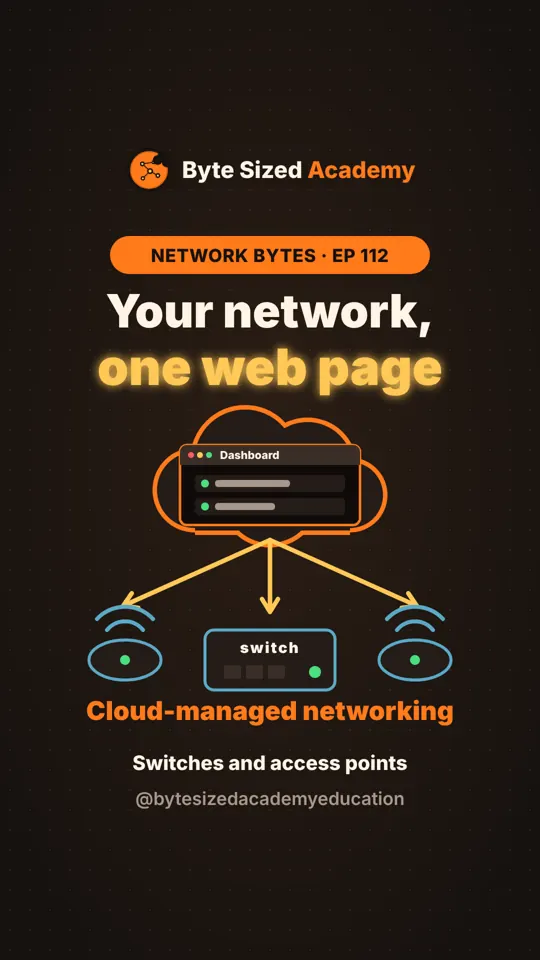 Network Bytes · EP112
"Cloud-managed switches and access points"
Cloud-managed switches and access points connect to a web dashboard as soon as they are plugged in, so one change reaches every device at every site. Only management traffic goes to the cloud; user data stays on your own network. The trade-offs are a license and needing internet to make changes.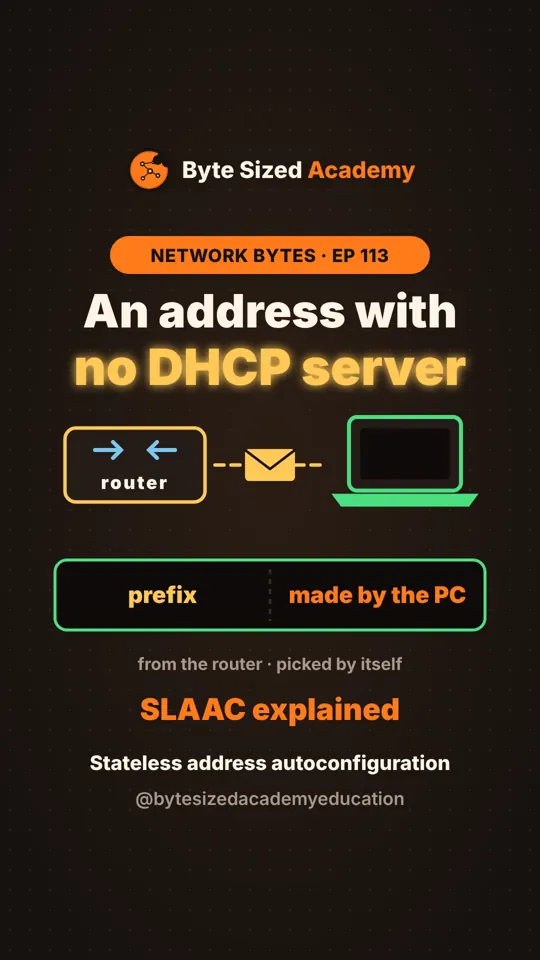 Network Bytes · EP113
"IPv6 SLAAC: an address with no DHCP server"
With SLAAC, an IPv6 host builds its own address. The router announces the network's prefix, the host makes up the second half itself, checks that nobody else is using the address, and uses the router as its default gateway. No server keeps a list of who has which address.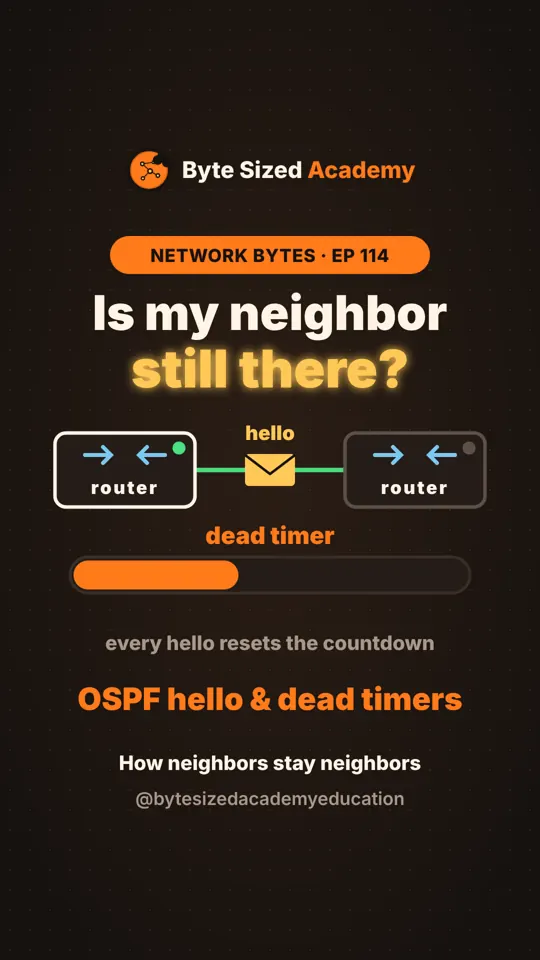 Network Bytes · EP114
"OSPF hello and dead timers"
OSPF neighbors send each other hello messages on a timer, every 10 seconds on Ethernet by default. If no hello arrives before the dead timer (40 seconds by default) runs out, the neighbor is declared down and routes are recalculated. Both timers must match, or the routers never become neighbors.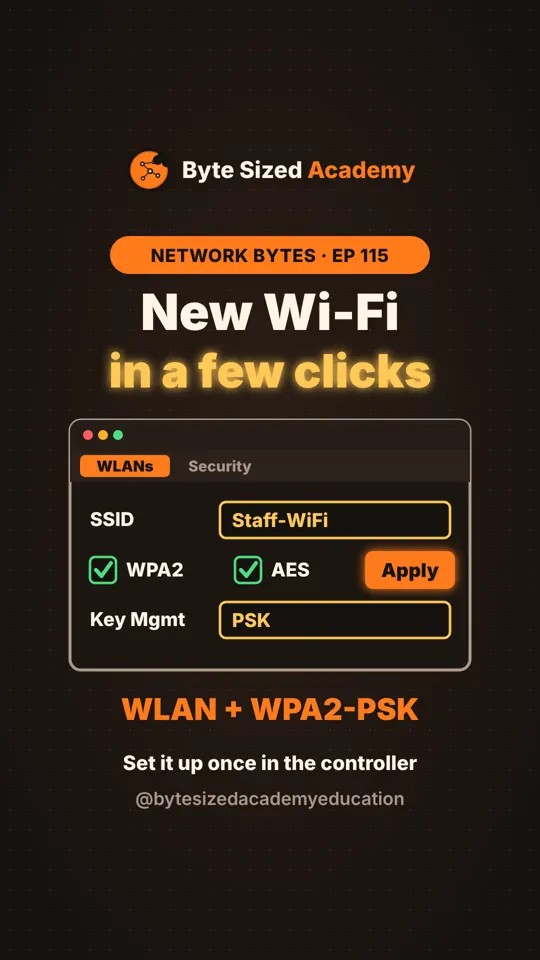 Network Bytes · EP115
"Creating a WLAN in the controller GUI with WPA2-PSK"
In an office, a wireless LAN controller runs the access points, so you create a Wi-Fi network once in its web page. Give the WLAN a profile name and SSID, map it to an interface (a VLAN), choose WPA2 with AES and PSK key management, type the passphrase, enable it and click Apply. The controller pushes it to its access points.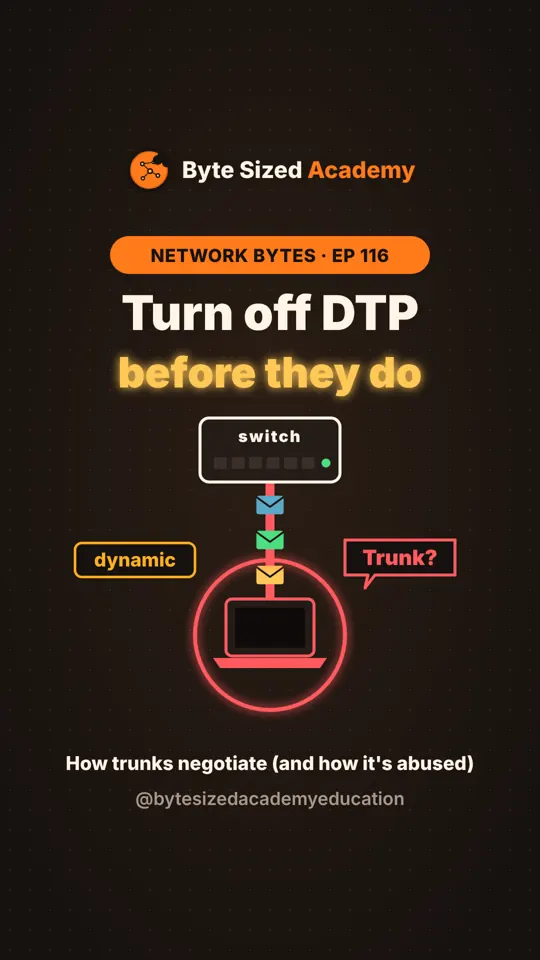 Network Bytes · EP116
"DTP: how trunks negotiate, and why to turn it off"
Cisco switches can negotiate a trunk on their own with DTP, the Dynamic Trunking Protocol. A dynamic desirable port asks, a dynamic auto port waits to be asked. Because an attacker's laptop can speak DTP too, set ports by hand and add switchport nonegotiate.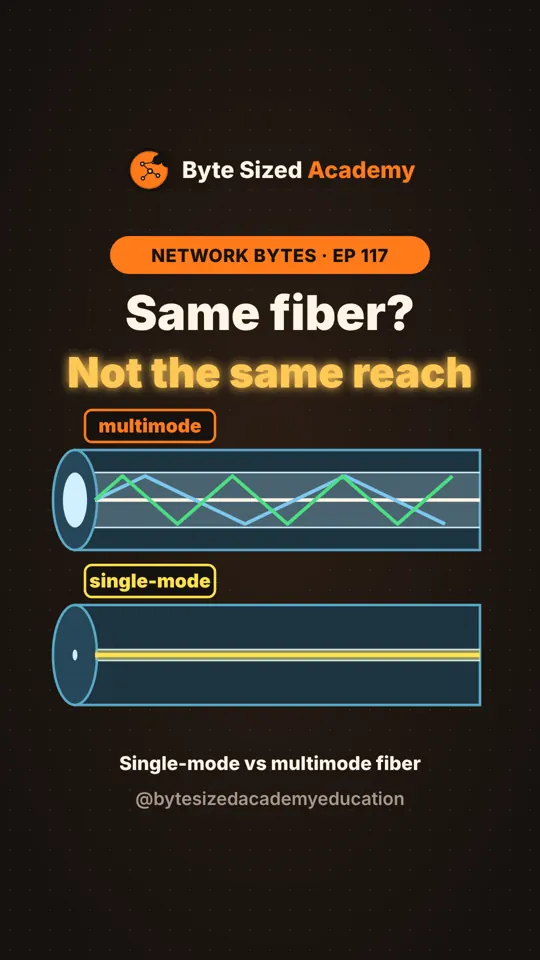 Network Bytes · EP117
"Single-mode vs multimode fiber"
Both kinds of fiber send light down a glass core. Multimode has a wide core where light takes many paths and pulses smear, so it reaches a few hundred meters; single-mode has a tiny core with one path, so it reaches 10 km and more.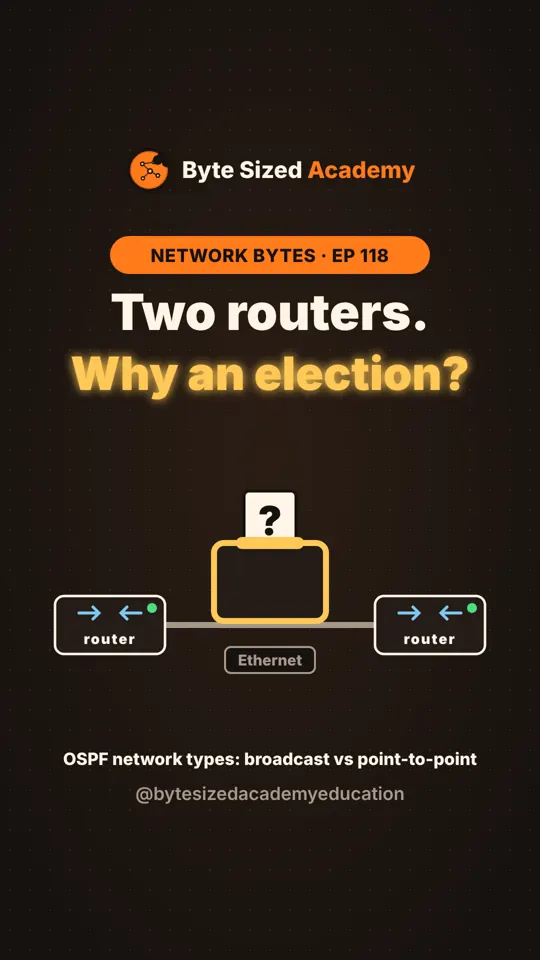 Network Bytes · EP118
"OSPF network types: broadcast vs point-to-point"
OSPF treats Ethernet as a broadcast network, so routers wait and then elect a designated router and a backup. On a link with only two routers that election just adds delay, so set the network type to point-to-point on both ends. Serial links are point-to-point by default.Circuit Bytes
77 lessons · swipe for moreCircuits and electronics from zero, one 60-second idea at a time, from what electricity is to how real circuits work.
 Circuit Bytes · EP01c
What is electricity?
Electricity isn't stuff pouring out of the wall. It's the push on electrons that are already in the wire, and the energy that push carries.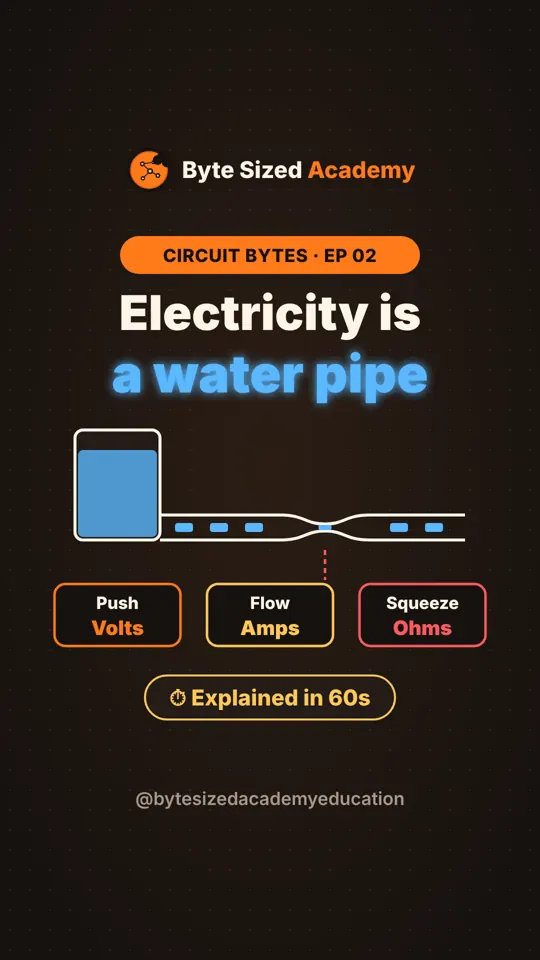 Circuit Bytes · EP02c
Voltage, current and resistance
Every circuit has a push, a flow and a squeeze. The water-pipe picture makes voltage, current and resistance easy to remember.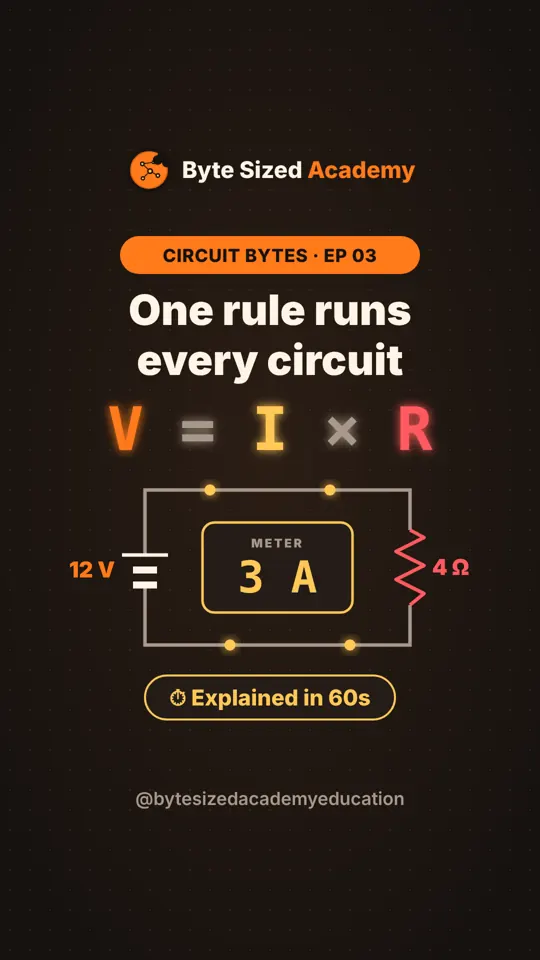 Circuit Bytes · EP03c
Ohm's law
V = I × R ties voltage, current and resistance together. Know any two and you can work out the third.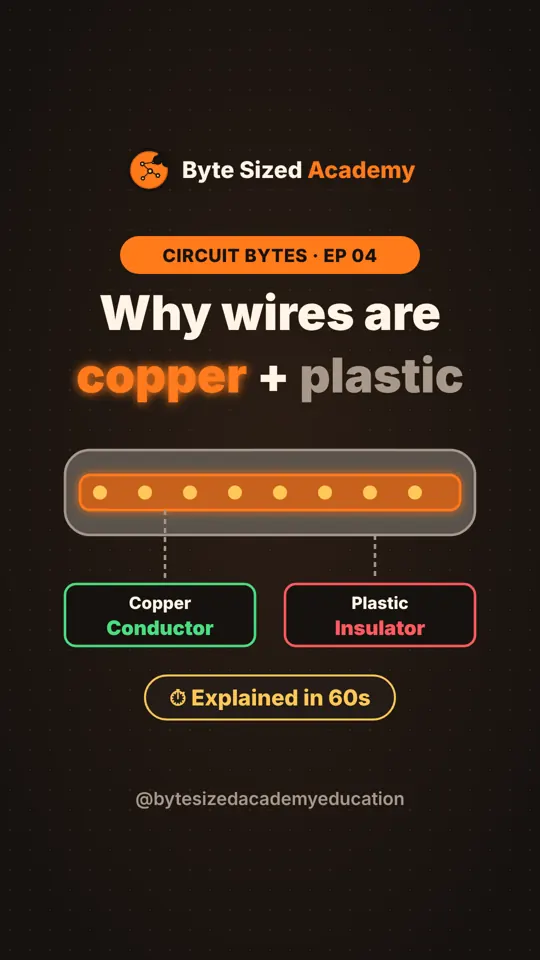 Circuit Bytes · EP04c
Conductors vs insulators
Wires are copper on the inside and plastic on the outside because copper lets electrons flow easily and plastic holds them tight. One conducts, one insulates.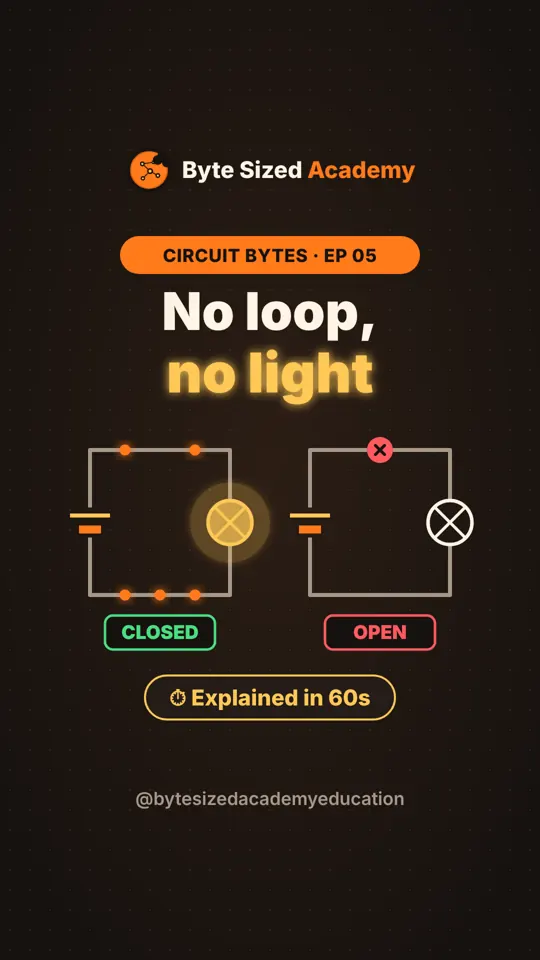 Circuit Bytes · EP05c
What makes a circuit
Current only flows when there's a complete loop from one end of the battery back to the other. Any gap opens the circuit, and a light switch is just a gap you control.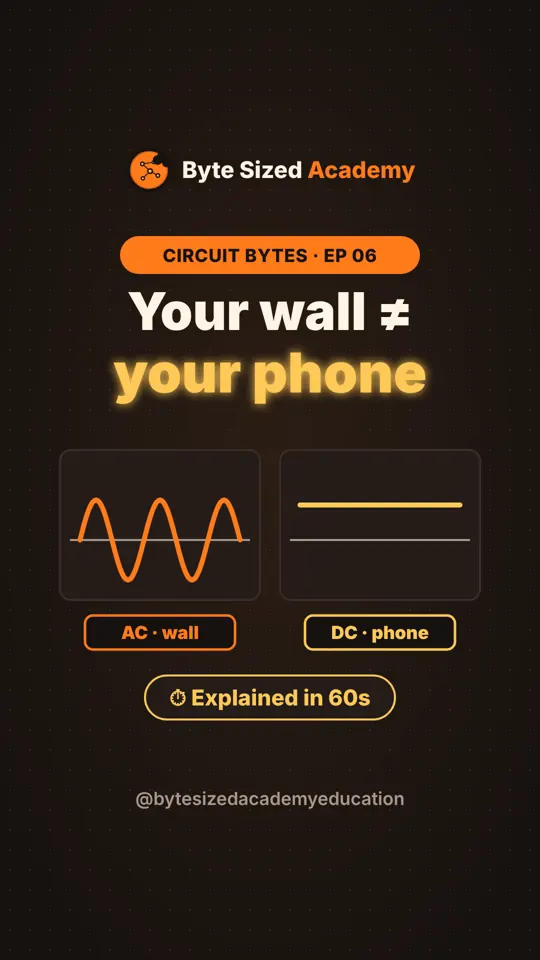 Circuit Bytes · EP06c
AC vs DC
A battery gives direct current that pushes one way; your wall gives alternating current that swings back and forth. The grid uses AC because transformers can step its voltage up and down, and your charger turns it back into DC.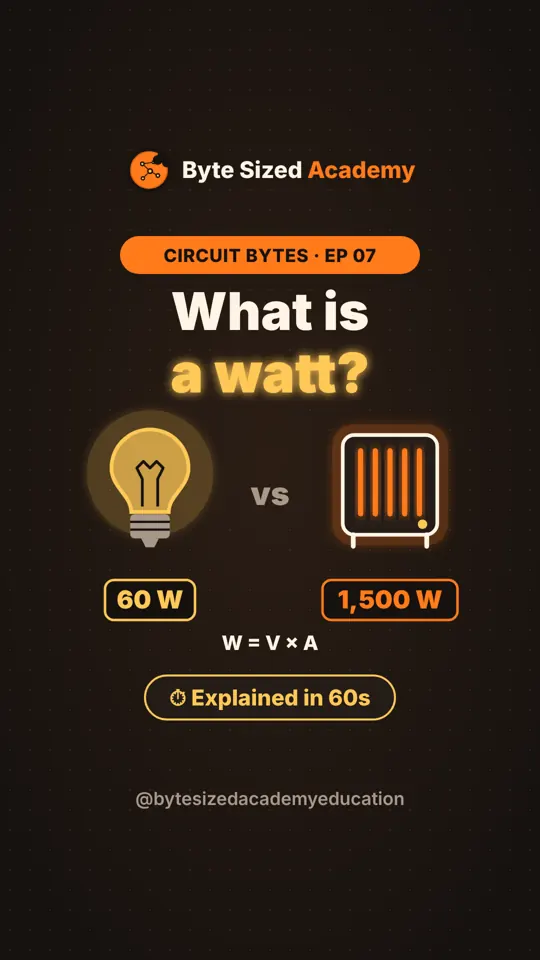 Circuit Bytes · EP07c
Power: watts
A watt measures power, how fast something uses energy. For electricity, watts equal volts times amps, which is why a 1,500 W heater uses 25 times the energy of a 60 W bulb every second.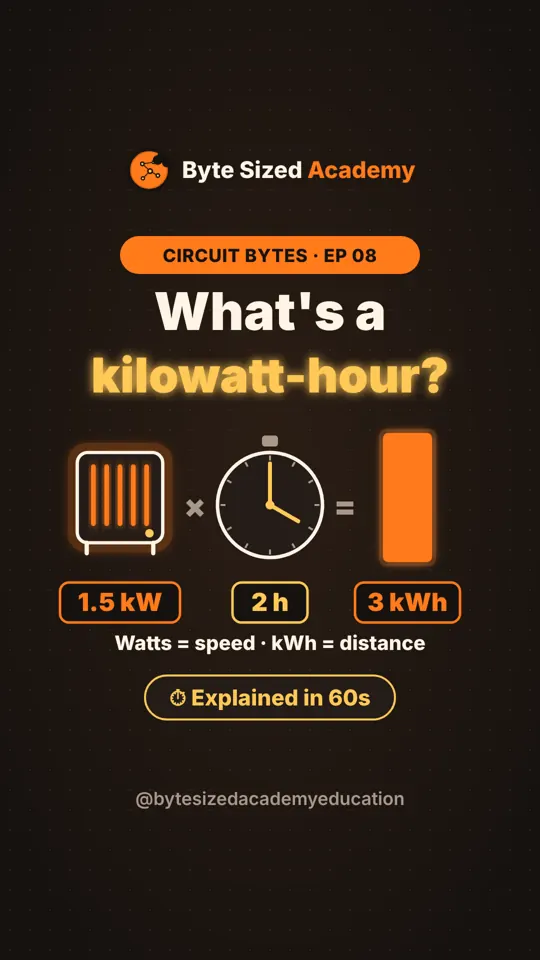 Circuit Bytes · EP08c
Watts vs kilowatt-hours
Watts measure how fast something uses energy; your power bill charges for the total energy, in kilowatt-hours. Run 1,000 watts for one hour and you've used one kilowatt-hour.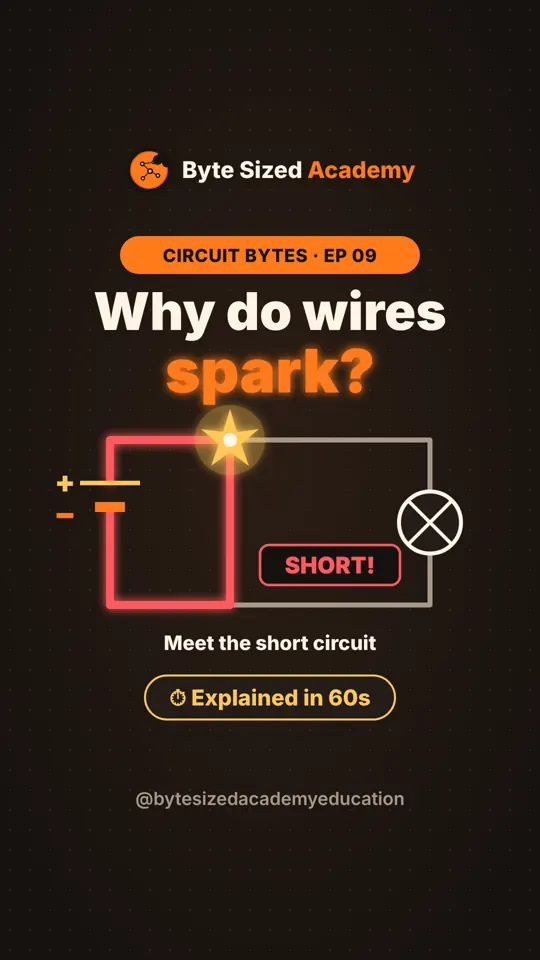 Circuit Bytes · EP09c
Short circuits
A short circuit is a shortcut path with almost no resistance. By Ohm's law the current shoots way up, the wires get hot fast, and that's why fuses and breakers exist.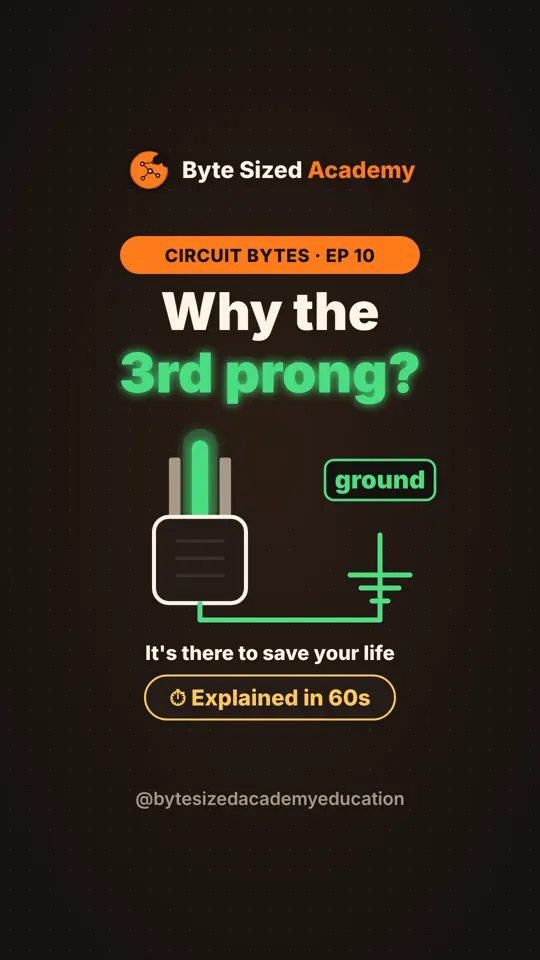 Circuit Bytes · EP10c
What ground means
The third prong on a plug connects an appliance's metal case to a ground wire that runs back to your panel and the earth. If a hot wire ever touches the case, the fault current rushes down that wire and trips the breaker instead of shocking you.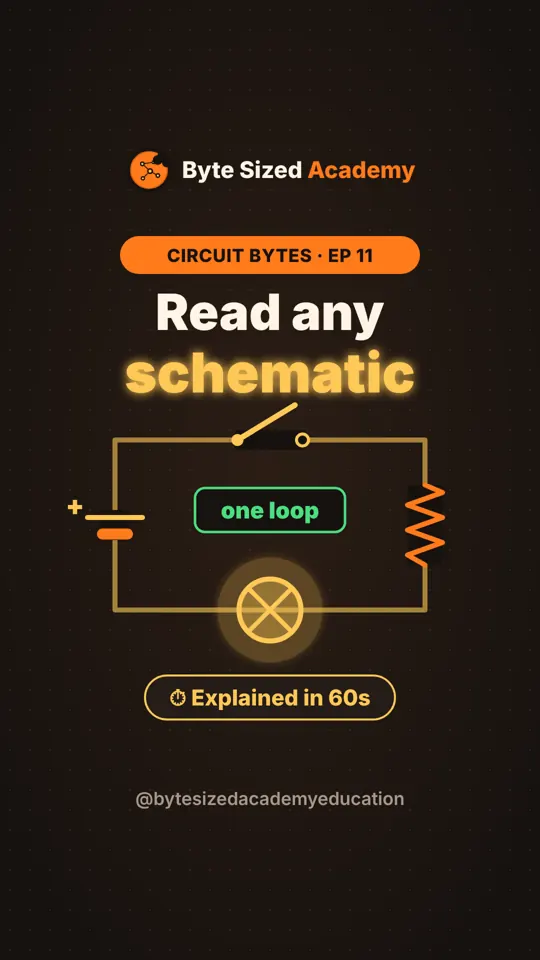 Circuit Bytes · EP11c
How to read a schematic
A schematic is a circuit drawn with symbols instead of pictures. Learn six of them (wires and dots, battery, resistor, lamp, switch and ground) and you can follow the wire around your first circuit.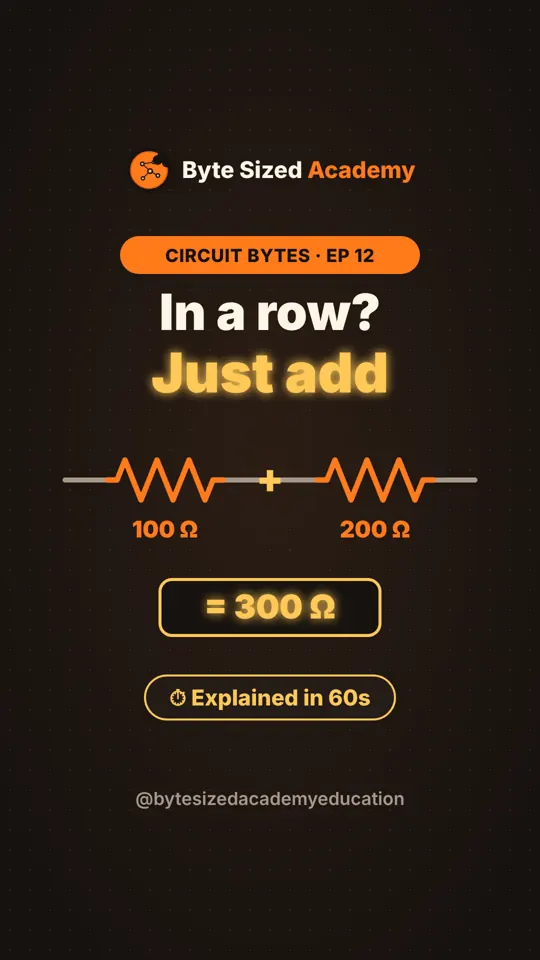 Circuit Bytes · EP12c
Resistors in series
Put resistors one after another on a single path and their resistances add. The same current flows through every one of them, while the battery's voltage is shared between them.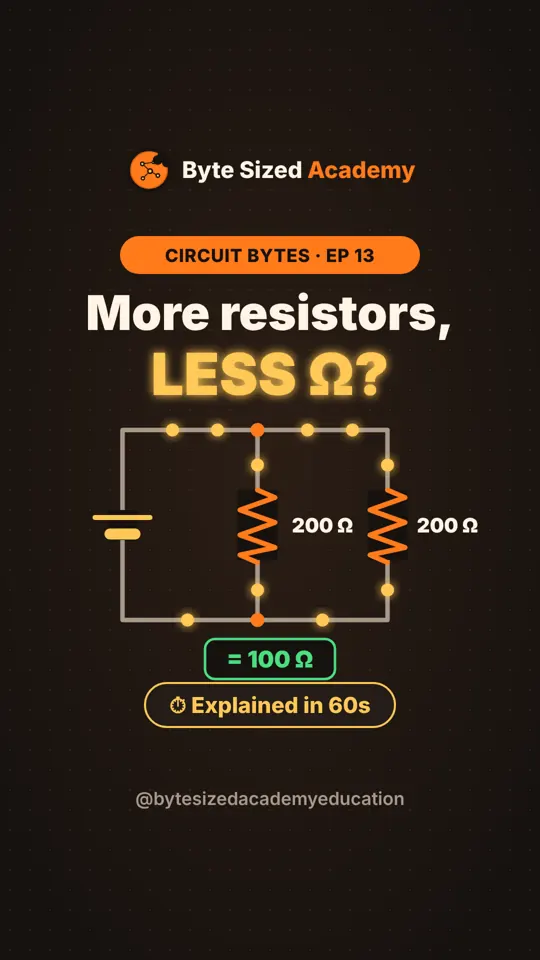 Circuit Bytes · EP13c
Resistors in parallel
Put resistors side by side and the total resistance drops, because the current gets more paths. Two 200 Ω resistors in parallel act like one 100 Ω resistor, and the total is always less than the smallest one. Circuit Bytes · EP14c
Series vs parallel Christmas lights
Mini Christmas lights are wired in series, one path, so one broken filament can darken the whole string. Parallel strings give every bulb its own path, and modern mini bulbs hide a shunt that bypasses a dead filament.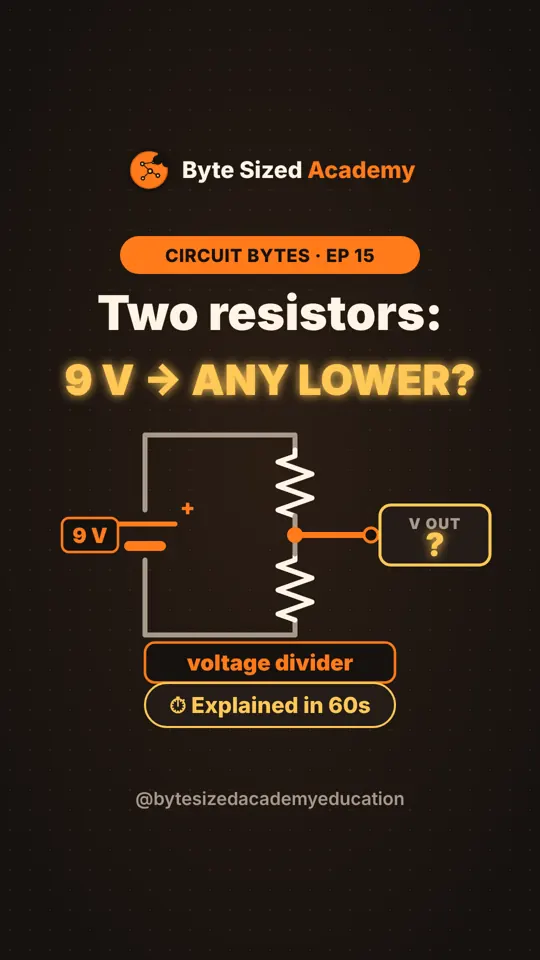 Circuit Bytes · EP15c
The voltage divider
Two resistors in series share a battery's voltage, so the point between them sits at a lower voltage. That's a voltage divider, and its output is V out = V in × R2 ÷ (R1 + R2).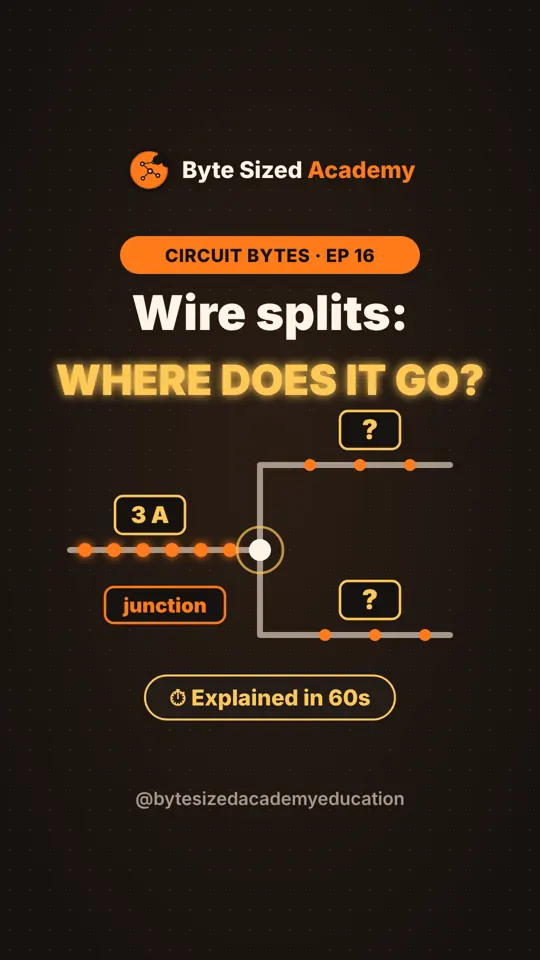 Circuit Bytes · EP16c
Kirchhoff's current law
A junction (node) is where wires meet. Charge can't pile up there or vanish, so the total current flowing in equals the total current flowing out. That's Kirchhoff's current law.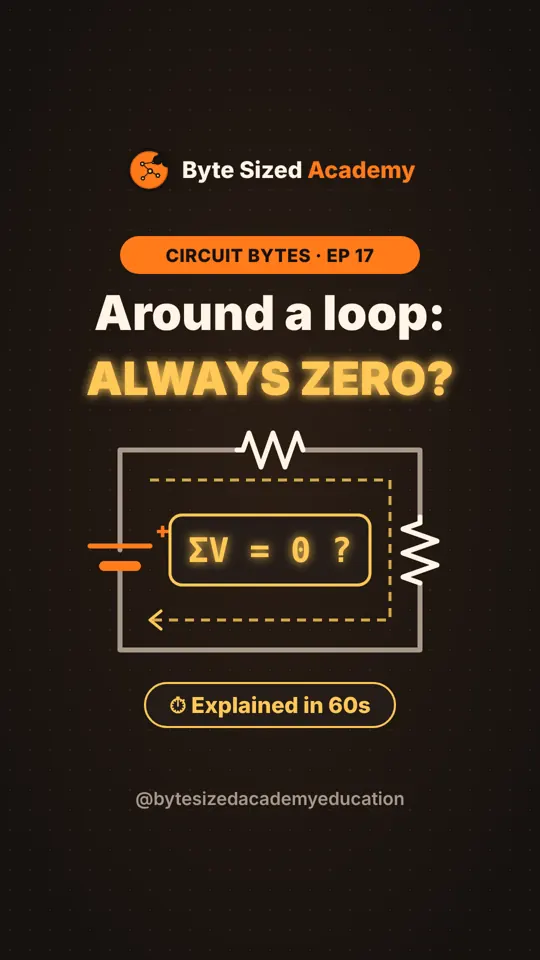 Circuit Bytes · EP17c
Kirchhoff's voltage law
Around any closed loop in a circuit, the voltage rises and drops cancel out, so they add up to zero. That's Kirchhoff's voltage law, and it explains why series resistors share a battery's voltage.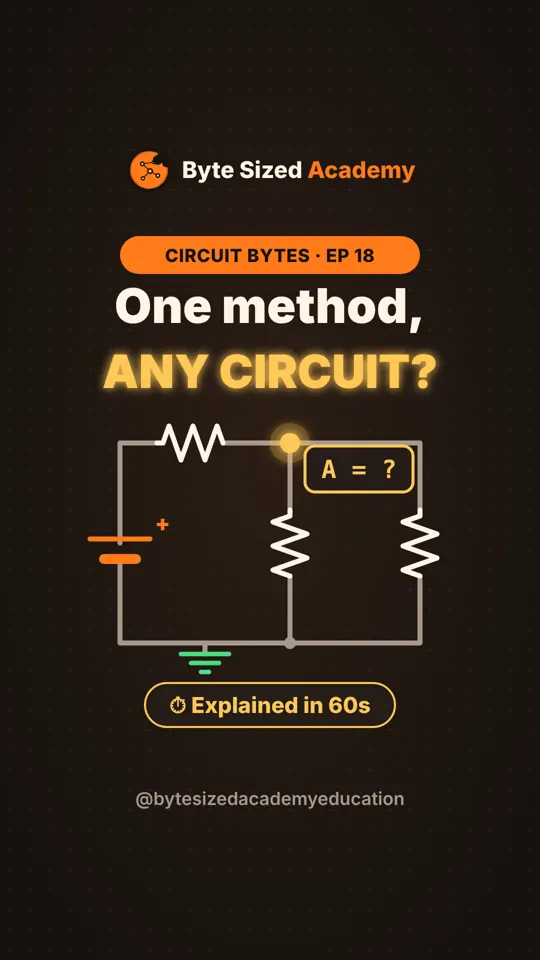 Circuit Bytes · EP18c
Nodal analysis in 60 seconds
Nodal analysis solves almost any circuit with one recipe: pick a ground node, label the other nodes with unknown voltages, then write "current in equals current out" at each one using Ohm's law.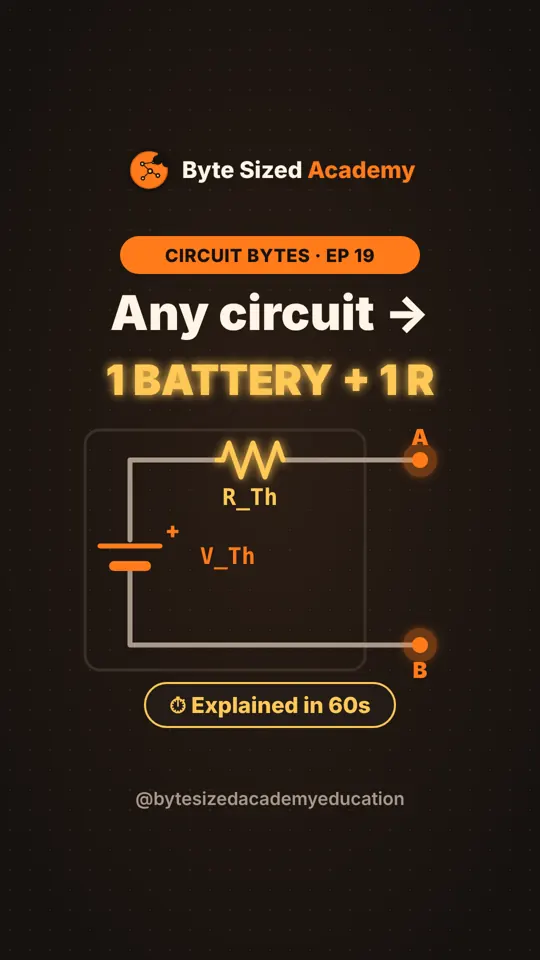 Circuit Bytes · EP19c
Thevenin equivalent
Seen from two terminals, any circuit of batteries and resistors acts like one voltage source in series with one resistor. Find the open-circuit voltage and the resistance looking in, and every load becomes one Ohm's law step.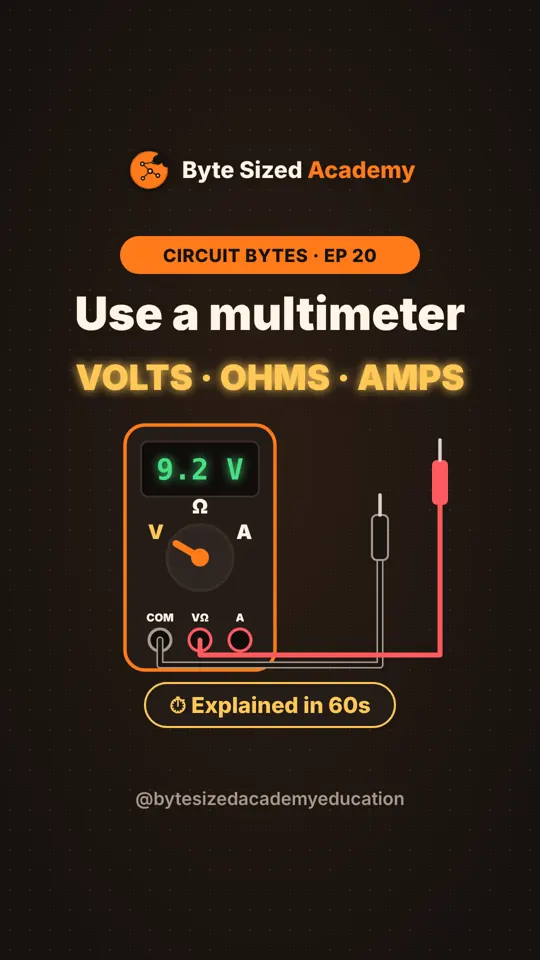 Circuit Bytes · EP20c
How to use a multimeter
A multimeter is a voltmeter, an ohmmeter and an ammeter in one. Black probe in COM; measure volts across a part with the power on, ohms with the power off and the part on its own, and amps by breaking the loop and putting the meter in series.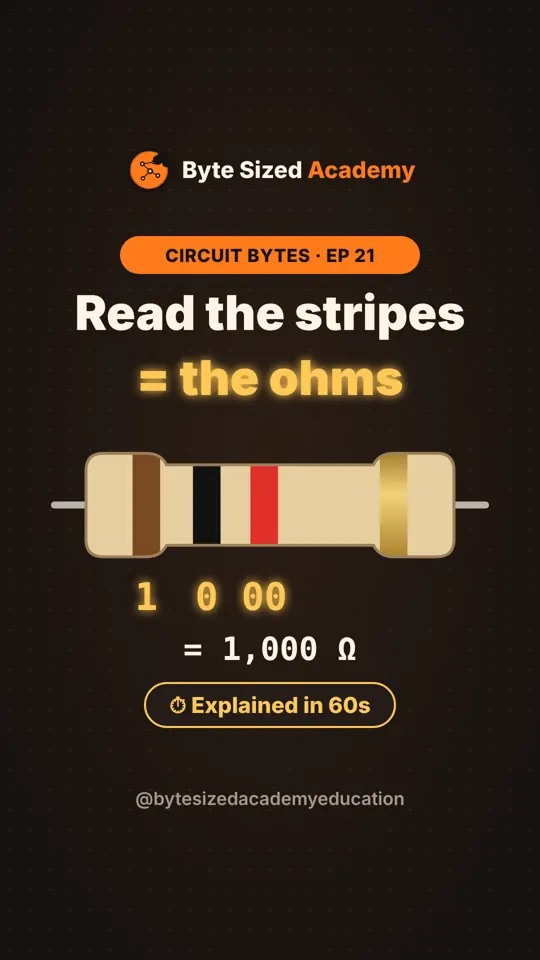 Circuit Bytes · EP21c
The resistor color code
The colored stripes on a resistor are a number. Each color is a digit from 0 to 9; read two digits, add the zeros the third band asks for, and the last band tells you how close the real value is.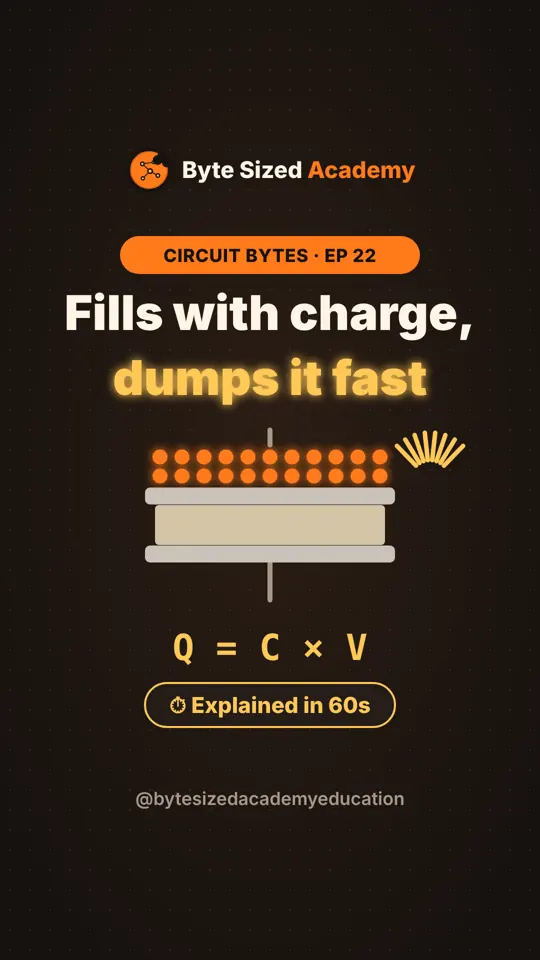 Circuit Bytes · EP22c
Capacitors
A capacitor is two metal plates with an insulator between them. It fills with charge like a bucket until its voltage matches the battery, stores charge Q = C × V, and can empty in a split second.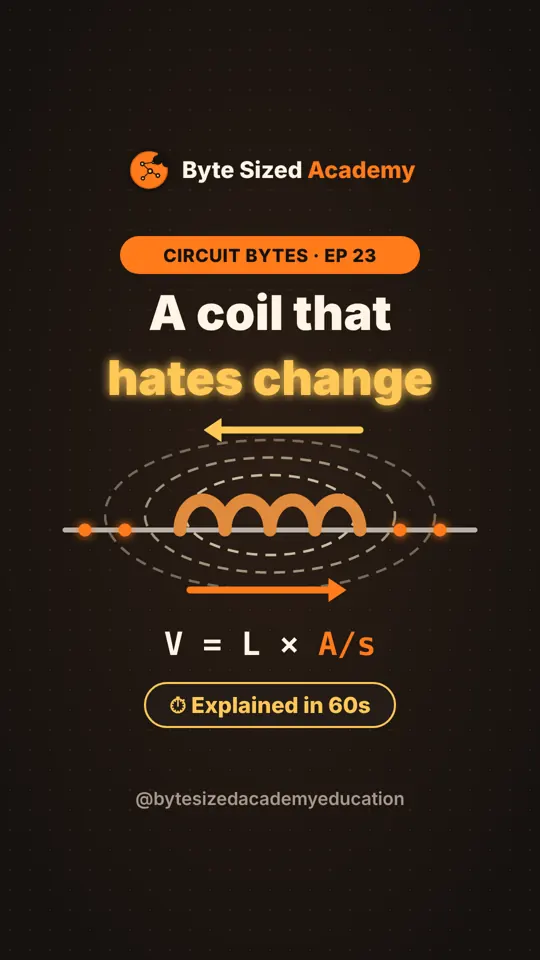 Circuit Bytes · EP23c
Inductors
An inductor is a coil of wire that pushes back against any change in current. The push-back voltage is the inductance, in henries, times how fast the current is changing.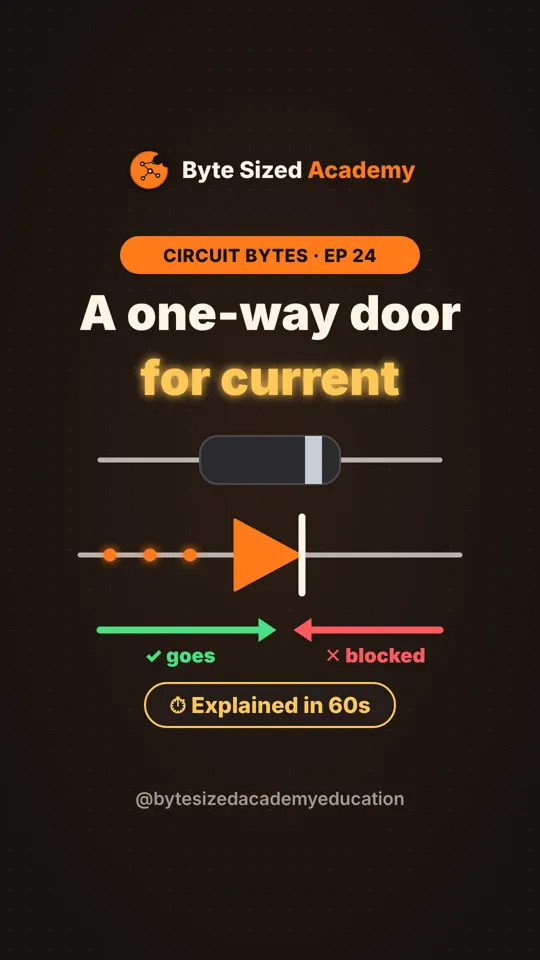 Circuit Bytes · EP24c
Diodes
A diode is a one-way door for current. Pointed forward it conducts and a silicon diode uses about 0.7 volts; pointed backward it blocks almost all current.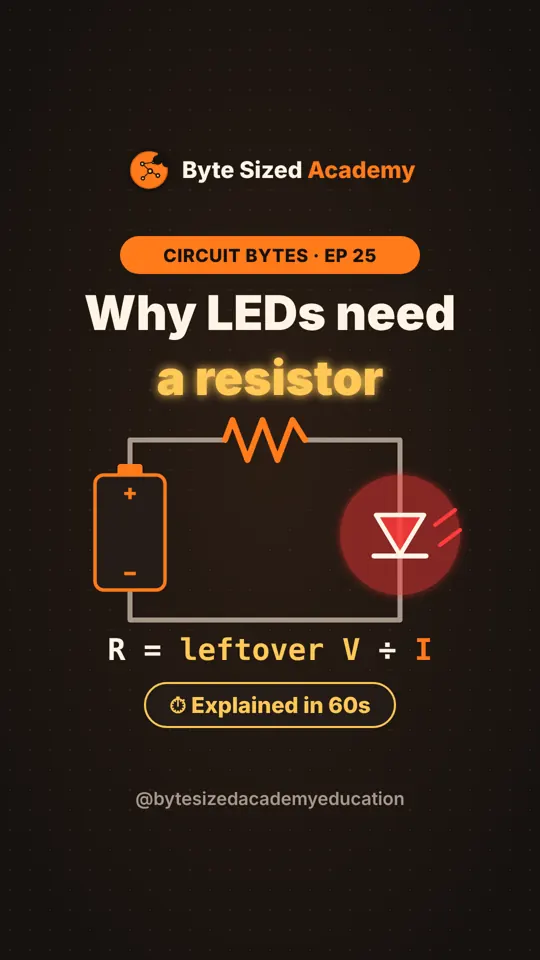 Circuit Bytes · EP25c
LEDs and why they need a resistor
An LED is a diode that glows, and past its turn-on voltage a little extra voltage makes a flood of current. A resistor in series takes the leftover voltage and sets a safe current.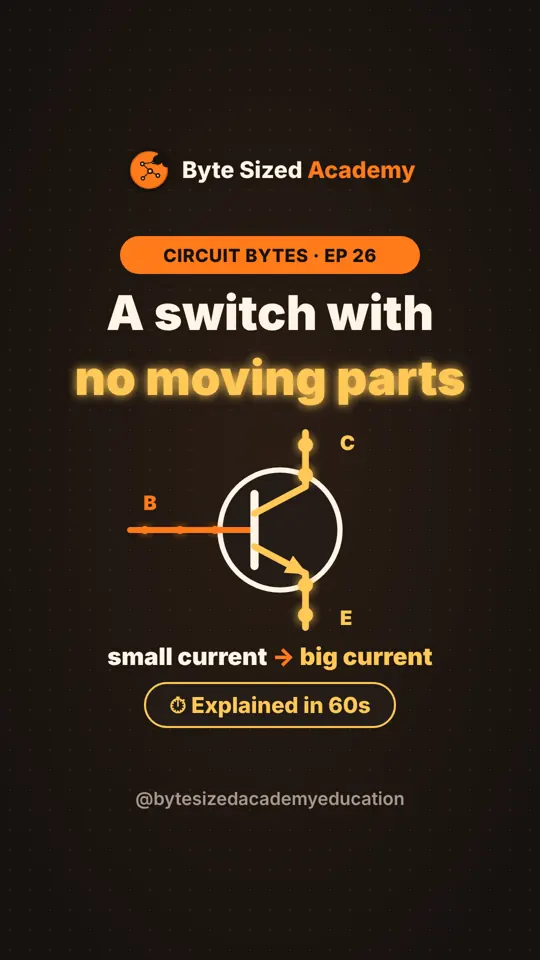 Circuit Bytes · EP26c
The transistor as a switch
A transistor is like a valve that a small trickle can open. A small current into the base lets a big current flow from collector to emitter, so a weak chip signal can switch a motor on and off.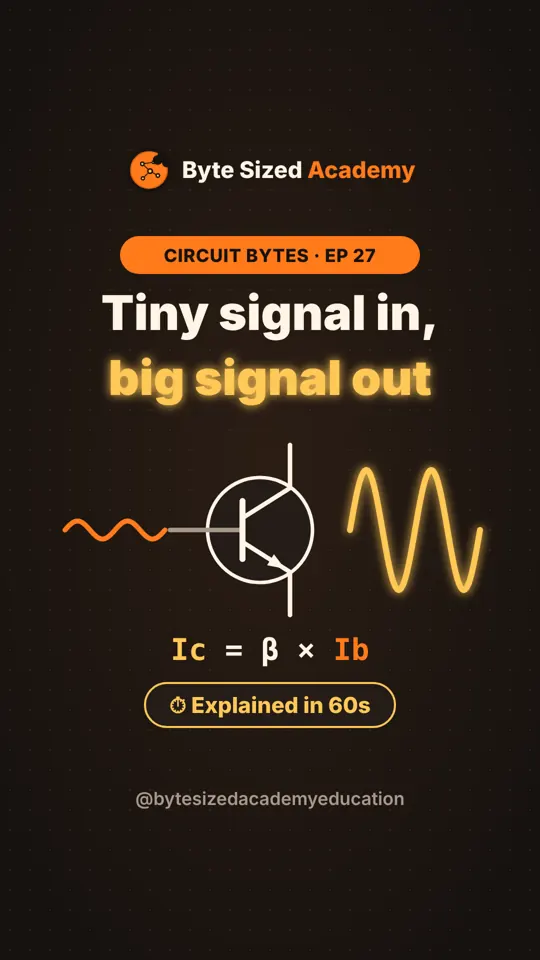 Circuit Bytes · EP27c
The transistor as an amplifier
Run a transistor in between off and on and the collector current is the base current times the gain, called beta. A small wiggle on the base comes out as a much bigger wiggle, powered by the battery.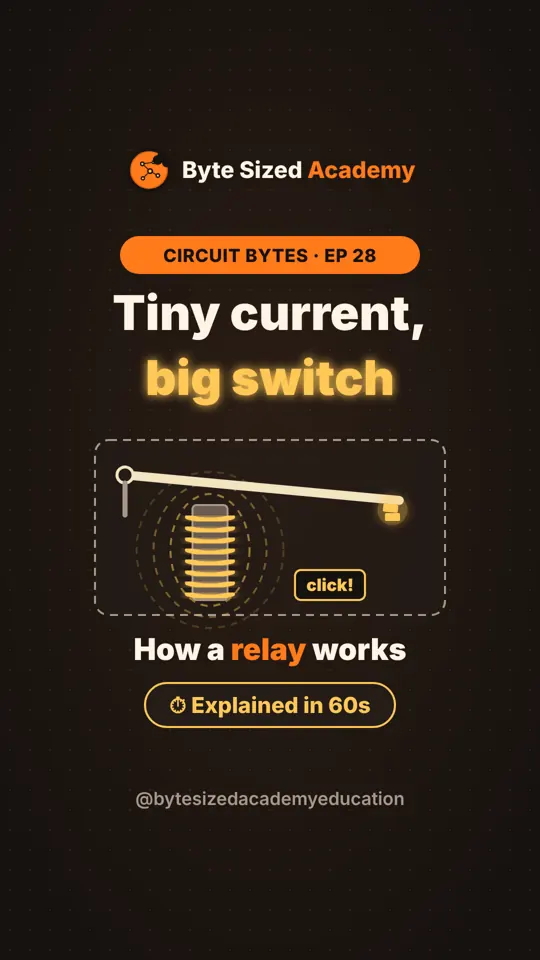 Circuit Bytes · EP28c
Relays
A relay is a switch flipped by a magnet. A small current through its coil pulls a metal arm and closes the contacts, so a tiny circuit can switch a much bigger one without the two ever touching.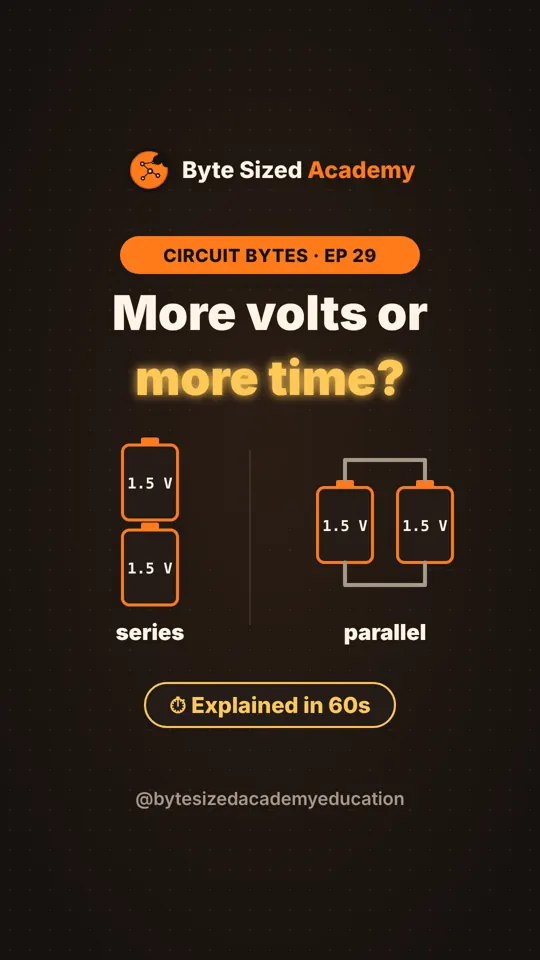 Circuit Bytes · EP29c
Batteries in series vs parallel
Wire batteries in series and their voltages add; wire them in parallel and the voltage stays the same while the capacity adds, so they last longer. Only ever combine matching batteries.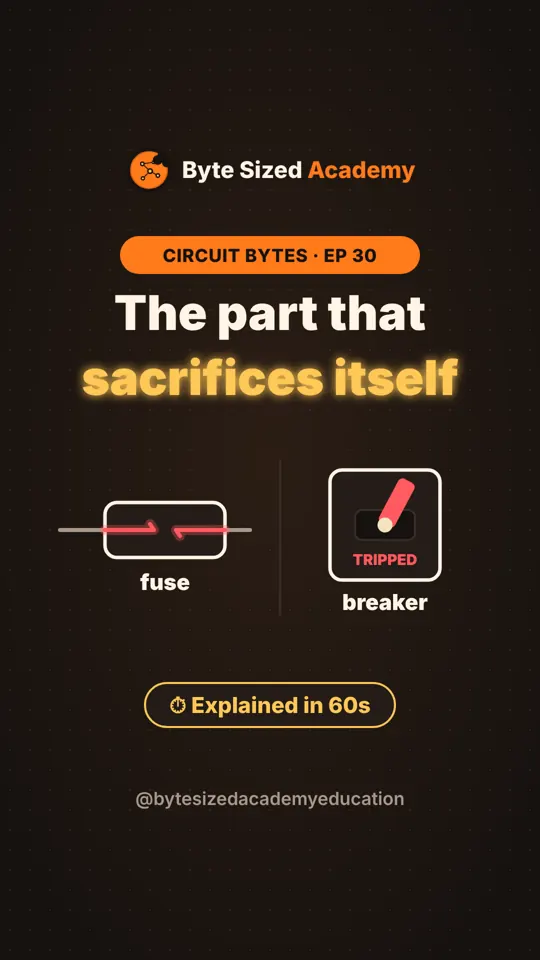 Circuit Bytes · EP30c
Fuses and circuit breakers
Too much current overheats wires. A fuse is a thin metal strip in series that melts first and opens the circuit; a circuit breaker trips instead and can be reset.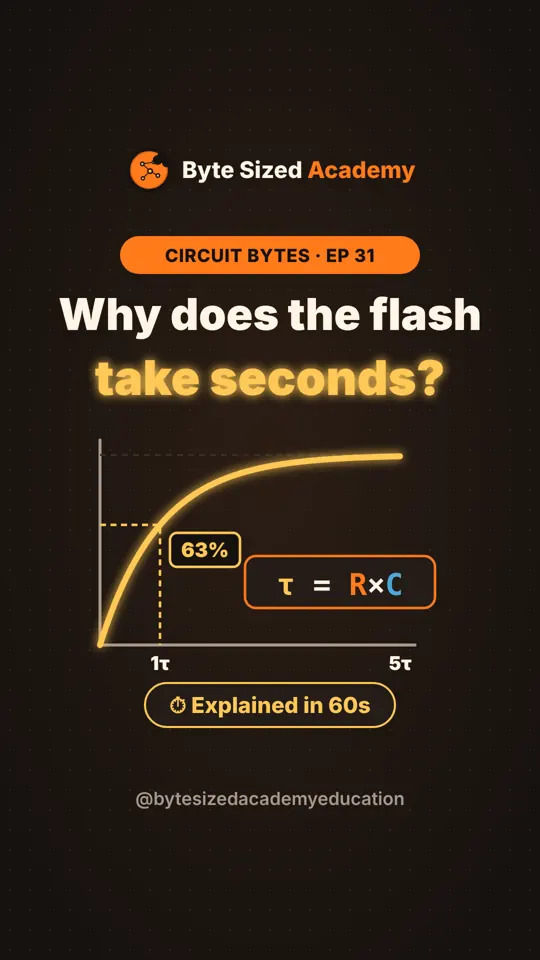 Circuit Bytes · EP31c
The RC time constant
A capacitor that charges through a resistor fills at a pace set by the time constant, tau = R × C. It is about 63% full after one time constant and basically full after five.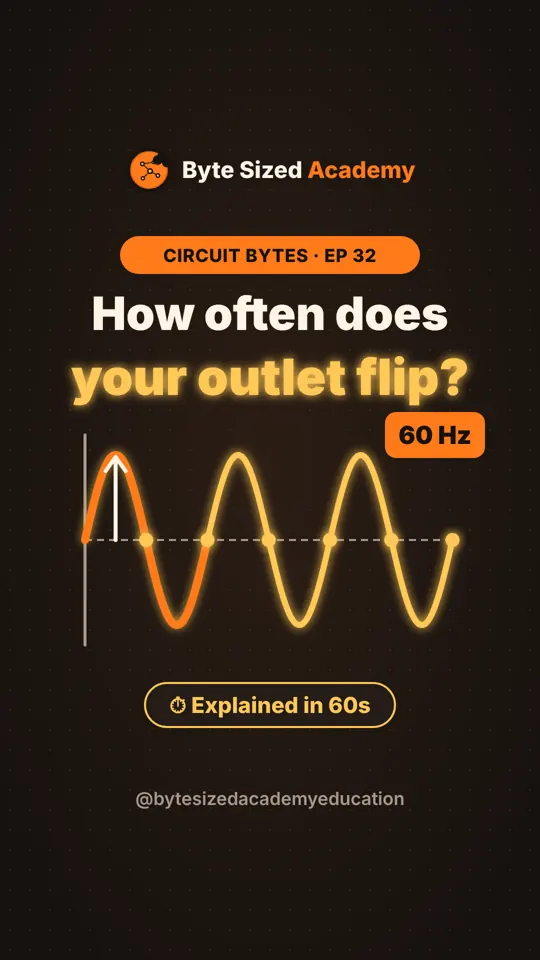 Circuit Bytes · EP32c
"Sine waves: frequency and amplitude"
Wall power is AC, a voltage that follows a sine wave. Its amplitude is the peak height, its frequency is cycles per second in hertz, and its period is the time for one cycle.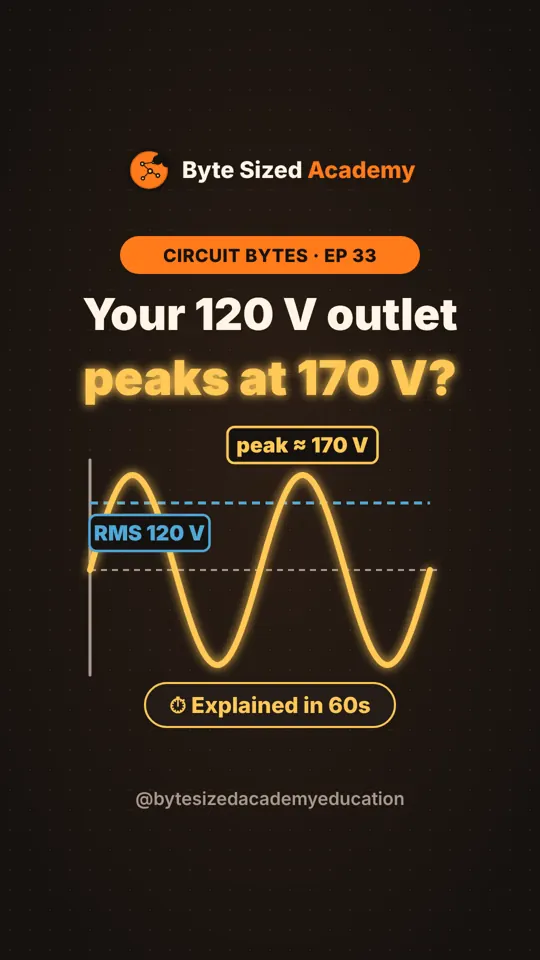 Circuit Bytes · EP33c
RMS voltage
AC voltage is a sine wave, so we describe it with its RMS value, the steady DC voltage that heats a resistor the same. For a sine wave, peak = RMS × 1.414, so a 120 V outlet peaks near 170 V.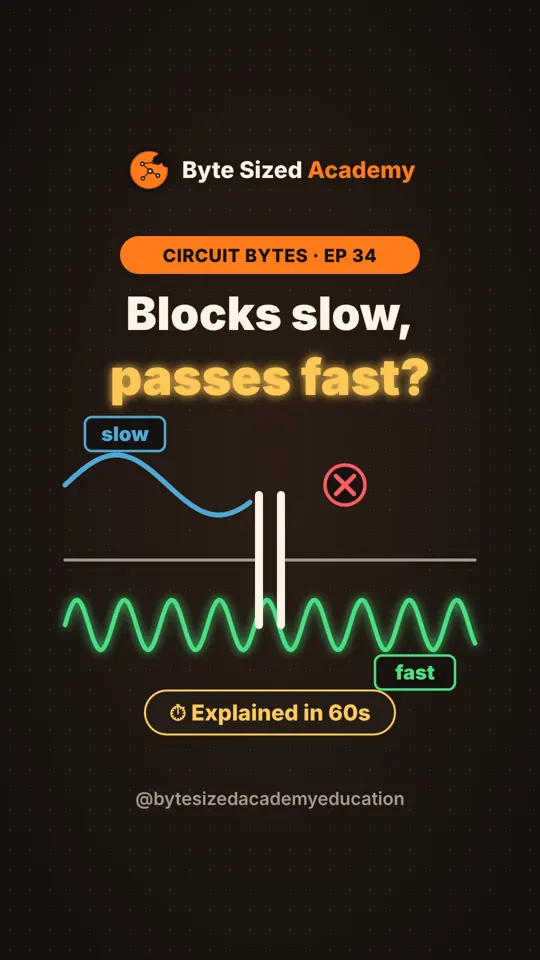 Circuit Bytes · EP34c
Reactance
Capacitors and inductors push back on AC with reactance, measured in ohms. A capacitor's reactance falls as frequency rises; an inductor's rises. That's why a capacitor blocks slow signals and DC but passes fast ones.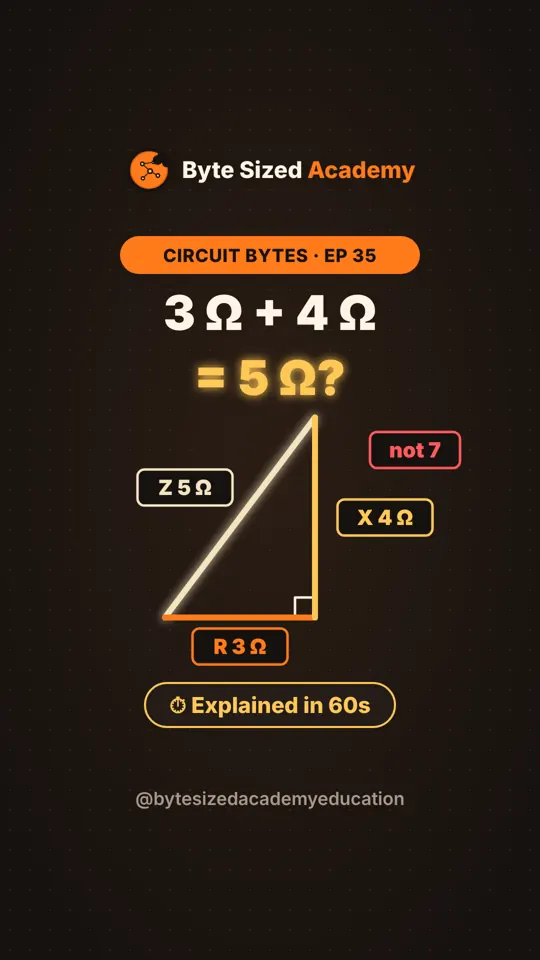 Circuit Bytes · EP35c
Impedance
Impedance (Z) is the total opposition to AC, in ohms. Resistance and reactance are 90° apart, so in series they add like the sides of a right triangle, Z = √(R² + X²), and Ohm's law becomes I = V ÷ Z.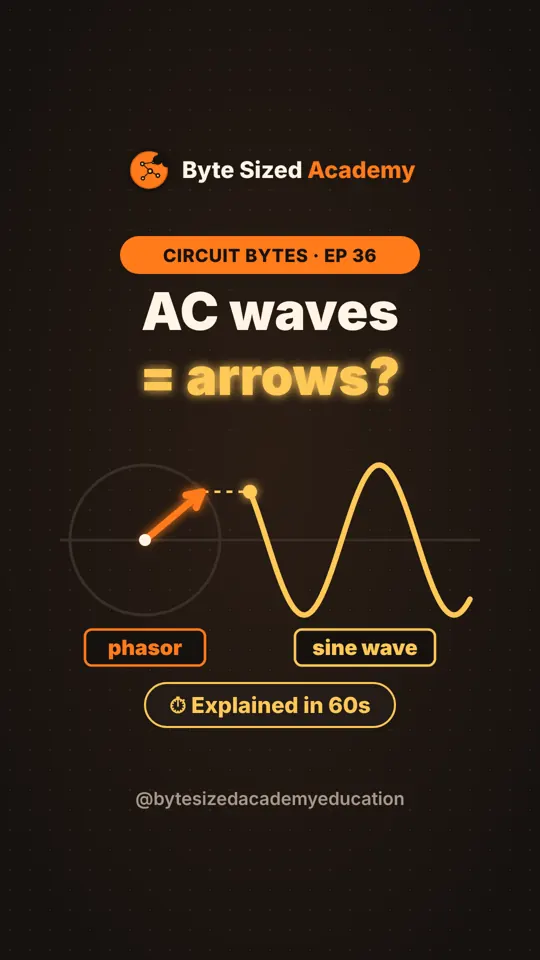 Circuit Bytes · EP36c
Phasors
A sine wave is the height of a spinning arrow's tip. Every wave in an AC circuit spins at the same frequency, so freeze the spin and each wave becomes a still arrow, a phasor, whose length is the amplitude and whose angle is the phase. Adding waves is then just adding arrows tip to tail.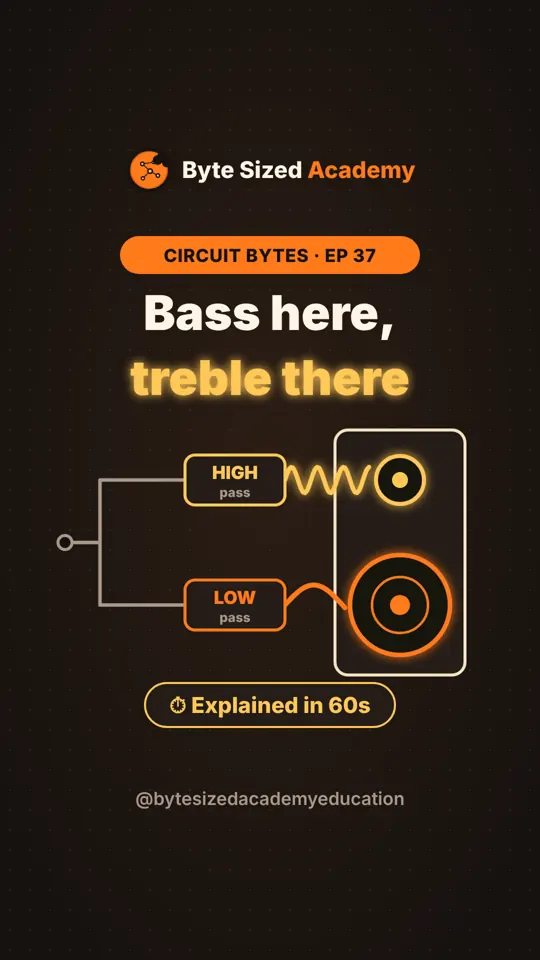 Circuit Bytes · EP37c
Low-pass and high-pass filters
A filter passes some frequencies and blocks others. An RC low-pass filter (resistor, then a capacitor to ground) lets lows through; swap the parts for a high-pass. The cutoff f = 1 ÷ (2πRC) is where the output drops to about 70%.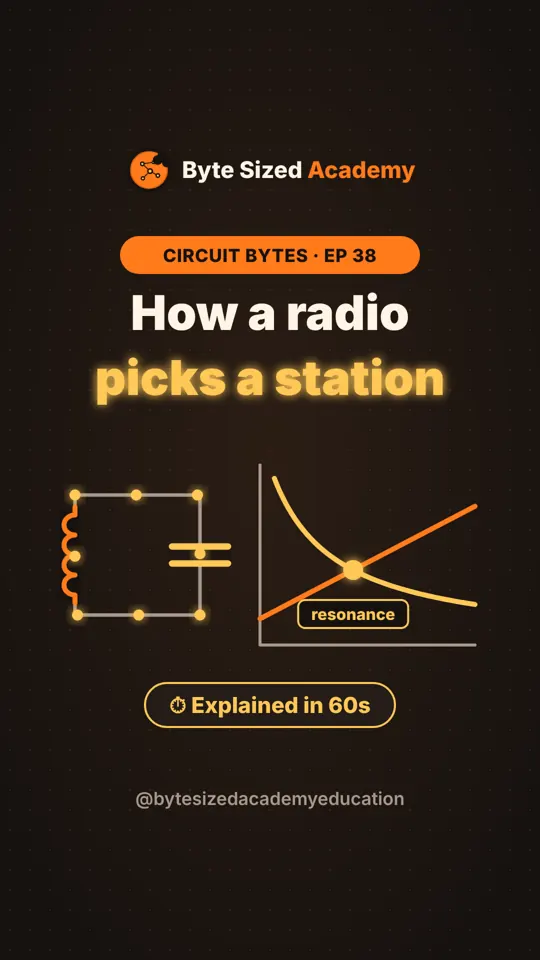 Circuit Bytes · EP38c
Resonance
An inductor's reactance rises with frequency and a capacitor's falls. At one frequency they're equal and cancel: that's resonance, f = 1 ÷ (2π√(LC)), and it's how a radio picks one station out of hundreds.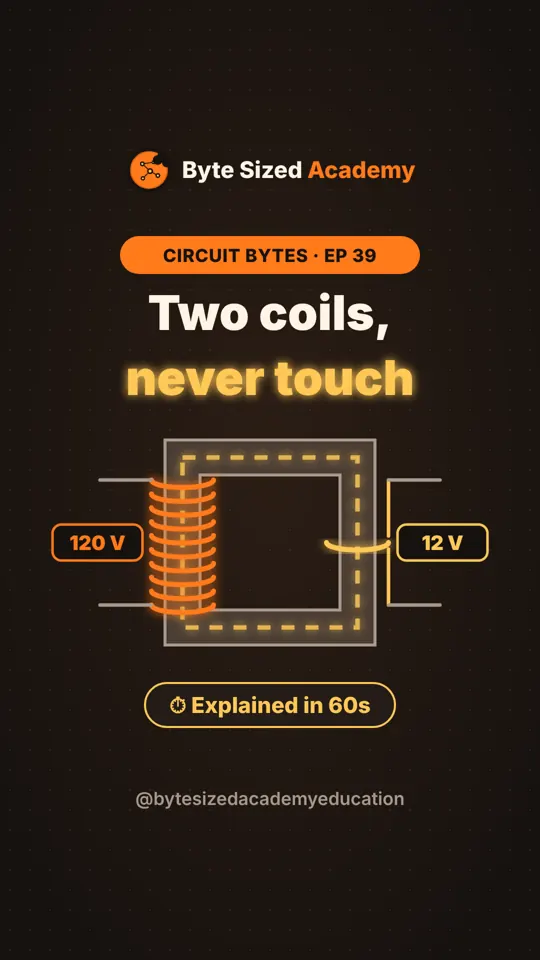 Circuit Bytes · EP39c
Transformers
A transformer is two coils on one iron core with no wire between them. AC in the first coil makes a changing magnetic field that induces a voltage in the second, and the voltage ratio equals the turns ratio.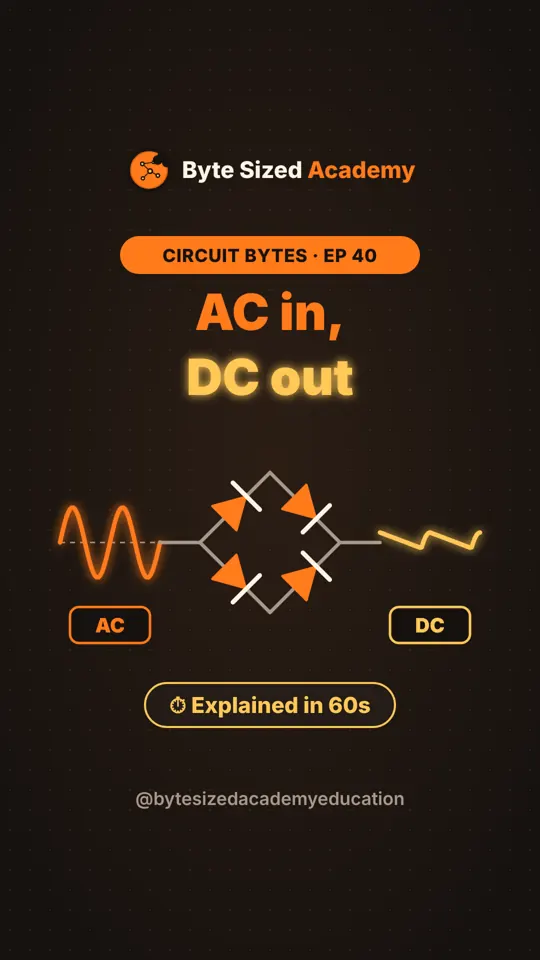 Circuit Bytes · EP40c
"The rectifier: AC to DC"
A rectifier uses diodes to turn back-and-forth AC into one-way DC. One diode keeps only the top halves; a four-diode bridge flips the bottom halves up, and a capacitor smooths the bumps into nearly steady DC.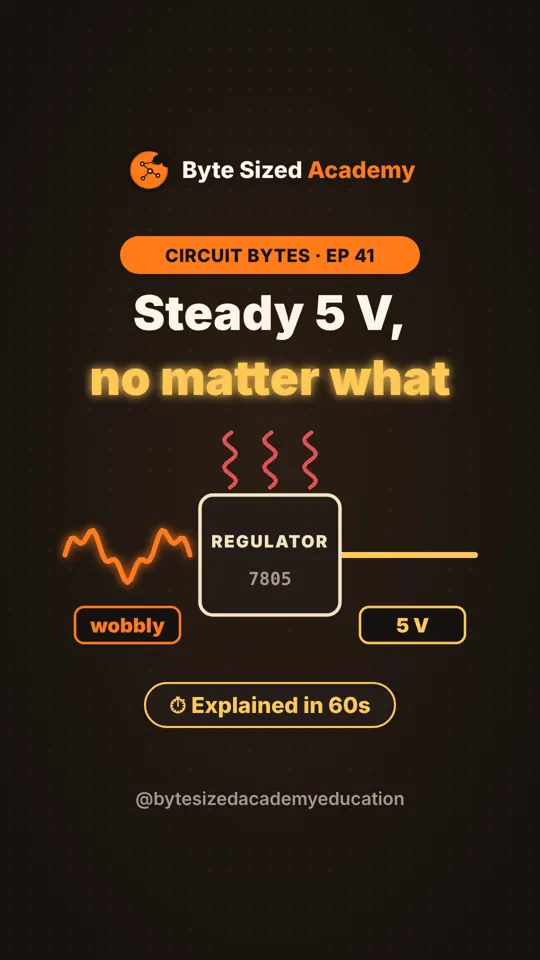 Circuit Bytes · EP41c
Voltage regulators
A voltage regulator holds its output steady while the input sags or ripples. A linear regulator burns the extra voltage as heat, (V in − V out) × I, while a switching regulator flicks on and off very fast and wastes far less.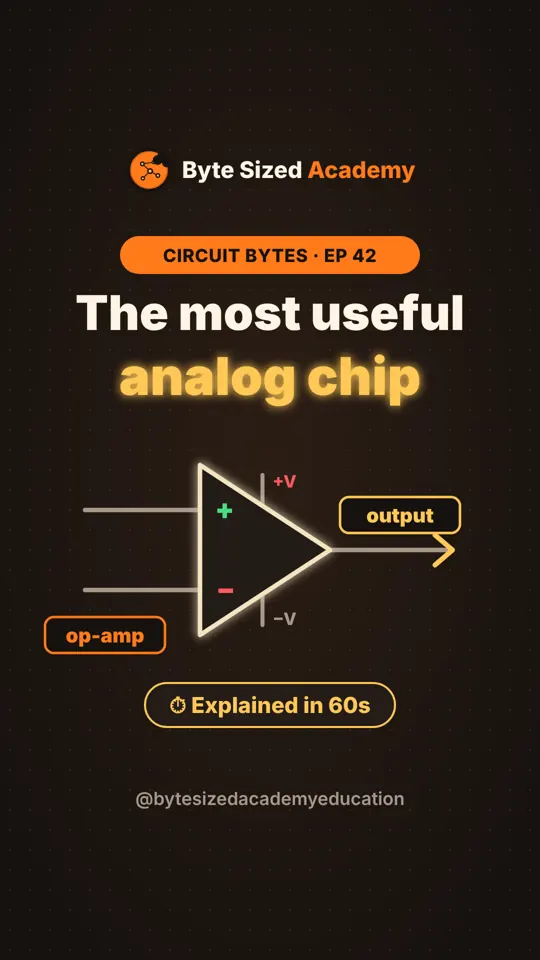 Circuit Bytes · EP42c
What an op-amp is
An op-amp has a plus input, a minus input and one output, and it multiplies the difference between its inputs by a huge gain. Without feedback even a tiny difference drives the output to its supply limit, which makes it a comparator.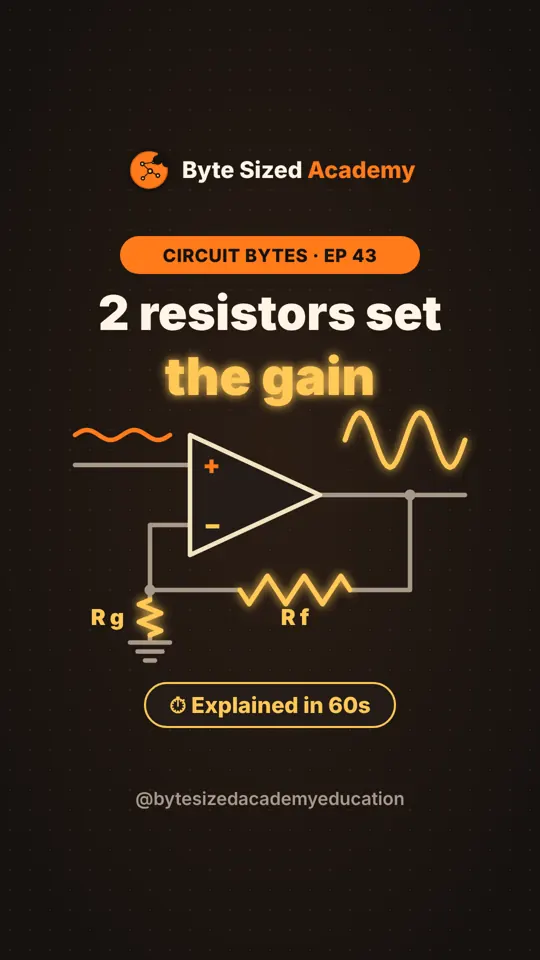 Circuit Bytes · EP43c
Op-amp amplifiers
Negative feedback tames an op-amp's huge gain. Feed the output back to the minus input through two resistors and the op-amp drives its output until both inputs match, so a non-inverting amplifier has a gain of 1 + R f ÷ R g, set by the resistors, not the chip.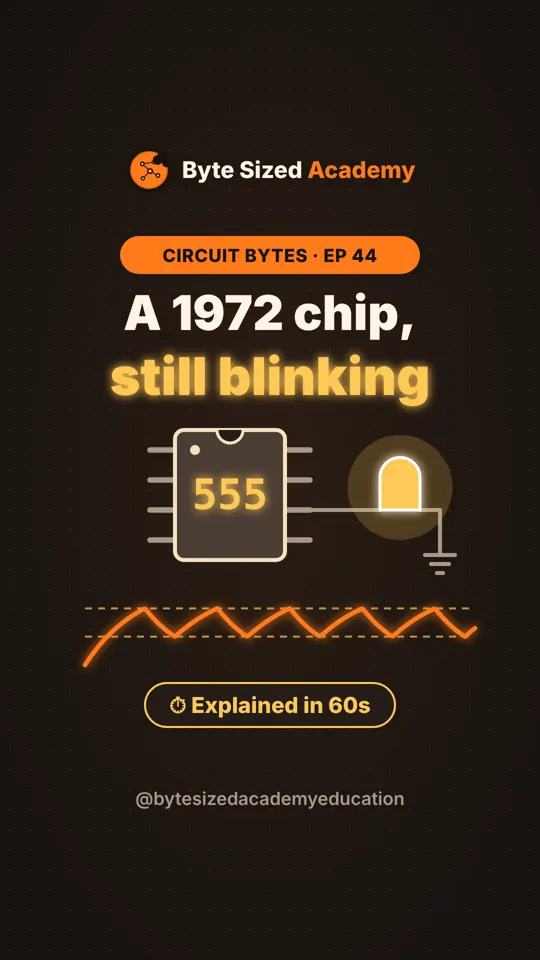 Circuit Bytes · EP44c
The 555 timer
The 555 timer, designed by Hans Camenzind and sold since 1972, blinks an LED by charging a capacitor through resistors to two-thirds of the supply, draining it to one-third, and flipping its output each time. The resistors and capacitor set the speed.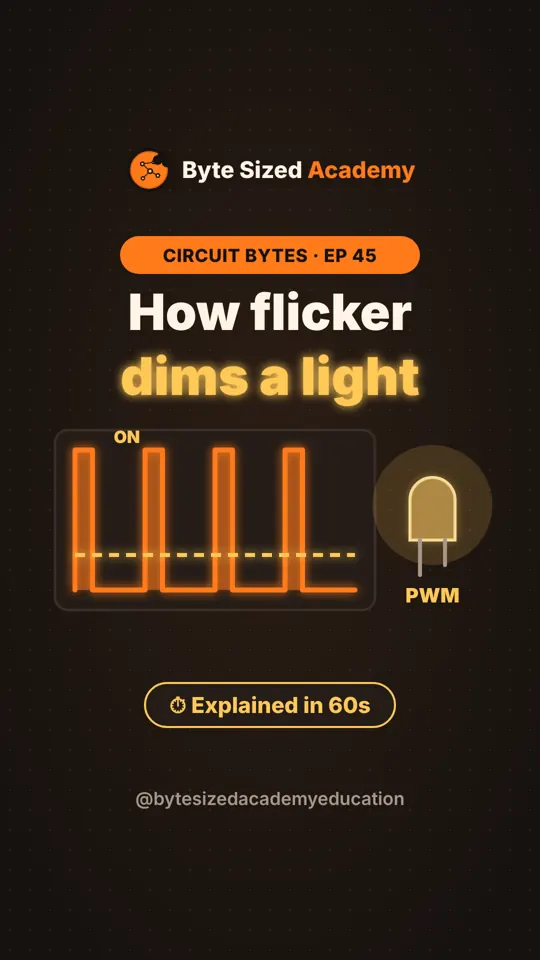 Circuit Bytes · EP45c
"PWM: fake analog"
A digital pin is only fully on or fully off, but switching it hundreds of times a second fakes an in-between level. The share of time it's on is the duty cycle, and the average voltage is the duty cycle times the supply, so 25% of 5 V is 1.25 V. That's PWM, pulse-width modulation.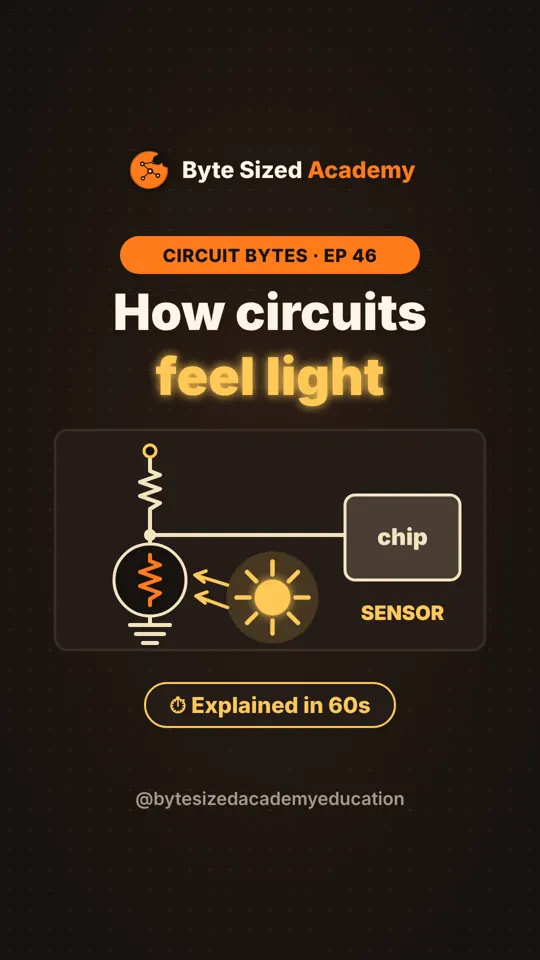 Circuit Bytes · EP46c
"Sensors"
A chip can't feel anything; it only reads voltage. A light-dependent resistor's resistance drops as light rises, and paired with a 10 kΩ resistor in a voltage divider across 5 V it turns light into a voltage: at 40 kΩ in dim light, it gets 4 of the 5 volts. That's a sensor, a part that turns heat, light or touch into a signal a chip can read.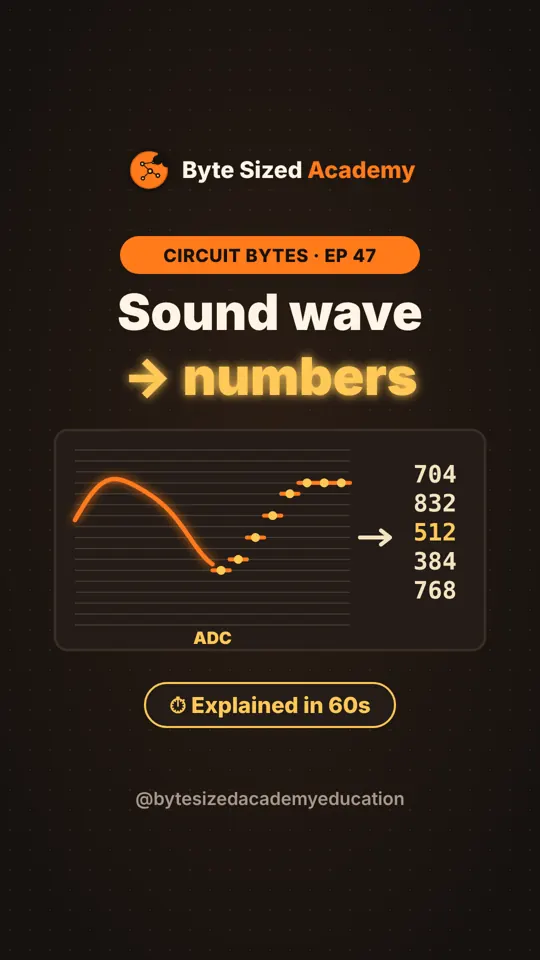 Circuit Bytes · EP47c
"Analog to digital"
A microphone turns sound into a smoothly varying analog voltage. An analog-to-digital converter (ADC) measures that voltage over and over, music CDs 44,100 times a second, and snaps each measurement to the nearest step. Many chips split 0 to 5 V into 1,024 steps, so 2.5 V, halfway up, is stored as 512.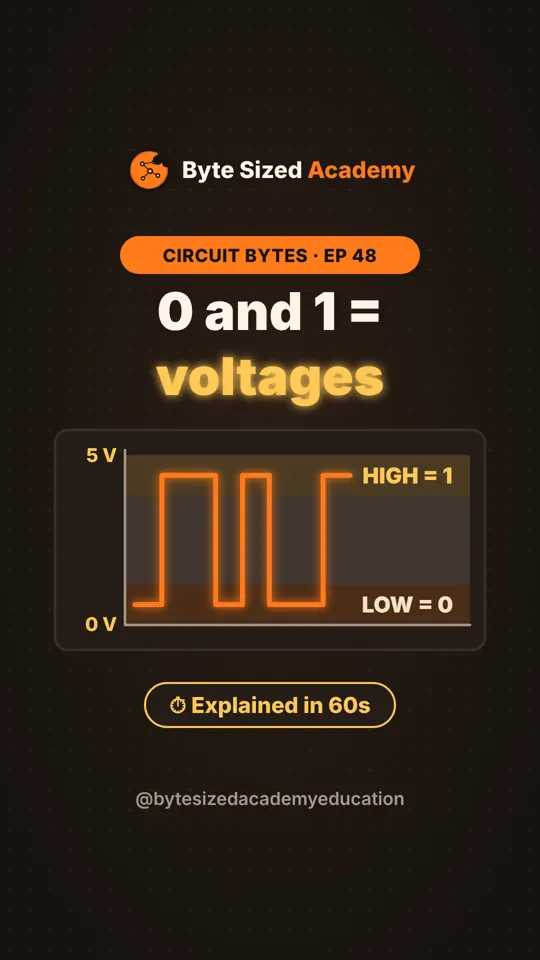 Circuit Bytes · EP48c
"Binary and logic levels"
Inside a chip, 0 and 1 are voltages. On a 5 V chip, near 0 V reads as 0 (low) and near 5 V reads as 1 (high); the gray zone between them keeps a little noise from flipping a bit. Each 0 or 1 is a bit, and every extra bit doubles the number of patterns, so 10 bits give 1,024.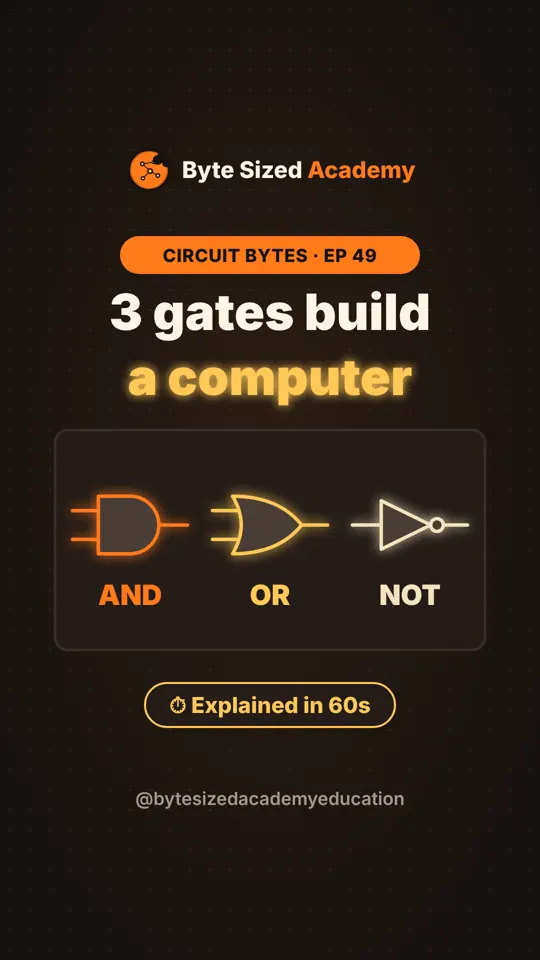 Circuit Bytes · EP49c
"Logic gates: AND, OR, NOT"
A logic gate takes in bits and puts out one bit by a fixed rule. AND gives 1 only when both inputs are 1 (switches in a row), OR gives 1 when either input is 1 (switches side by side), and NOT flips its one input. Millions of them wired together add, compare and run every app.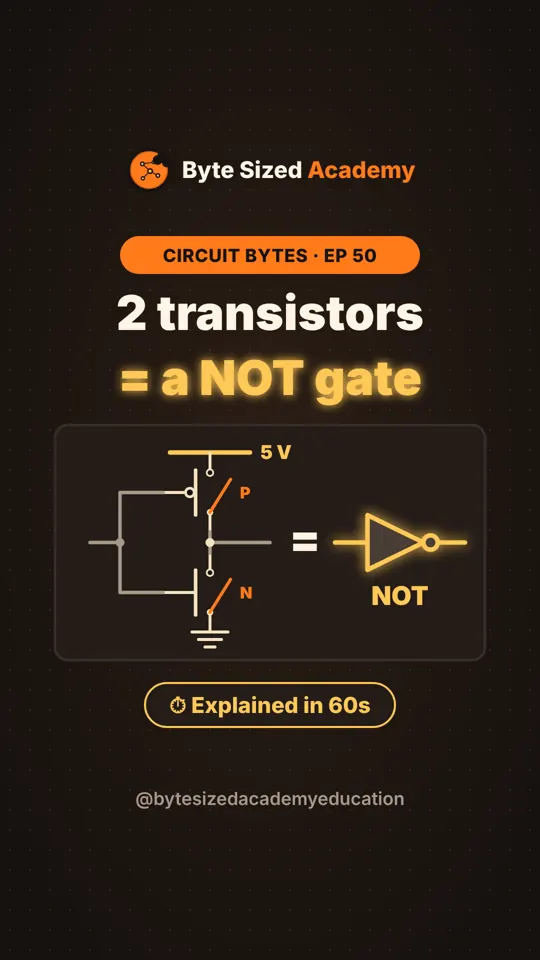 Circuit Bytes · EP50c
"How transistors make a gate"
Chips build gates from two kinds of transistor switch. N-type turns on when its input is high, P-type when it is low. Stack a P-type to 5 V over an N-type to ground, drive both from one input, and you get a NOT gate, the CMOS inverter, which uses almost no power while it waits.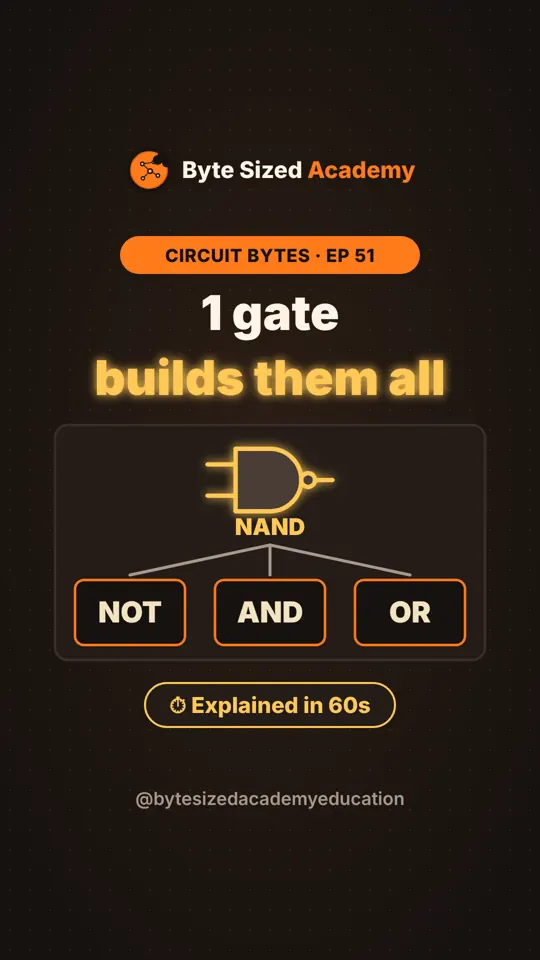 Circuit Bytes · EP51c
"NAND: the universal gate"
NAND is an AND gate with its answer flipped. Tie its inputs together and it becomes NOT; add that NOT after a NAND and you get AND; flip both inputs first and you get OR. Since AND, OR and NOT can build any logic, NAND alone can too, and a CMOS NAND takes only four transistors.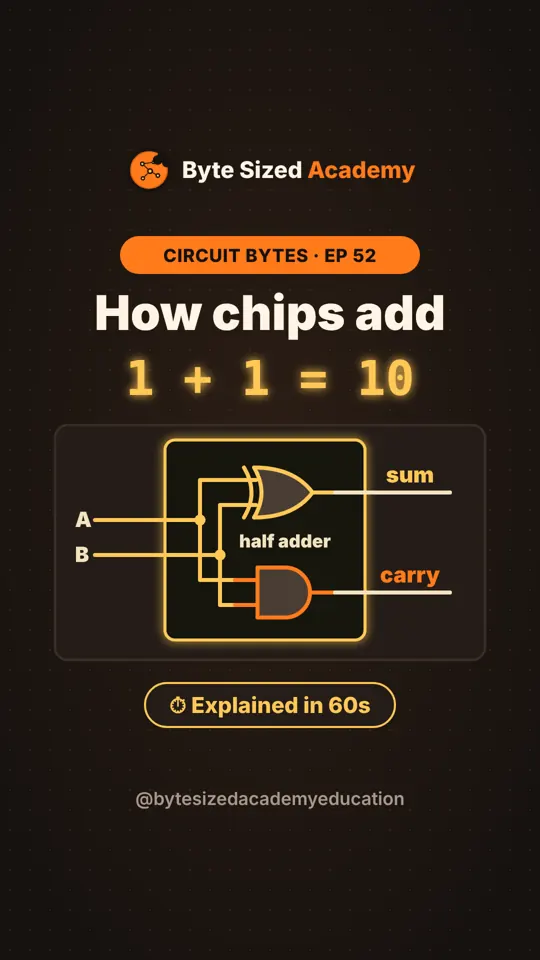 Circuit Bytes · EP52c
"Adding numbers with gates"
In binary, 1 + 1 is written 10, so adding two bits needs a sum bit and a carry bit. The carry is an AND gate and the sum is an XOR gate; side by side they make a half adder. Chain adders one per column, passing each carry along, and a chip can add numbers of any size.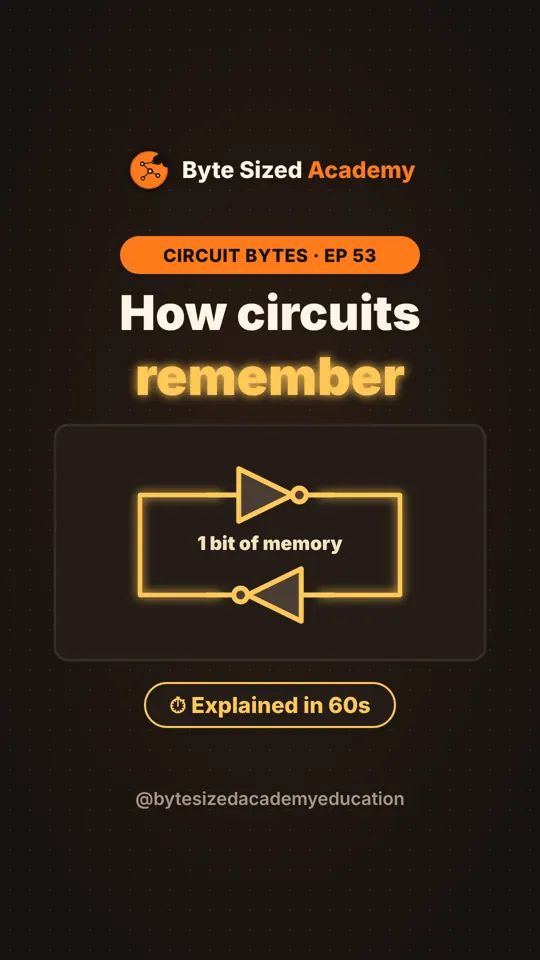 Circuit Bytes · EP53c
"Flip-flops: one bit of memory"
Ordinary gates forget their answer as soon as their inputs change. Wire two NOT gates in a ring and the loop holds a bit by itself. Add set and reset inputs and you have a latch; make it update only on a clock tick and you have a flip-flop, which stores one bit.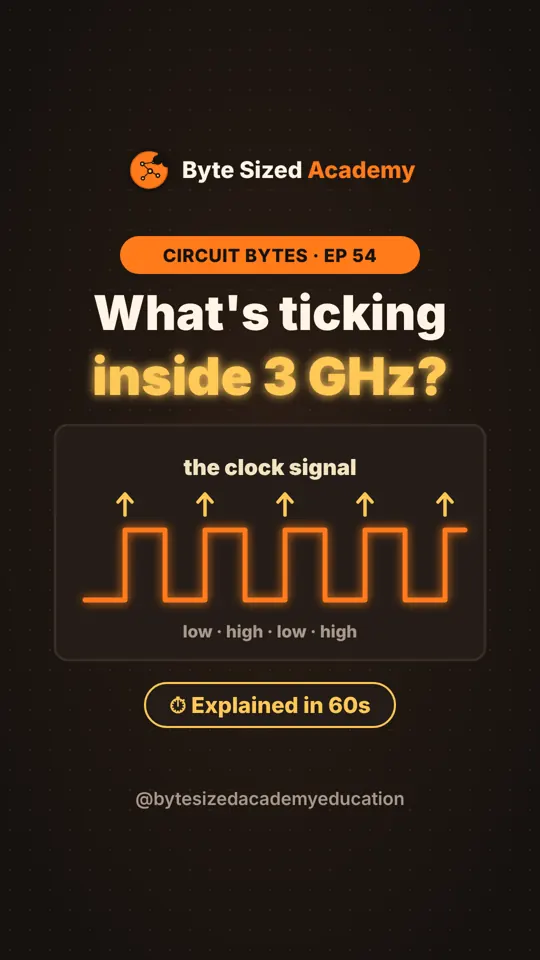 Circuit Bytes · EP54c
"Clock signals"
A clock is a signal that flips low, high, low, high at a steady beat. Flip-flops grab new values only on the rising edge, which gives the gates between them time to settle so every answer is stored at once. One low-high round is a cycle, so 3 GHz means 3 billion cycles every second, and most clocks start from a quartz crystal.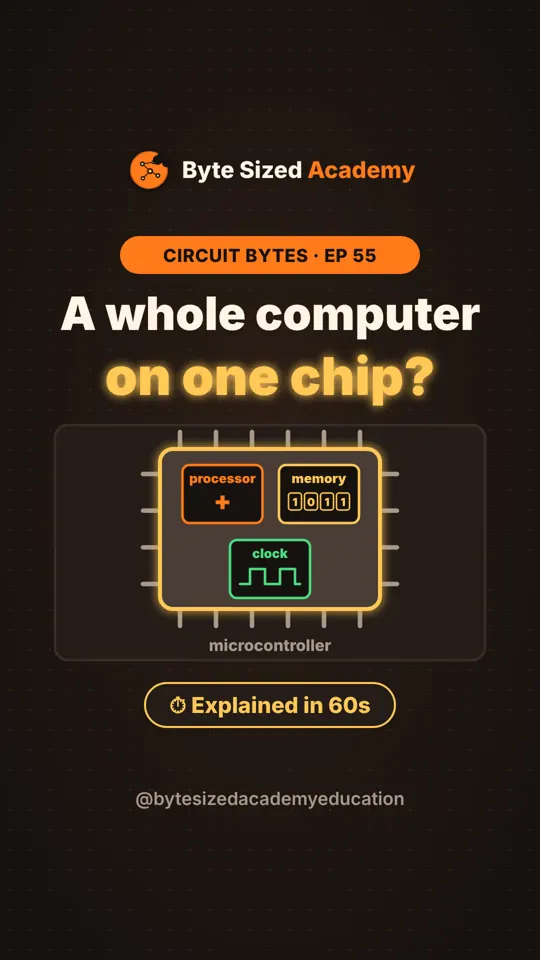 Circuit Bytes · EP55c
"What a microcontroller is"
A computer needs a processor, memory and a clock. In a laptop those are separate chips; a microcontroller puts them all on one cheap chip, plus input and output pins, and runs one program in a loop. They hide in microwaves, remotes and washing machines, and a modern car has dozens.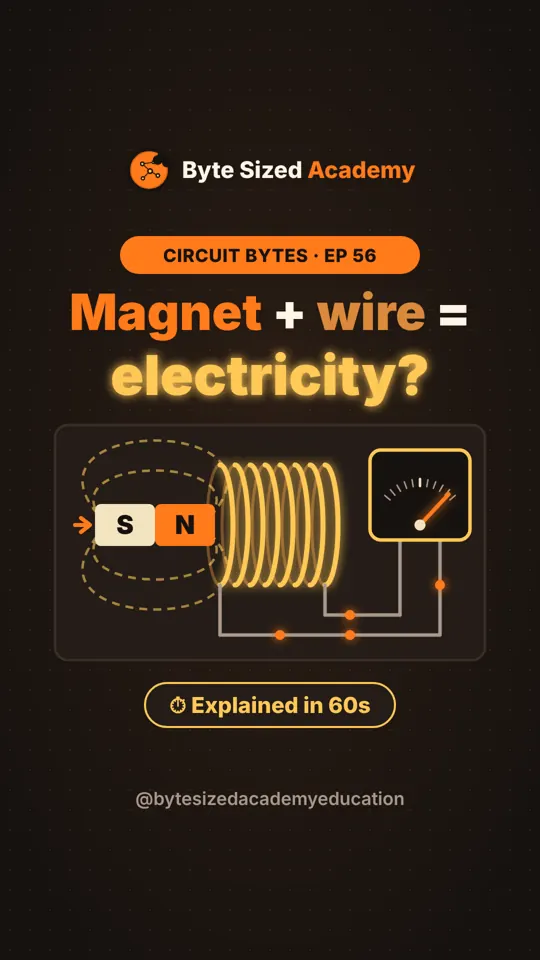 Circuit Bytes · EP56c
"Electromagnetic induction"
Hold a magnet still inside a coil and nothing happens; move it and a meter jumps. A changing magnetic field through a loop of wire pushes current around it. That is electromagnetic induction, and it runs transformers and the generators in most power plants.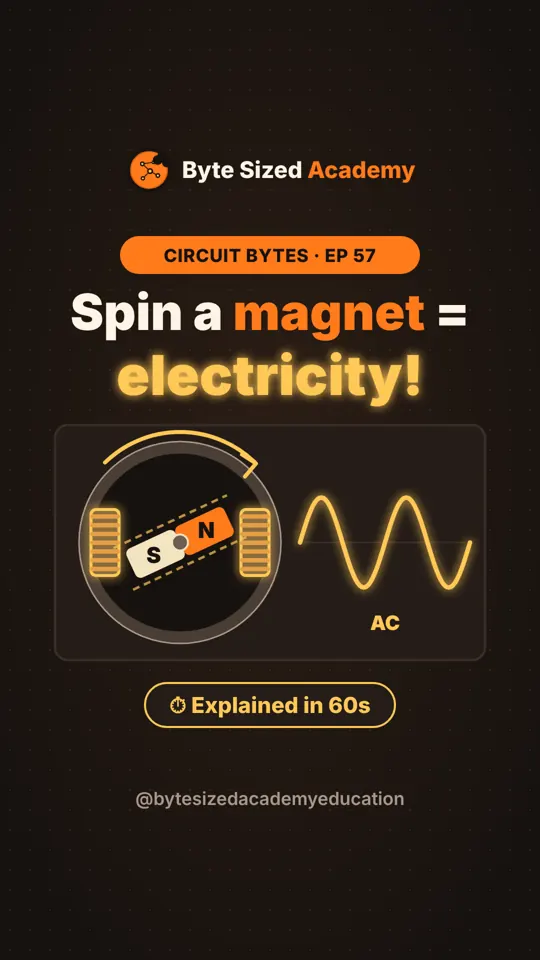 Circuit Bytes · EP57c
"How a generator works"
A generator spins a magnet inside coils of wire, so the magnetic field through the coils keeps changing and a voltage appears. North then south poles sweeping past make alternating current, and steam, falling water or wind does the spinning.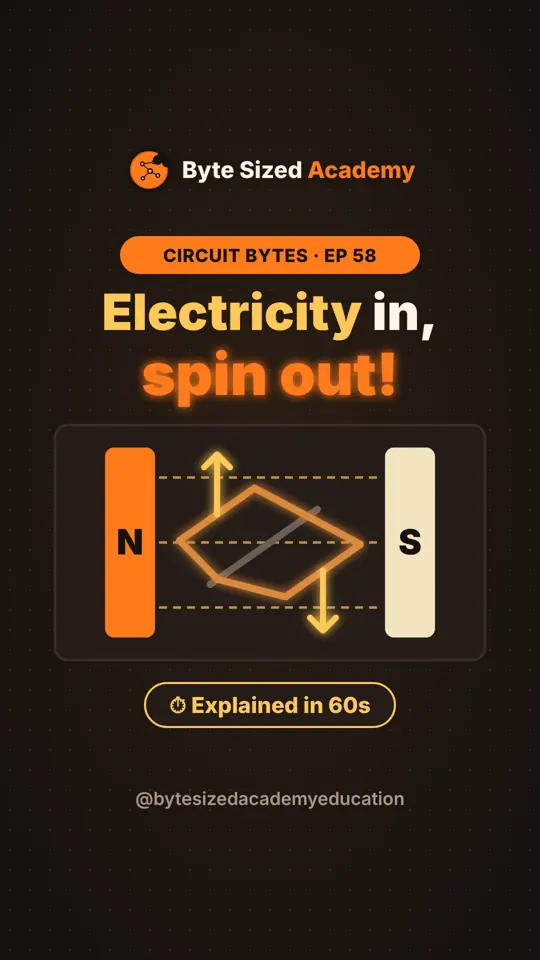 Circuit Bytes · EP58c
"How an electric motor works"
A motor is a generator run backward. Current in a wire loop between two magnets gets pushed up on one side and down on the other, so the loop twists, and a split-ring commutator reverses the current every half turn so it keeps spinning.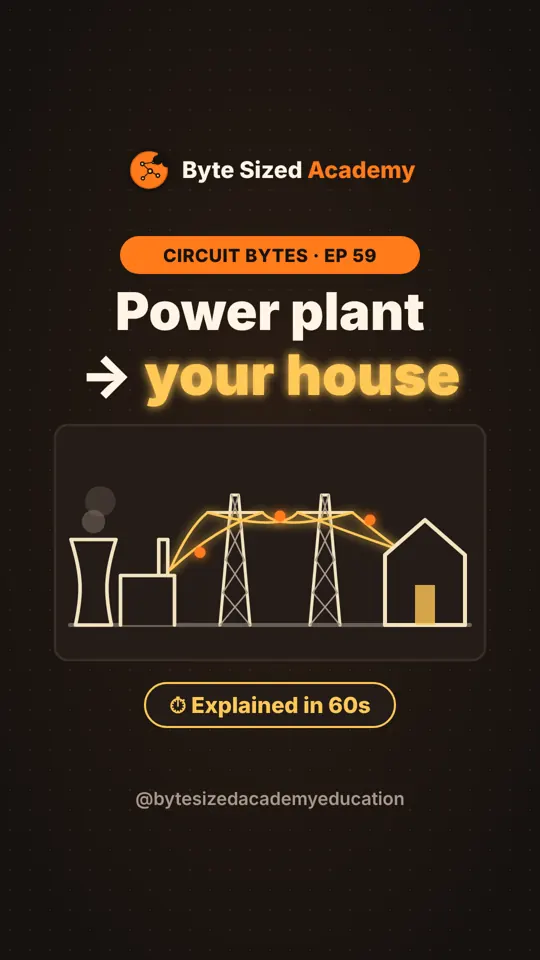 Circuit Bytes · EP59c
"How electricity gets to your house"
Electricity leaves a power plant's generator at about 20,000 volts, gets stepped up to hundreds of thousands of volts for long-distance transmission lines, is stepped down at a substation near town for the street lines, and a pole or pad transformer drops it to 240 and 120 volts for your home.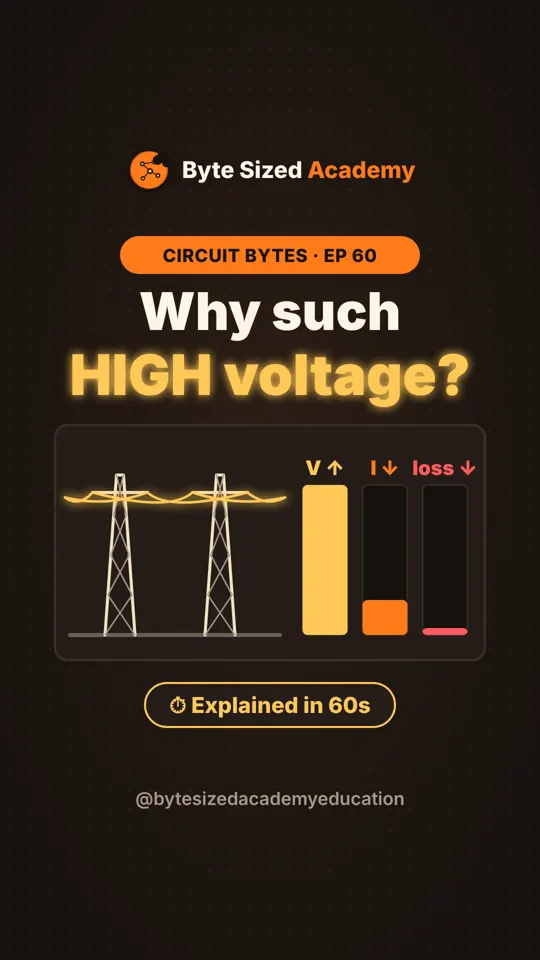 Circuit Bytes · EP60c
"Why power lines use high voltage"
Power is voltage times current, so a higher transmission voltage sends the same power with less current. Wire resistance wastes power as heat at a rate of current squared times resistance, so ten times the voltage gives a tenth the current and one hundredth of the loss.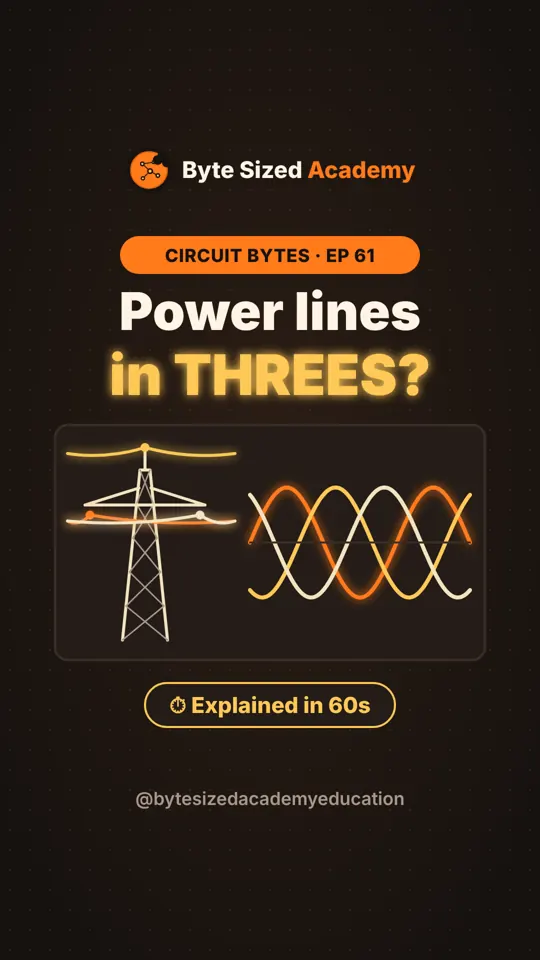 Circuit Bytes · EP61c
"Three-phase power"
A single AC wire's voltage passes through zero twice every wave, so its power comes in pulses. Three-phase power uses three waves a third of a turn apart, so the total power stays smooth for motors and the return currents cancel, letting three wires do the job of six.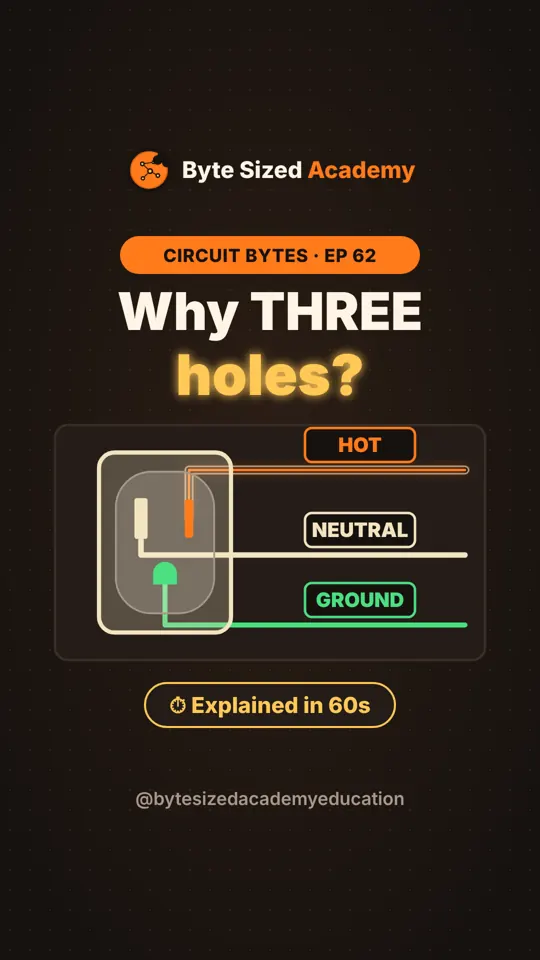 Circuit Bytes · EP62c
"Home wiring: hot, neutral, ground"
A North American wall outlet has three holes because three wires run to it. The hot wire carries 120 volts out from the panel, the neutral carries the current back, and the ground normally carries nothing, but gives fault current an easy path so the breaker trips instead of shocking you.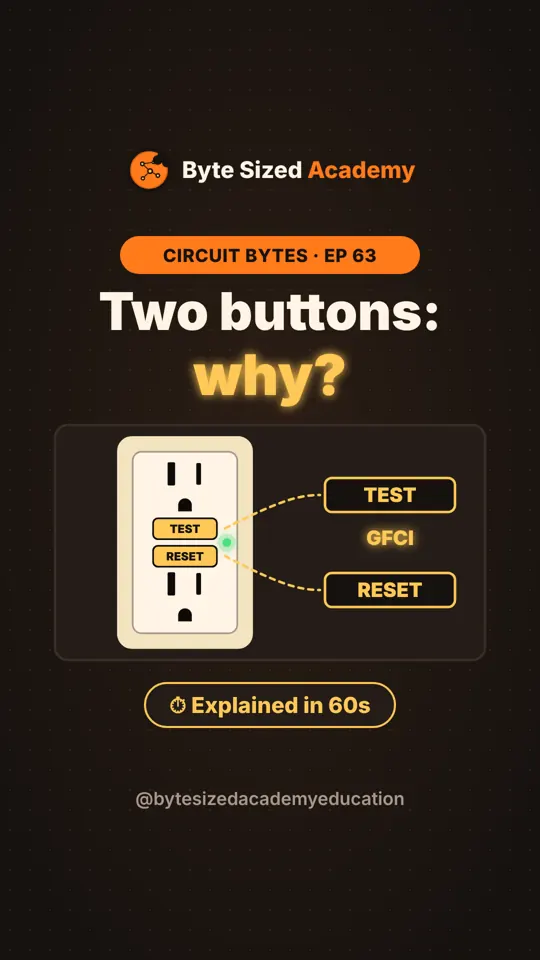 Circuit Bytes · EP63c
"GFCI outlets"
A GFCI (ground fault circuit interrupter) outlet compares the current going out on the hot wire with the current coming back on the neutral. If about 5 milliamps go missing, for example leaking through a person to a wet floor, it cuts the power in a split second. That's why GFCIs are required near water, and why you should press TEST every month.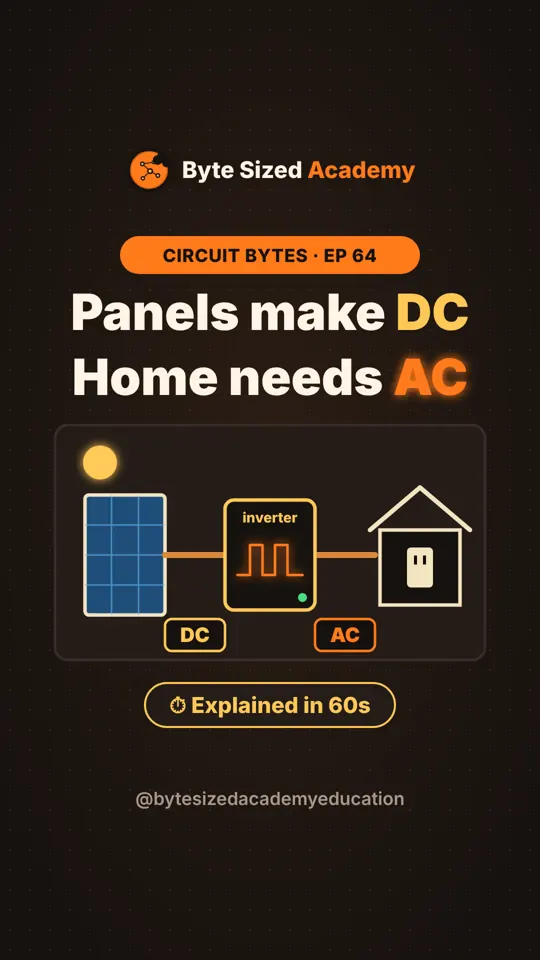 Circuit Bytes · EP64c
"Solar panels and inverters"
A solar cell is a slice of silicon that turns sunlight into direct current, about half a volt per cell, so a panel chains dozens of cells together. Your house runs on alternating current, so an inverter switches the DC very fast to build a smooth AC wave that matches the grid, and shuts off when the grid goes down to protect line workers.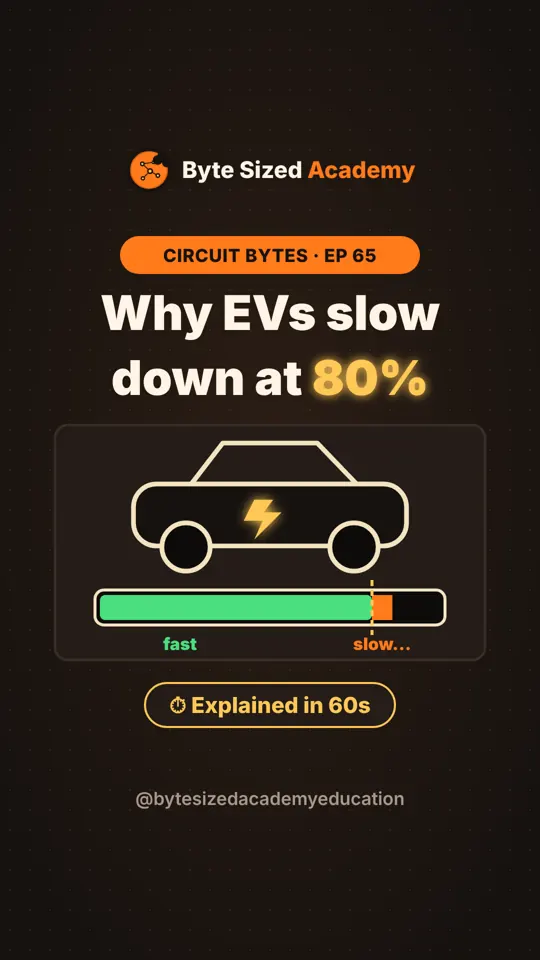 Circuit Bytes · EP65c
"EV batteries and charging"
An electric car's lithium-ion battery stores DC. At home the car's on-board charger turns AC into DC slowly, while a fast charger converts inside the station and pours DC straight in. Charging is fast while the battery is low, then slows near full because the voltage reaches a safe limit and the current has to taper off to protect the cells.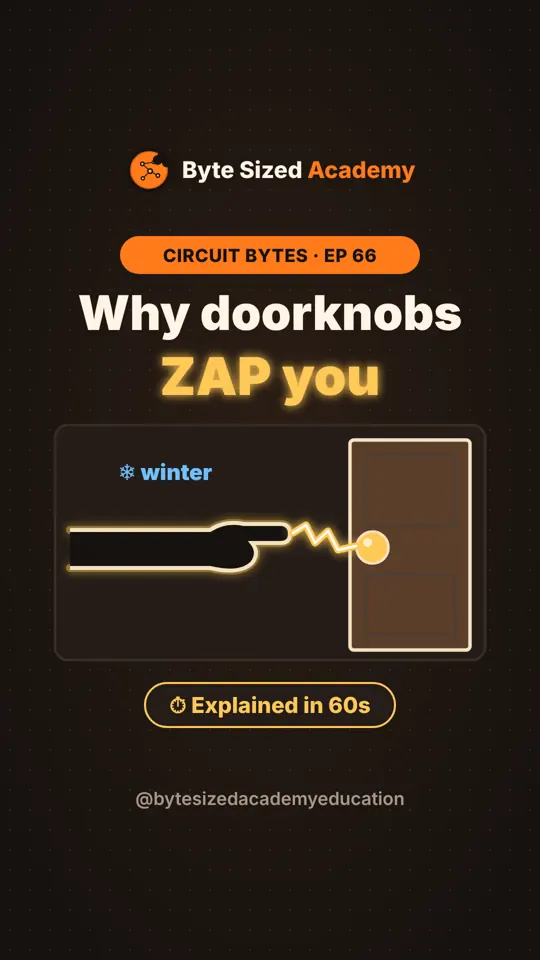 Circuit Bytes · EP66c
"Static electricity"
Atoms hold positive protons and negative electrons that usually balance. Rubbing two different materials, like shoes on a carpet, moves electrons from one onto the other, leaving you charged. That charge stays put, which is why it's called static, until you touch a metal doorknob and it jumps the gap in a tiny spark of thousands of volts that lasts only an instant. Dry winter air lets more charge build up.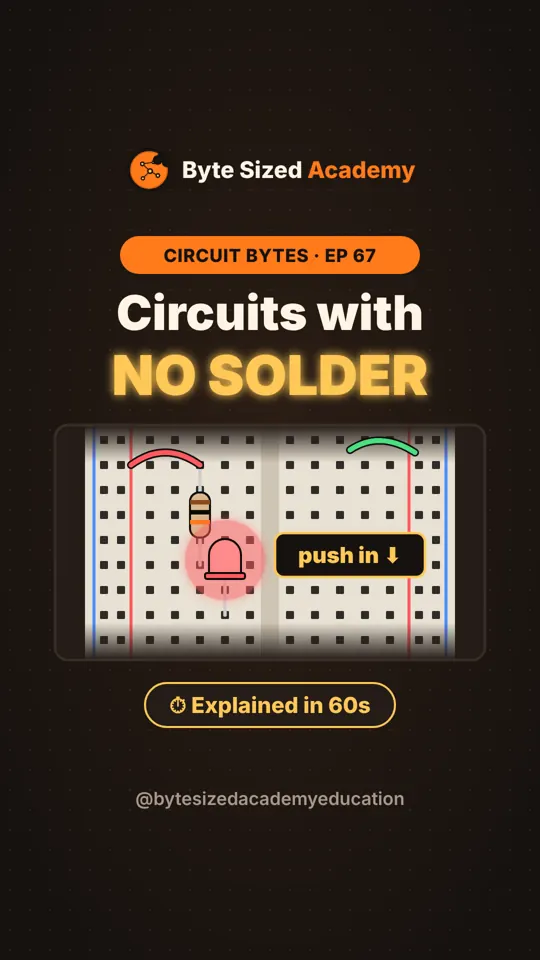 Circuit Bytes · EP67c
"Breadboards: circuits without solder"
A breadboard is a plastic board full of holes with spring metal clips underneath, so you can build a circuit without solder. Each short row of five holes is joined by one metal strip, a gap down the middle lets a chip sit across it with each leg in its own row, and long rails along the edges carry power and ground. Breadboards are for battery circuits, never wall power.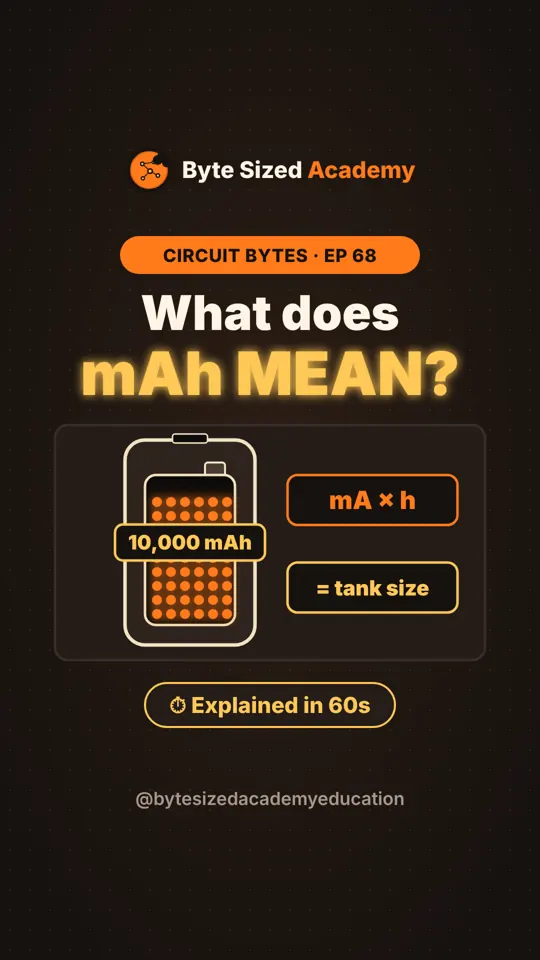 Circuit Bytes · EP68c
"Battery capacity: what mAh means"
A milliamp-hour (mAh) rating tells you how much charge a battery holds, like the size of a fuel tank. It means milliamps times hours, so a 1,000 mAh battery can give 1,000 milliamps for one hour or 100 milliamps for ten hours. Real batteries give a bit less when they are cold, old or drained fast, and a power bank loses some energy inside, so your phone gets less than the label number.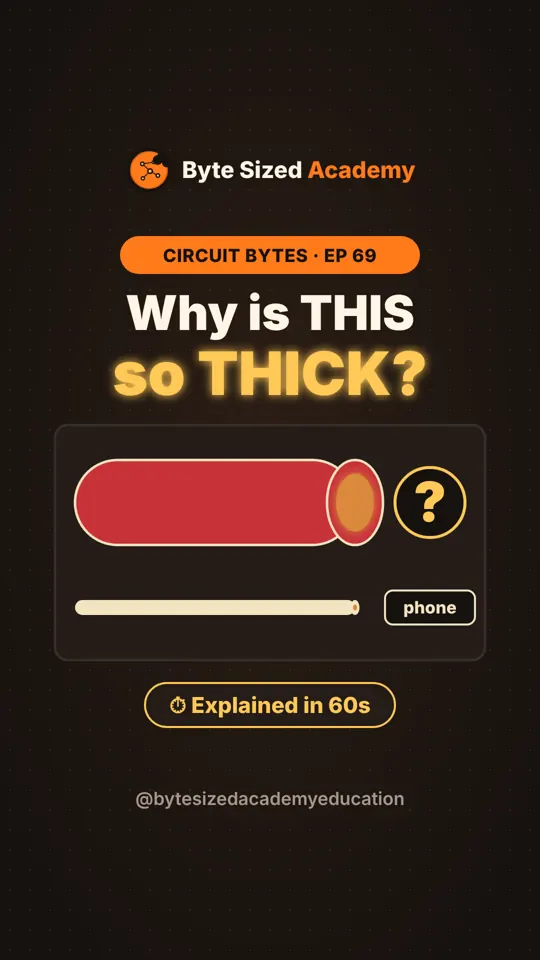 Circuit Bytes · EP69c
"Wire gauge: why thicker wire carries more"
A thicker wire has less resistance, so the same current makes less heat in it. Push too much current through a thin wire and it overheats, which can melt its coating and start a fire. Wire thickness is called gauge, and in the American Wire Gauge system a smaller number means a thicker wire, which is why jumper cables that carry hundreds of amps are far thicker than a phone cable that carries a few.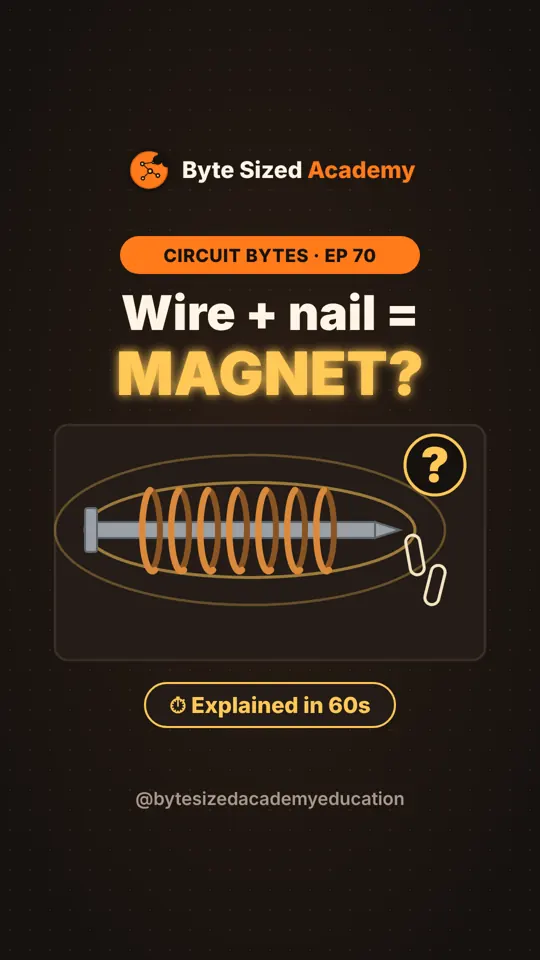 Circuit Bytes · EP70c
"Electromagnets"
Any wire carrying current makes a weak magnetic field. Coil the wire and the fields of all the loops add up, slide an iron nail inside and the field gets much stronger: that is an electromagnet. Switch off the current and most of the magnetism goes away, so it is a magnet you can turn on and off, used in scrapyard cranes, relays, door locks and speakers.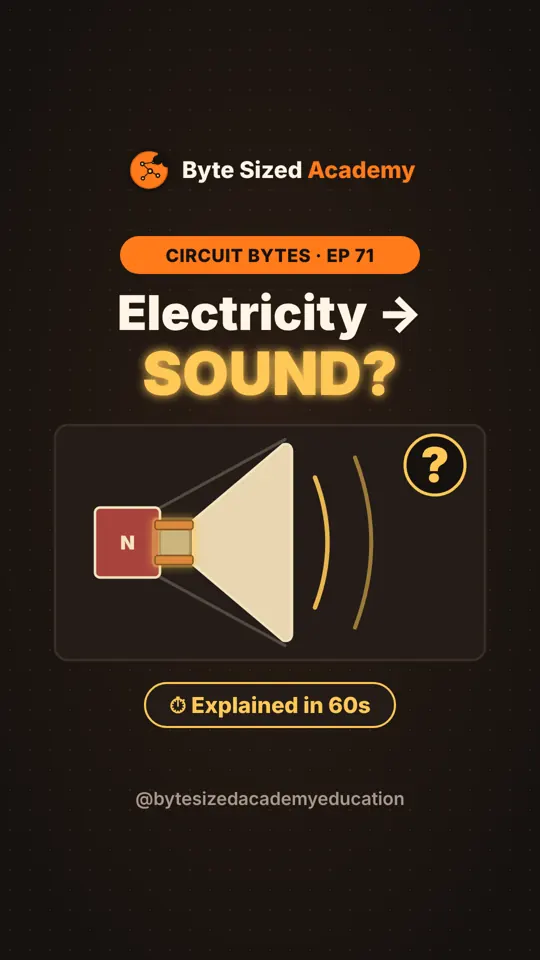 Circuit Bytes · EP71c
"How a speaker makes sound"
Sound is air pushed back and forth. Inside a speaker, a paper cone is attached to a voice coil that sits around a strong magnet. Current makes the coil an electromagnet, so the magnet pushes it out or pulls it in depending on the current's direction. Music flips the current hundreds or thousands of times a second, so the cone shakes and pushes sound waves through the air to your ear.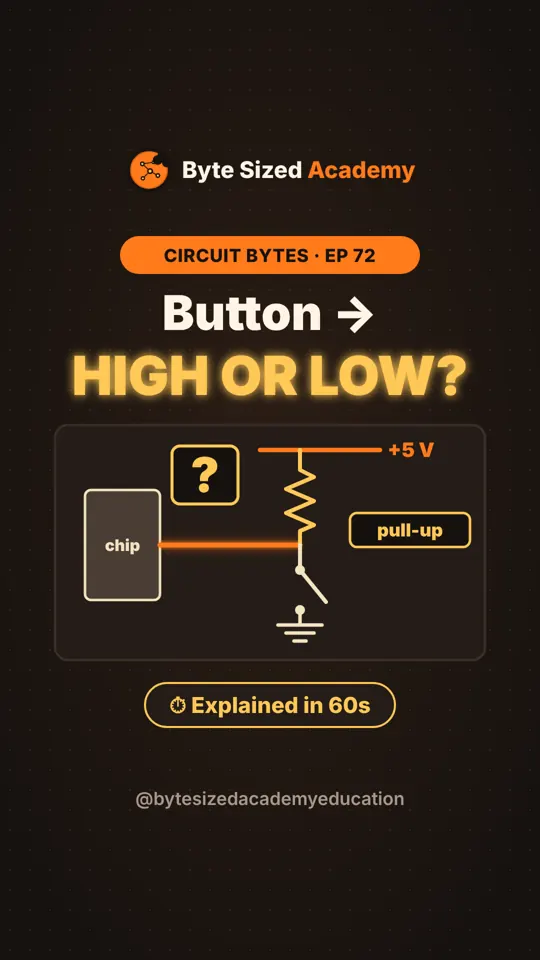 Circuit Bytes · EP72c
"Pull-up and pull-down resistors"
A microcontroller pin reads voltage, high as 1 and low as 0. A button to ground alone leaves the pin floating when it is released, so it reads random 1s and 0s. A pull-up resistor to the supply holds the pin high until the button pulls it to ground, and a pull-down resistor does the opposite.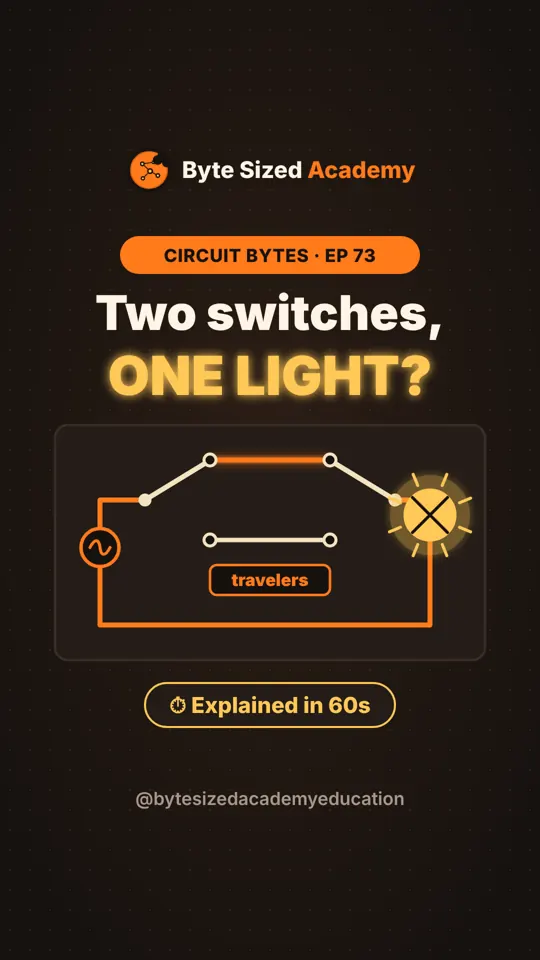 Circuit Bytes · EP73c
"Three-way switches"
A three-way switch has no off position; it always connects its common terminal to one of two travelers. With two of them, the light is on when both pick the same traveler and off when they pick different ones, so either switch can change the light.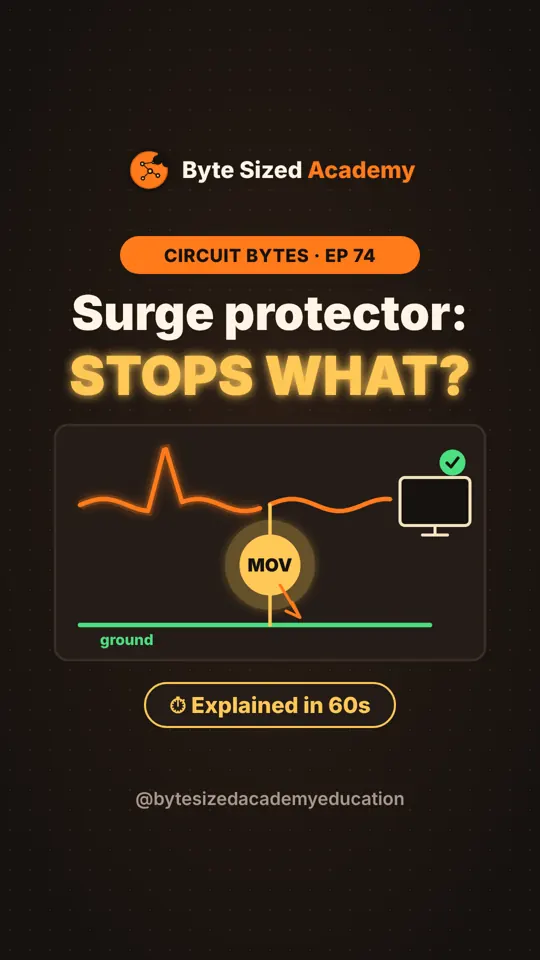 Circuit Bytes · EP74c
"Surge protectors"
A surge is a sudden voltage spike far above the normal 120 V. Inside a surge protector, a varistor blocks current at normal voltage, but when a spike hits its resistance drops and it diverts the extra current to the ground wire, away from your devices. Each surge wears it down, and it can't stop direct lightning.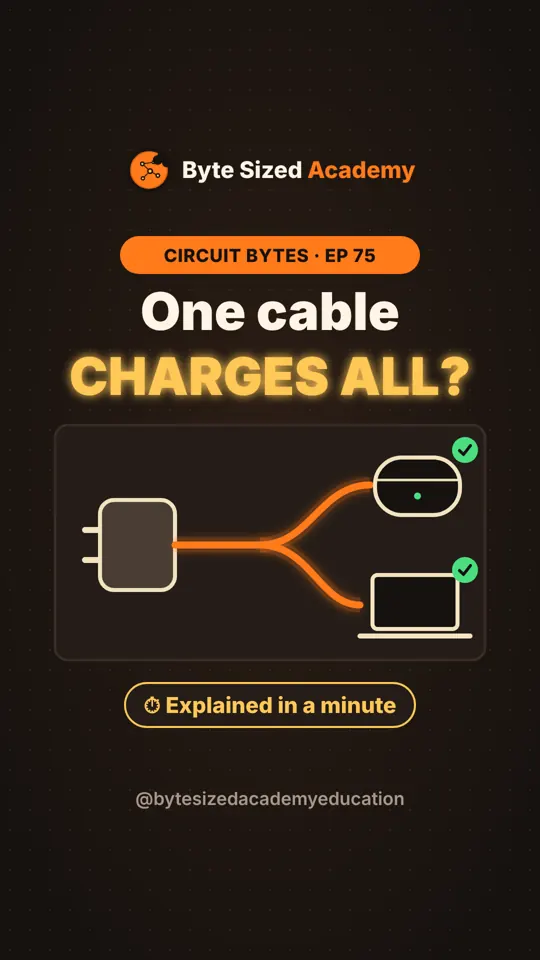 Circuit Bytes · EP75c
"USB power: why one cable charges everything"
Power is voltage times current, and a laptop needs many times more than earbuds. With USB Power Delivery, the charger and the device talk first over the USB-C cable. Every connection starts at a safe 5 V, the charger offers a menu of voltages, and the device asks for one, so the charger raises the voltage only when asked.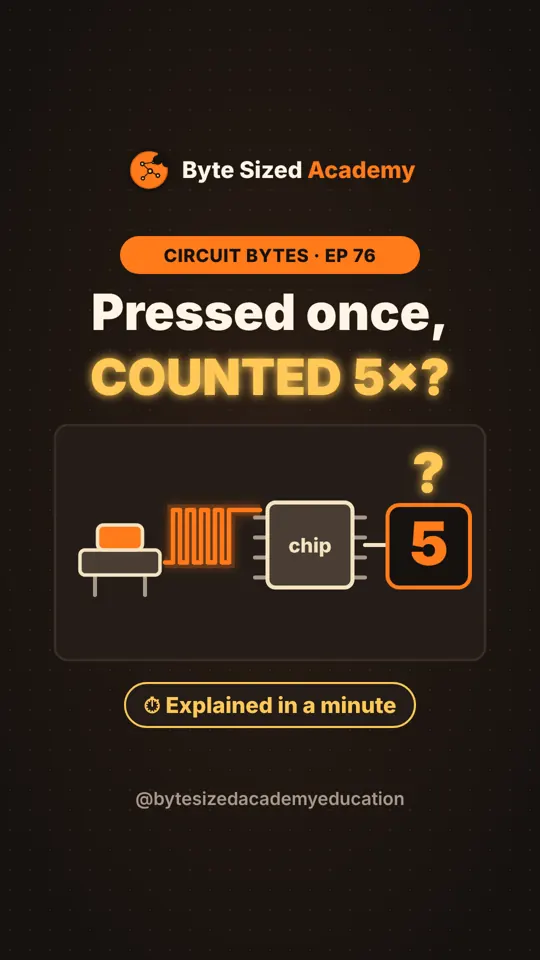 Circuit Bytes · EP76c
"Debouncing a button"
Inside a push button, two metal contacts bounce for a few milliseconds when they close, and a chip is fast enough to see every bounce, so one press can count as several. Debouncing fixes it: in code, wait about 20 ms and check again; in hardware, a resistor and capacitor smooth the bounces into one clean change.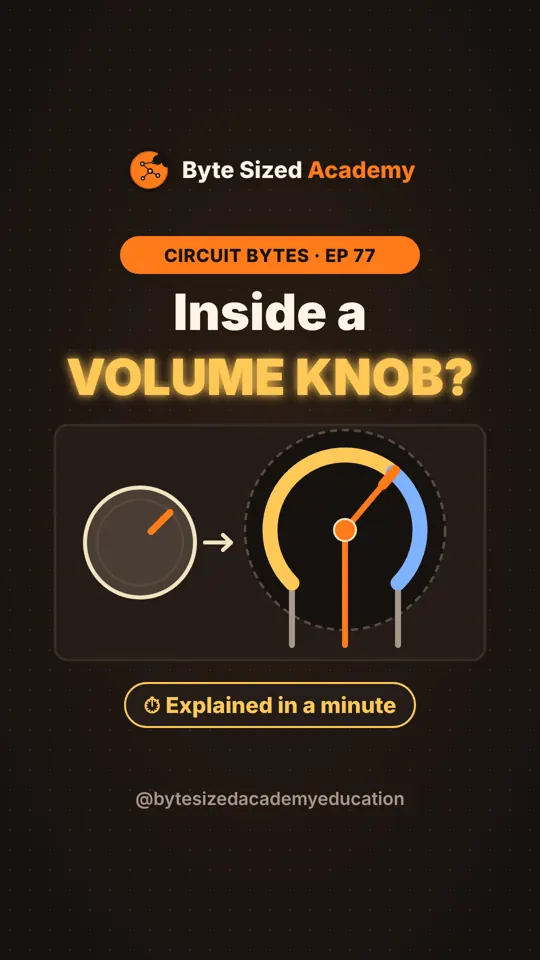 Circuit Bytes · EP77c
"Potentiometers: the volume knob"
A potentiometer is a resistor you adjust by turning. A curved resistive strip sits between two end pins, with a fixed resistance end to end, and the middle pin connects to a wiper that slides along the strip. Turning it shifts resistance from one side of the wiper to the other, and with a battery across the ends the wiper gives any voltage from zero up to the battery's.History Bytes
99 lessons · swipe for moreShort, map-based lessons on early North American history, from the nations who lived here first to the founding of the United States and Canada.
 History Bytes · EP01h
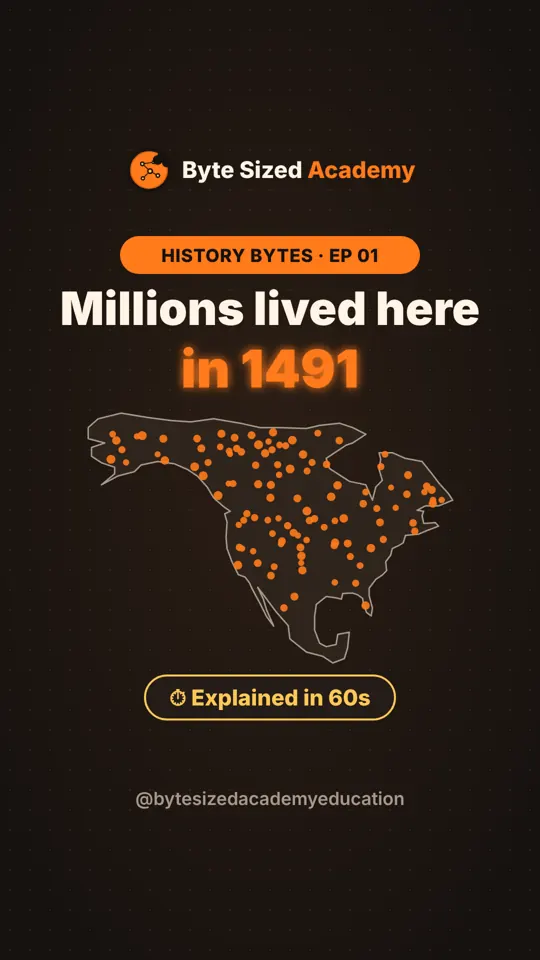
North America in 1491
In 1491, the year before Columbus sailed, millions of people already lived in North America, in hundreds of nations that spoke hundreds of languages and lived in very different ways.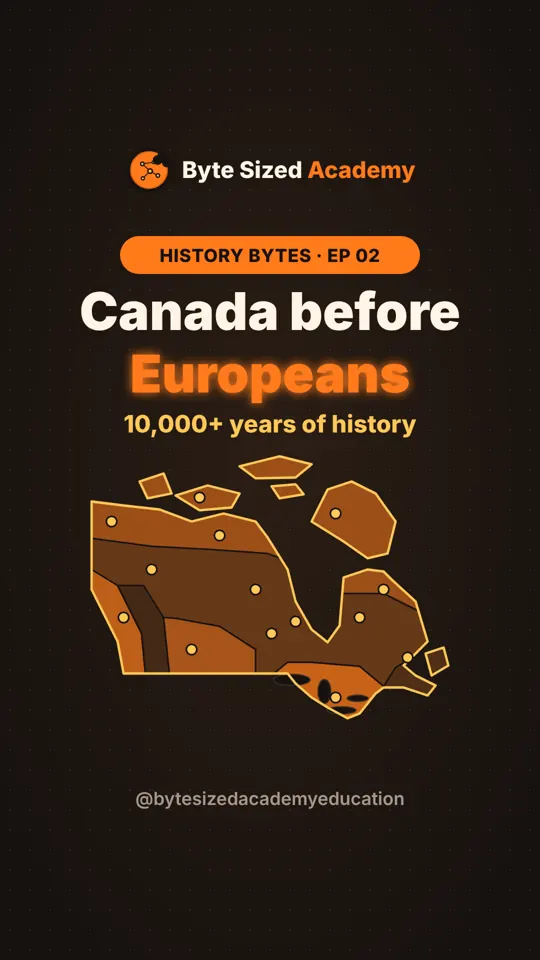 History Bytes · EP02h
Canada before Europeans
People lived in what is now Canada for more than 10,000 years before any European ship arrived. Around 1500, many nations with their own languages, laws and ways of life lived across the land.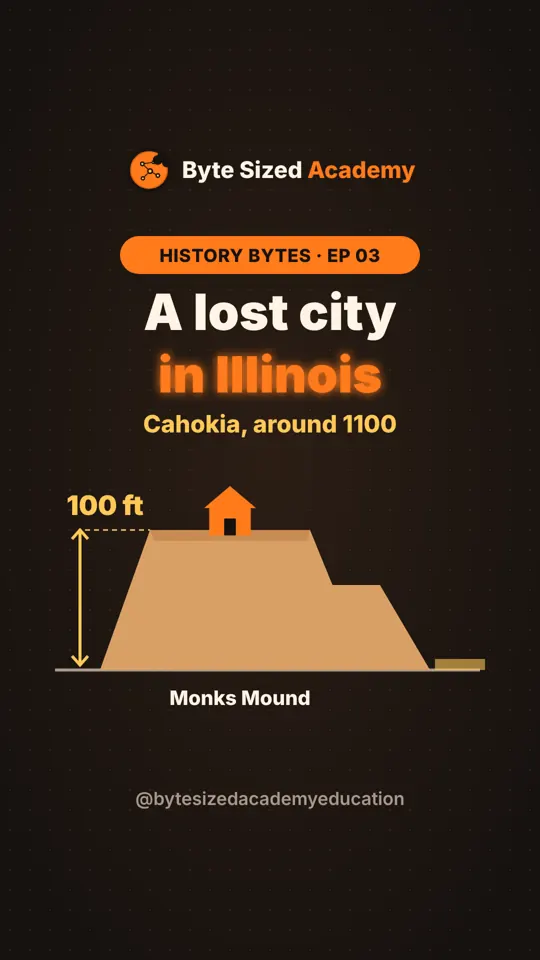 History Bytes · EP03h
Cahokia
Around 1100, Cahokia, near today's St. Louis, was home to 10,000 to 20,000 people and more than 100 earthen mounds. By about 1350 it was mostly empty, and historians still debate why.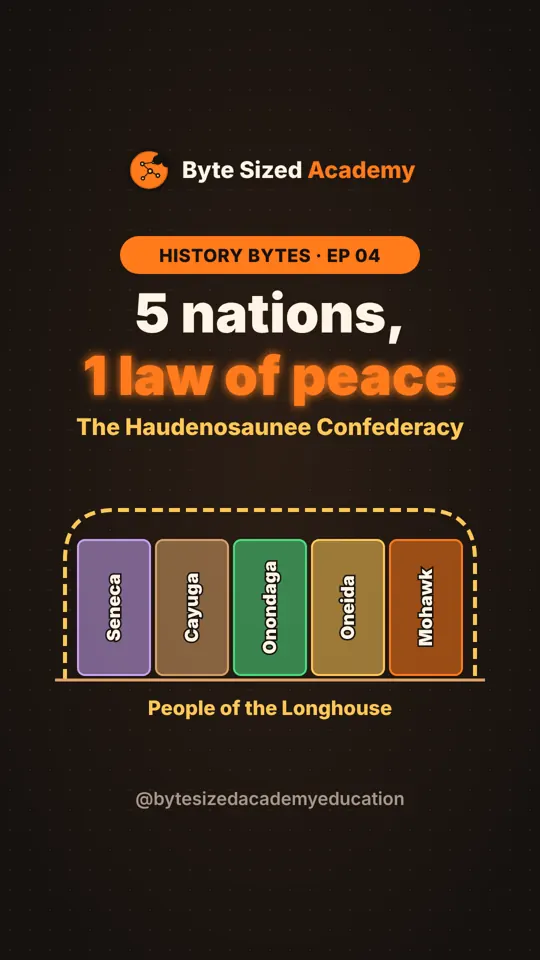 History Bytes · EP04h
The Haudenosaunee Confederacy
Five Haudenosaunee nations in what is now upstate New York joined under the Great Law of Peace, with a shared council and clan mothers who choose the chiefs. The Tuscarora joined in 1722, and the Confederacy still exists today.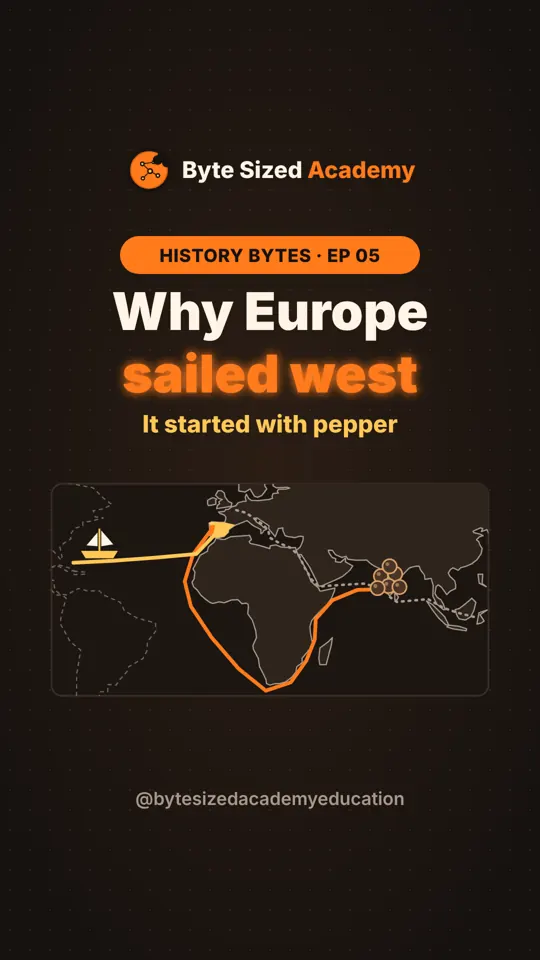 History Bytes · EP05h
Why Europe sailed west
In the 1400s, spices from India and Southeast Asia reached Europe through a long chain of middlemen, each adding a markup. Portugal and Spain, shut out of those profits, looked for their own sea routes to Asia: Portugal around Africa, Spain west across the Atlantic.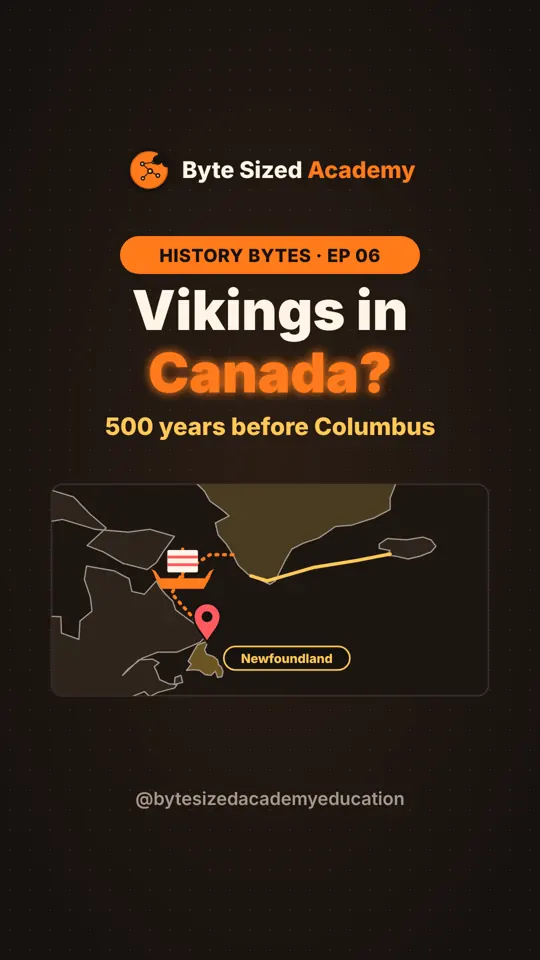 History Bytes · EP06h
Vikings in Canada
Norse sailors from Greenland reached North America about 500 years before Columbus. Their camp at L'Anse aux Meadows, Newfoundland, found in 1960, held eight sod-and-wood buildings and an iron forge, and tree rings prove they were there in 1021.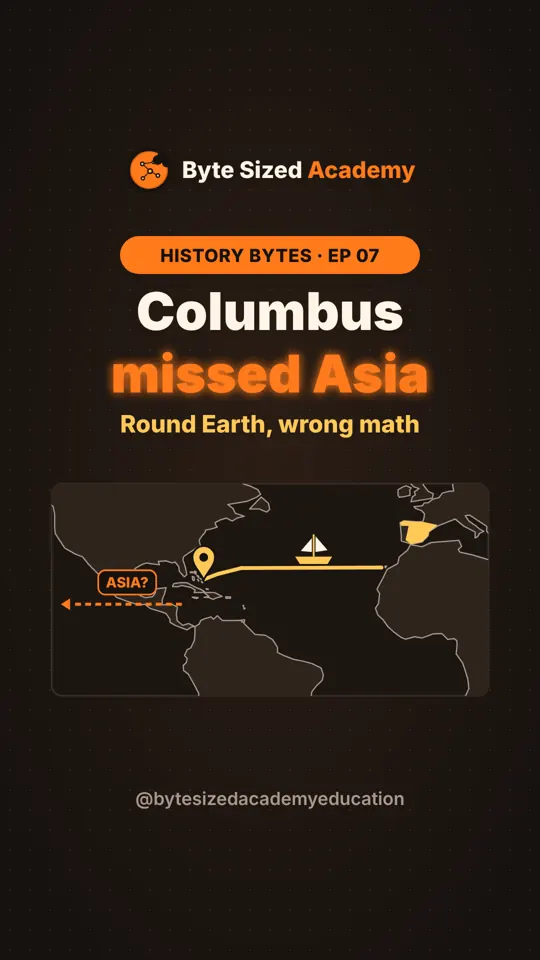 History Bytes · EP07h
Columbus, 1492
In 1492, Columbus sailed west from Spain to reach Asia. His mistake wasn't a flat Earth but bad math: he thought the Earth was much smaller, so two continents he didn't expect stood in the way. He landed in the Bahamas, on an island its Taíno people called Guanahani.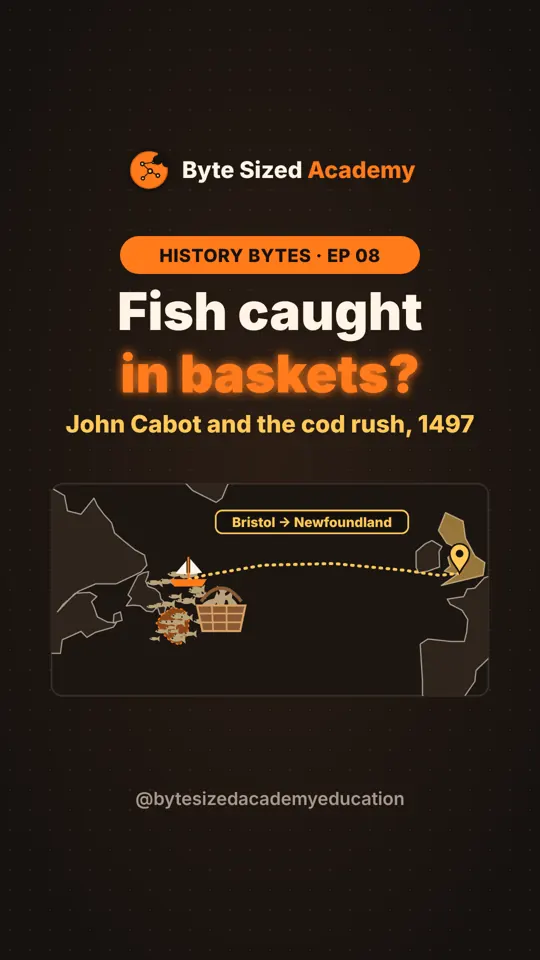 History Bytes · EP08h
John Cabot and the cod rush
In 1497, John Cabot sailed west from Bristol for England's king, looking for Asia. He reached land somewhere around Newfoundland and found no gold, but his crew's stories of seas thick with cod drew fishing fleets to the Grand Banks for centuries.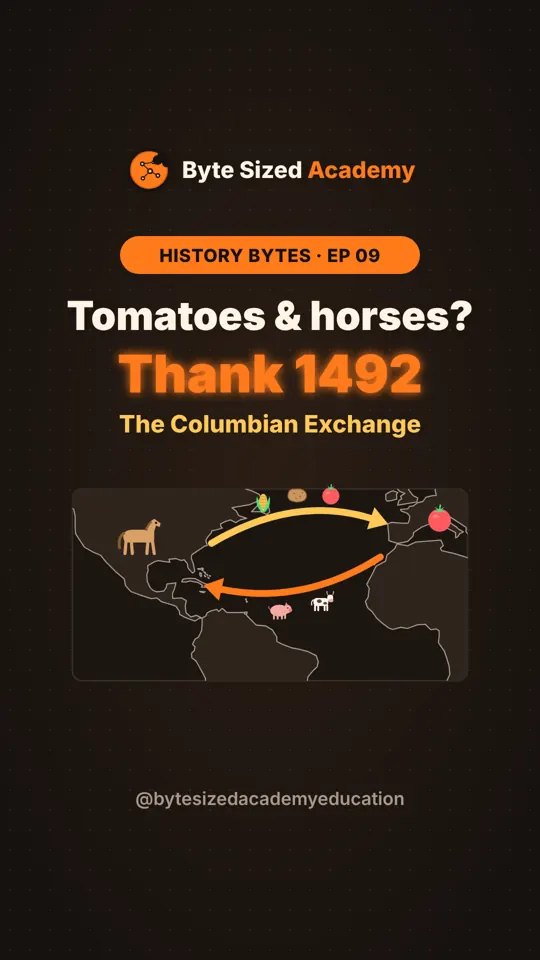 History Bytes · EP09h
The Columbian Exchange
After 1492, ships carried plants, animals and germs both ways across the Atlantic. Corn, potatoes and tomatoes spread to the world; wheat, cattle and horses came to the Americas, and new diseases killed millions of Indigenous people.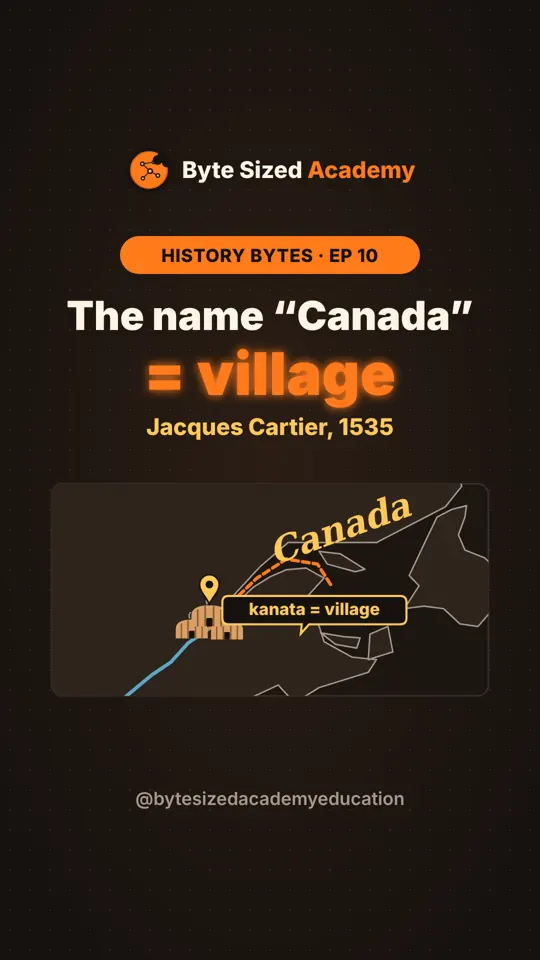 History Bytes · EP10h
Jacques Cartier and the name "Canada"
The name Canada comes from kanata, a St. Lawrence Iroquoian word for "village." In 1535, two young men from Stadacona, taken to France by Jacques Cartier the year before, used the word for their home, and Cartier wrote it down as "Canada."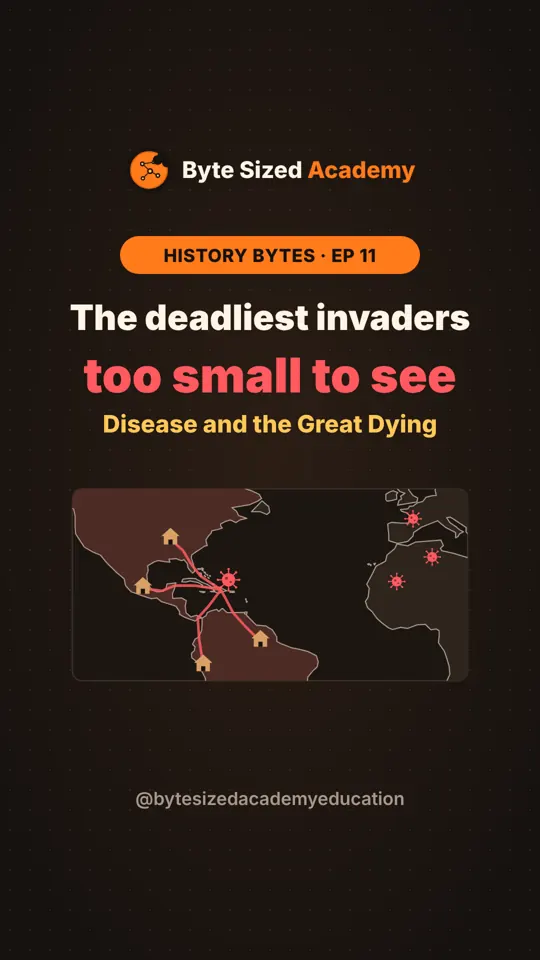 History Bytes · EP11h
Disease and the Great Dying
After 1492, smallpox, measles and influenza reached the Americas, where no one had immunity. Together with war, forced labor and hunger, these epidemics caused a population collapse some call the Great Dying.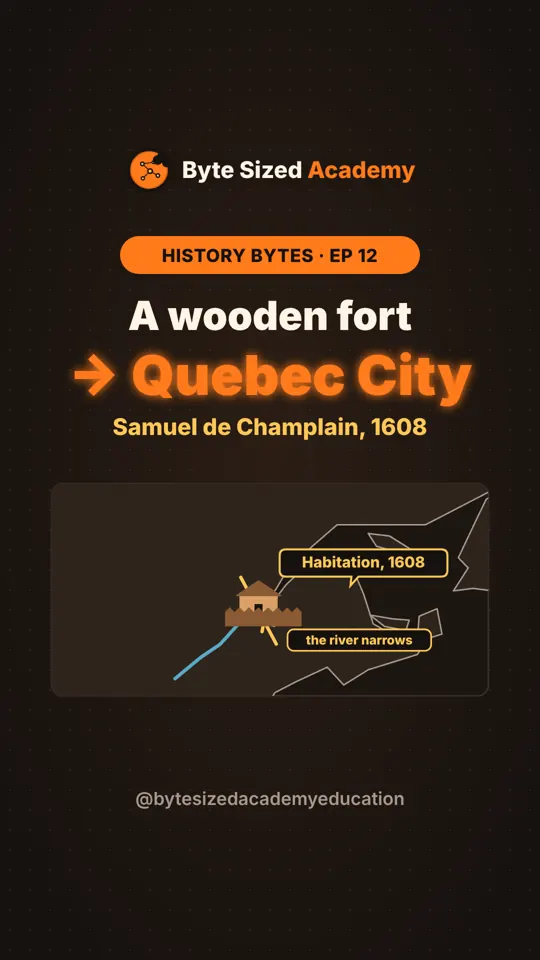 History Bytes · EP12h
Champlain founds Quebec, 1608
In 1608 Samuel de Champlain built a fortified fur post, the Habitation, where the St. Lawrence River narrows. Most of his men died the first winter, but with Innu, Algonquin and Wendat trading partners the post grew into Quebec City.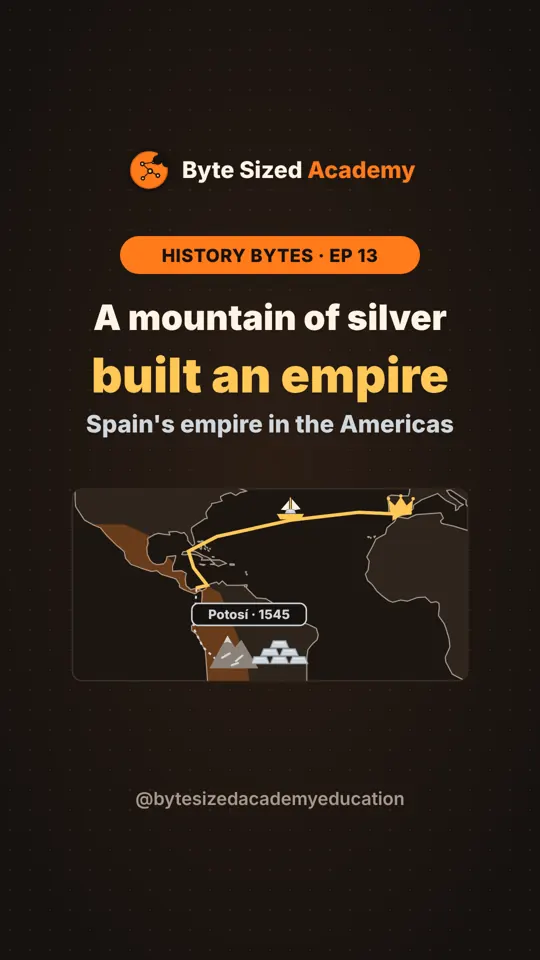 History Bytes · EP13h
Spain's empire in the Americas
Spain was the first European power to build a large empire in the Americas. Conquest of the Aztec and Inca empires, and silver mined by forced Indigenous labor at Potosí, made it rich, and viceroys ruled for the king.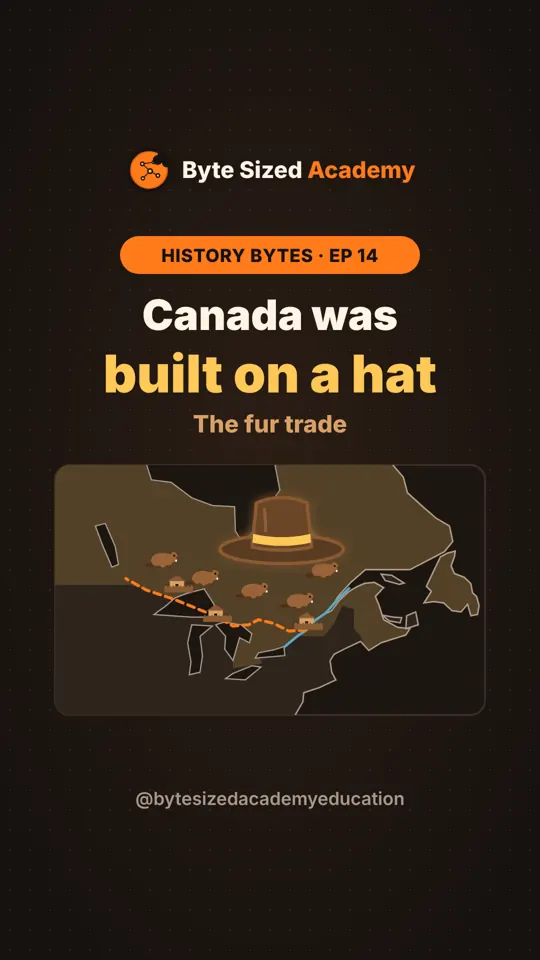 History Bytes · EP14h
The fur trade
European demand for beaver hats drove the fur trade. Indigenous hunters trapped beavers and traded the pelts to French and later British traders for metal goods and cloth, and the search for more beaver pushed traders inland, building the posts and alliances that shaped Canada.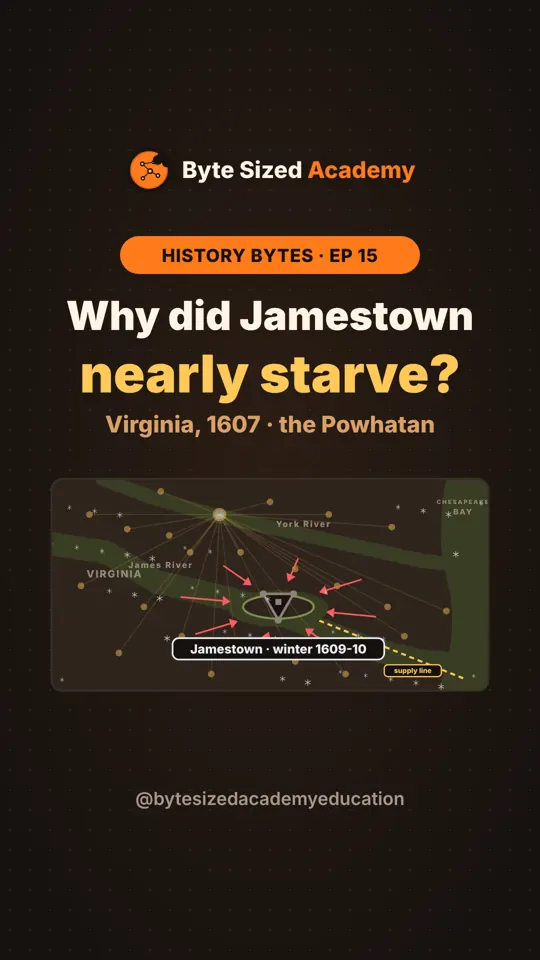 History Bytes · EP15h
Jamestown, 1607
In 1607 English settlers founded Jamestown in the land of the Powhatan. Bad choices, bad water, disease and war with the Powhatan nearly destroyed it, until a supply fleet arrived in 1610.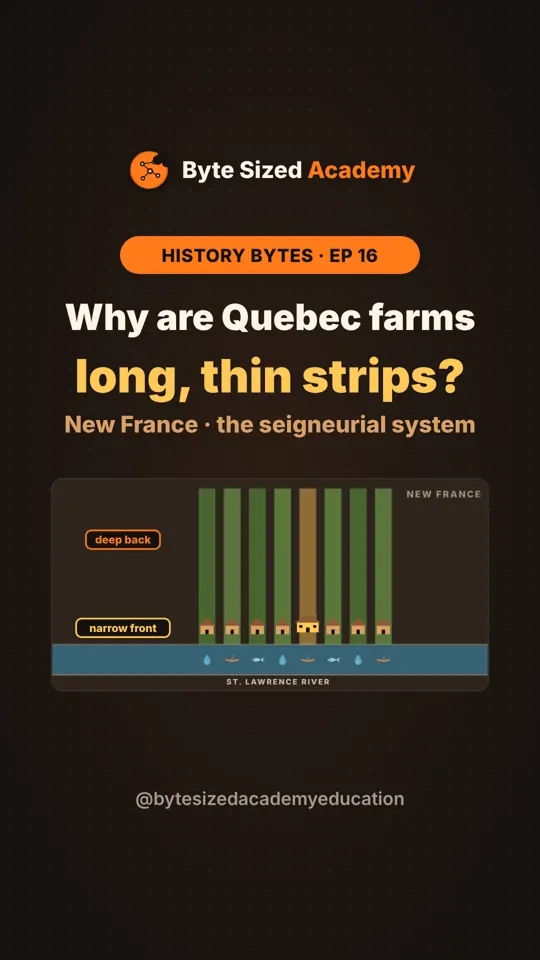 History Bytes · EP16h
The seigneurial system
In New France, land was granted in big blocks called seigneuries and split into farms for settlers. Because the St. Lawrence River was the main road, each farm became a long, thin strip running back from the water, a pattern you can still see today.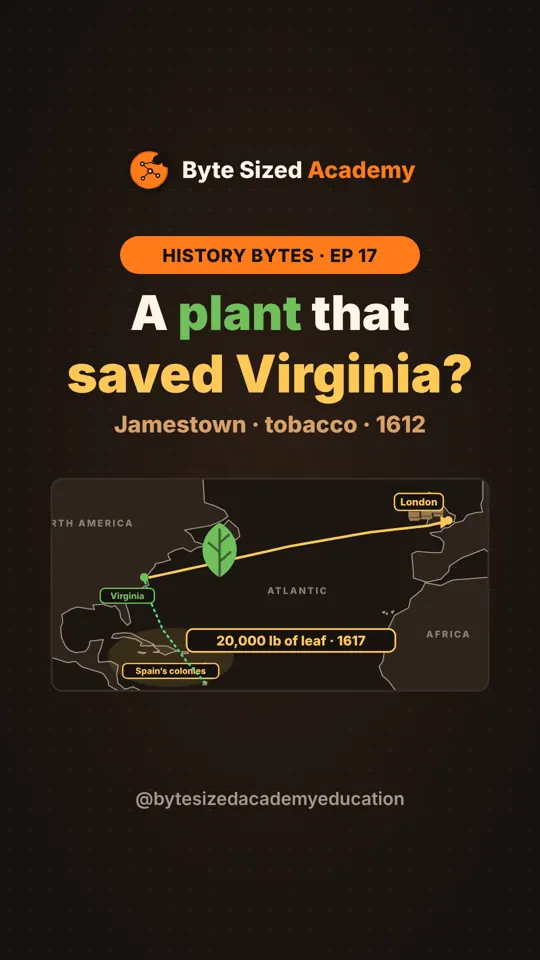 History Bytes · EP17h
Tobacco saves Virginia
Jamestown survived the Starving Time but had nothing to sell. A sweeter tobacco, grown from 1612, made Virginia profitable, set off a land rush onto Powhatan land and drove a huge demand for workers.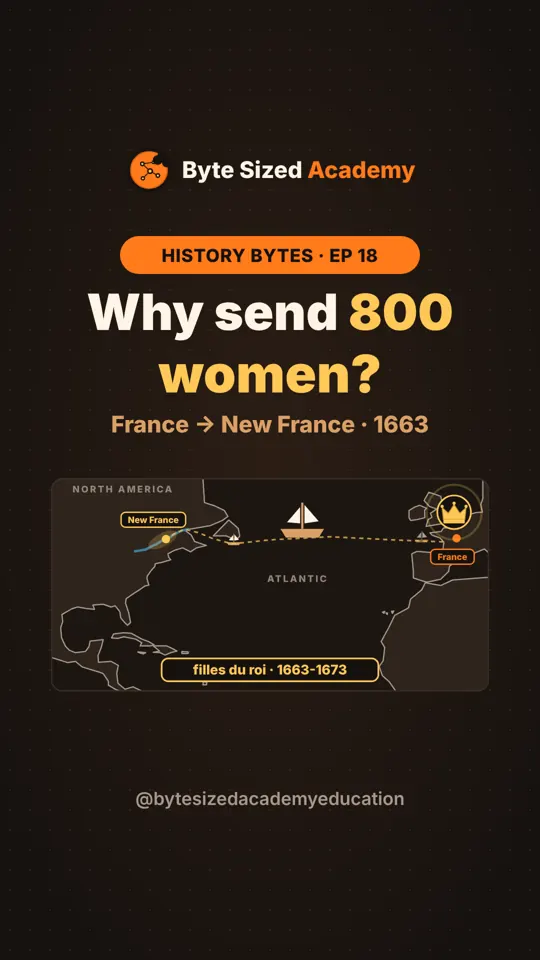 History Bytes · EP18h
The filles du roi
New France had far more men than women, so from 1663 to 1673 the French Crown paid to send about 800 young women to the colony. They married, raised big families, and millions of people today descend from them.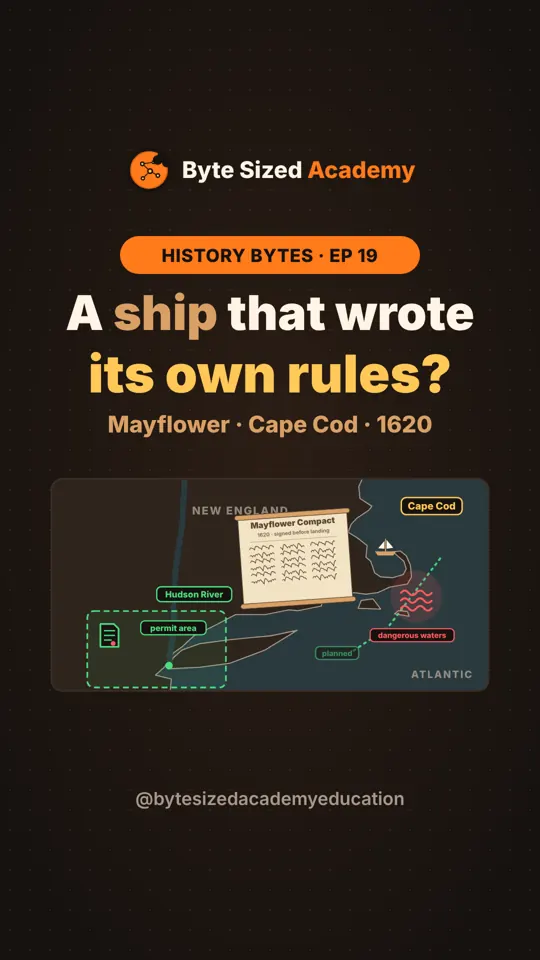 History Bytes · EP19h
Pilgrims and the Mayflower Compact
In 1620 the Mayflower ended up near Cape Cod, outside the land its passengers had permission to settle. Before going ashore, the men signed a short agreement to make their own laws and obey them, remembered as an early step toward self-government.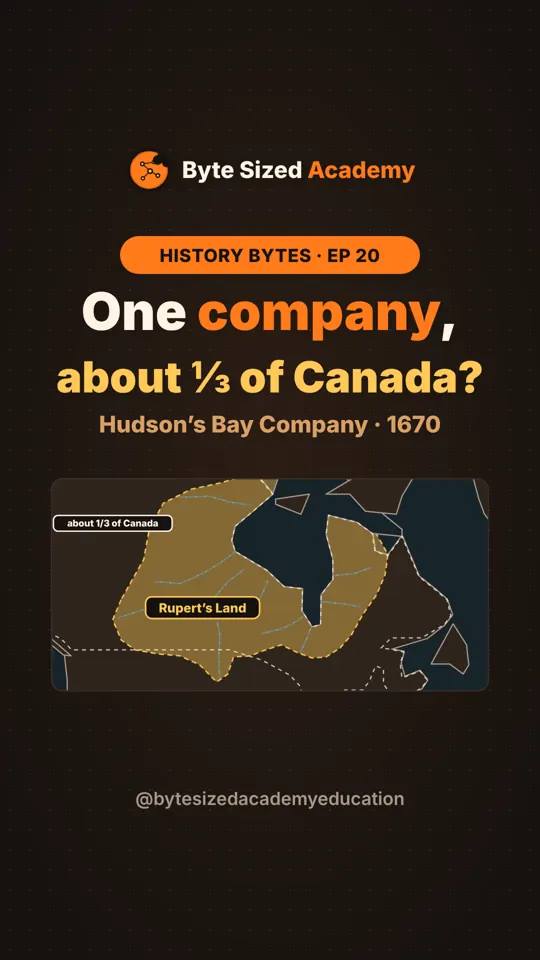 History Bytes · EP20h
The Hudson's Bay Company
Two French fur traders showed England the way to the beaver country around Hudson Bay. In 1670 a royal charter gave the new Hudson's Bay Company sole trading rights over all land draining into the bay, Rupert's Land, about a third of today's Canada, without asking the First Nations who lived there.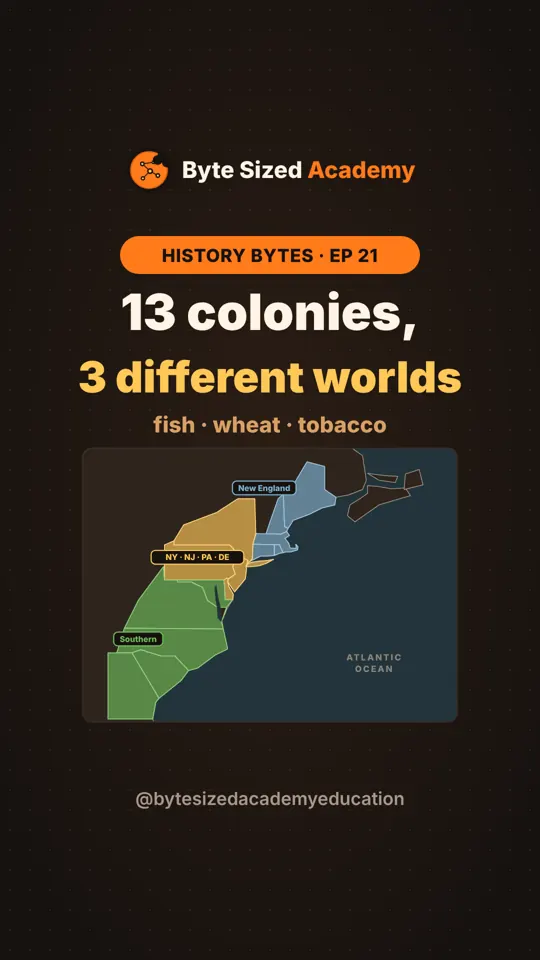 History Bytes · EP21h
The three colonial regions
The thirteen British colonies are usually split into three regions. Land and weather shaped each one: fishing, timber, ships and trade in New England, wheat and grain in New York and Pennsylvania, and plantation cash crops in the South, worked more and more by enslaved Africans.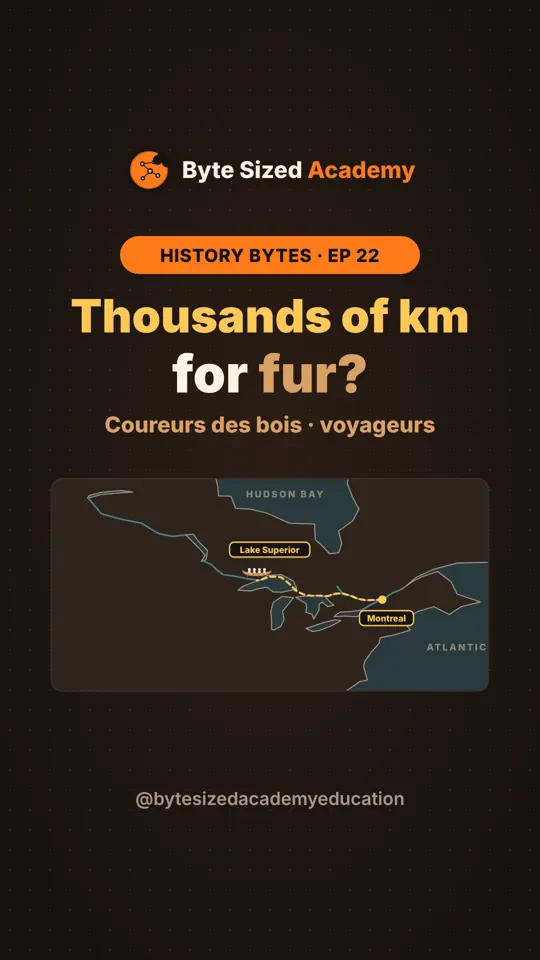 History Bytes · EP22h
Coureurs des bois and voyageurs
In New France, coureurs des bois went into the woods to trade furs with First Nations, often without a licence. Later, licensed voyageurs paddled huge birchbark canoes from Montreal to Lake Superior, and their routes became the highways of the fur trade.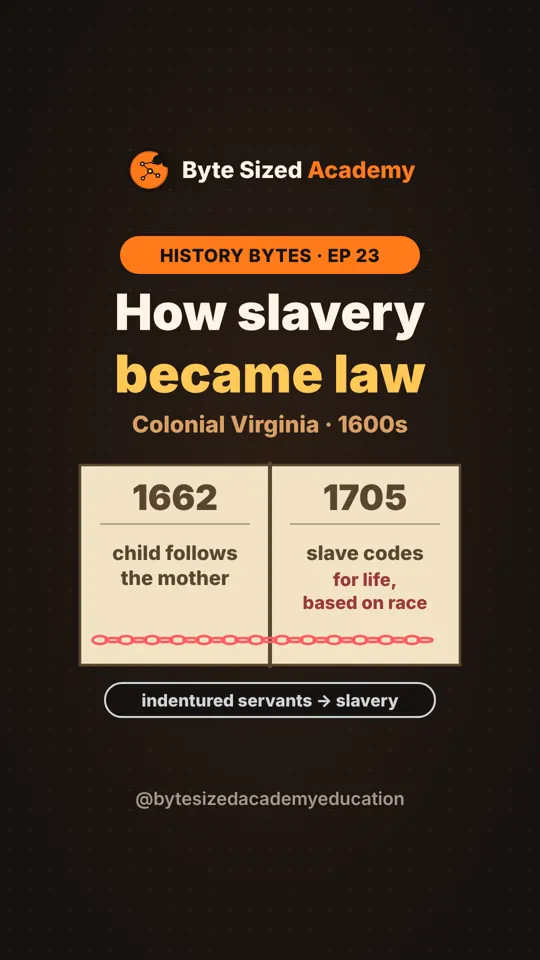 History Bytes · EP23h
From indentured servants to slavery
Early Virginia's tobacco farms ran on indentured servants who worked for a few years and then went free. When the first Africans arrived there were no slave laws, but step by step, through laws in 1662 and 1705, Virginia made slavery lifelong, inherited and based on race.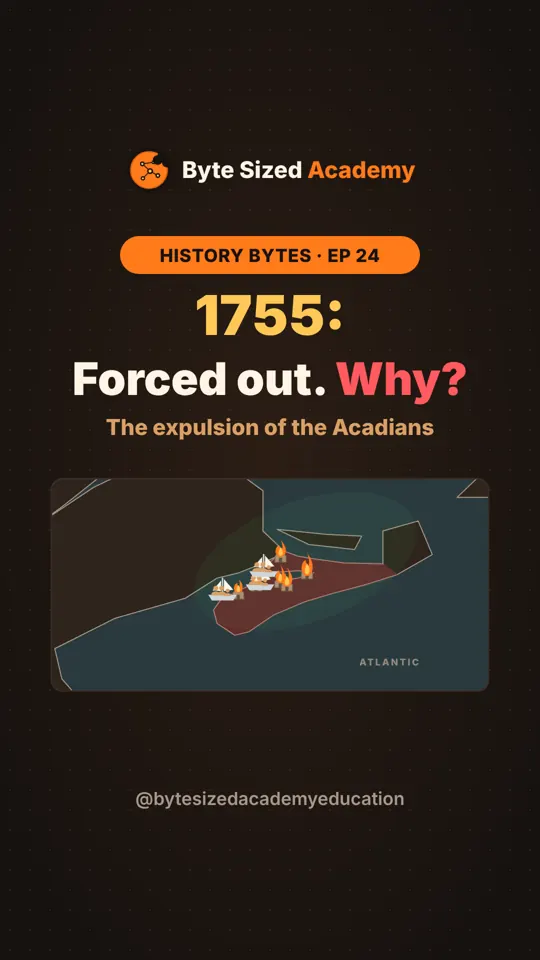 History Bytes · EP24h
The expulsion of the Acadians
In 1755, British officials ordered the French-speaking Acadians out of Nova Scotia after they refused an oath that might force them to fight France. About 10,000 were deported by 1763, families were split up, and many later settled on the Gulf coast, where their descendants became the Cajuns.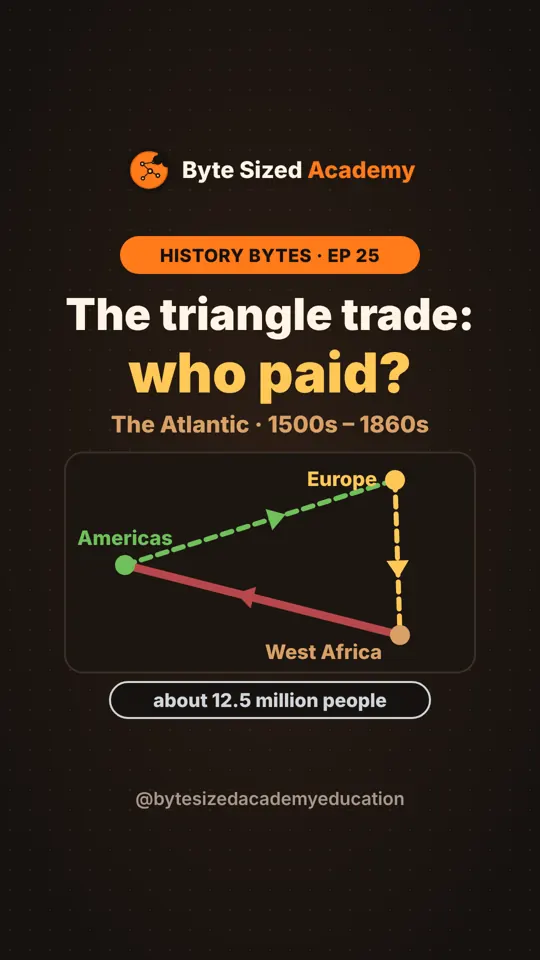 History Bytes · EP25h
The Atlantic slave trade
For more than 300 years, ships sailed a rough triangle across the Atlantic, carrying European goods to West Africa, captured Africans to the Americas, and slave-grown crops back to Europe. About 12.5 million people were forced aboard and well over a million died at sea, while European traders profited.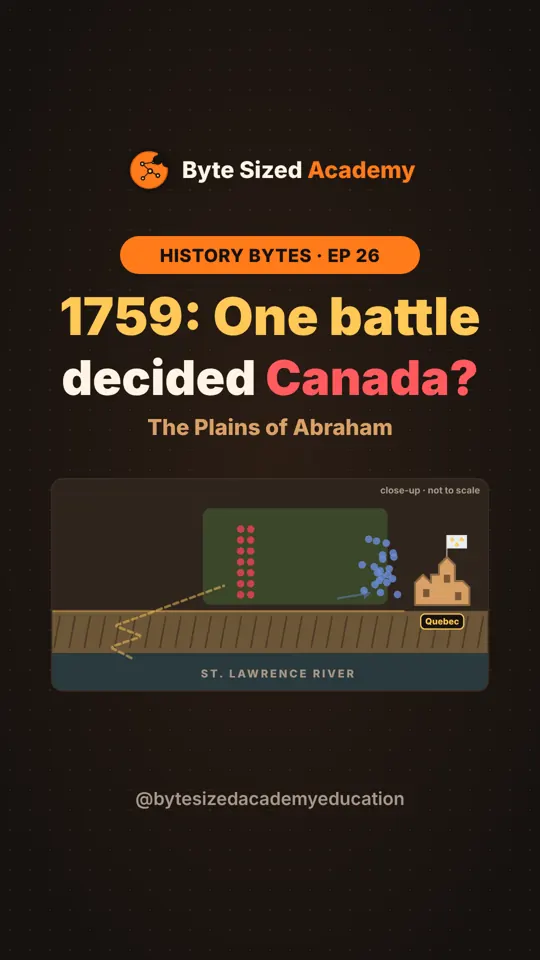 History Bytes · EP26h
The Plains of Abraham, 1759
In 1759 a British army besieged Quebec, the capital of New France. Before dawn on September 13, British soldiers climbed the cliffs onto the Plains of Abraham and won a short, sharp battle in which both generals were fatally wounded. Quebec surrendered days later, and by 1760 New France had fallen to Britain.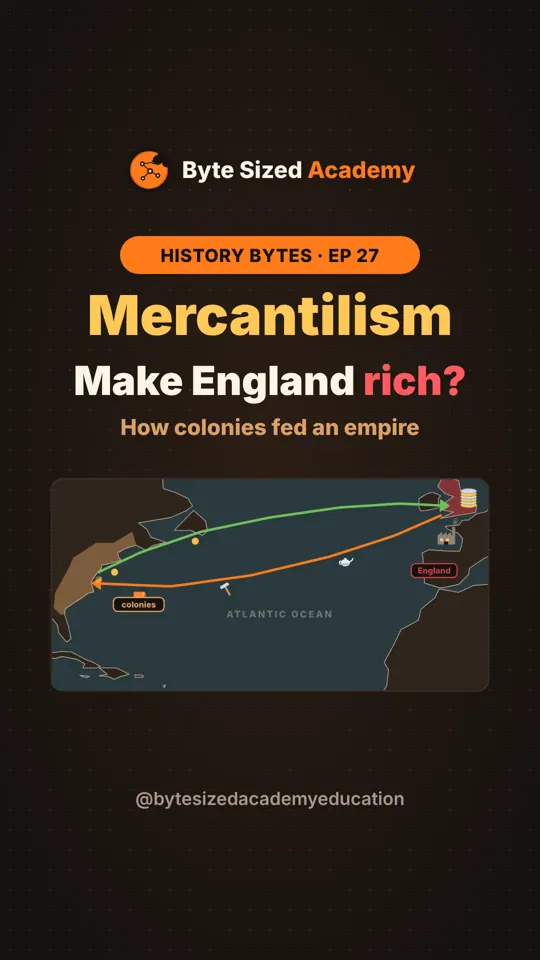 History Bytes · EP27h
Mercantilism
Mercantilism was the idea that a country grew rich by selling more than it bought and piling up gold and silver. England used its American colonies for raw materials and as buyers for its goods, and passed shipping laws to keep the profit at home.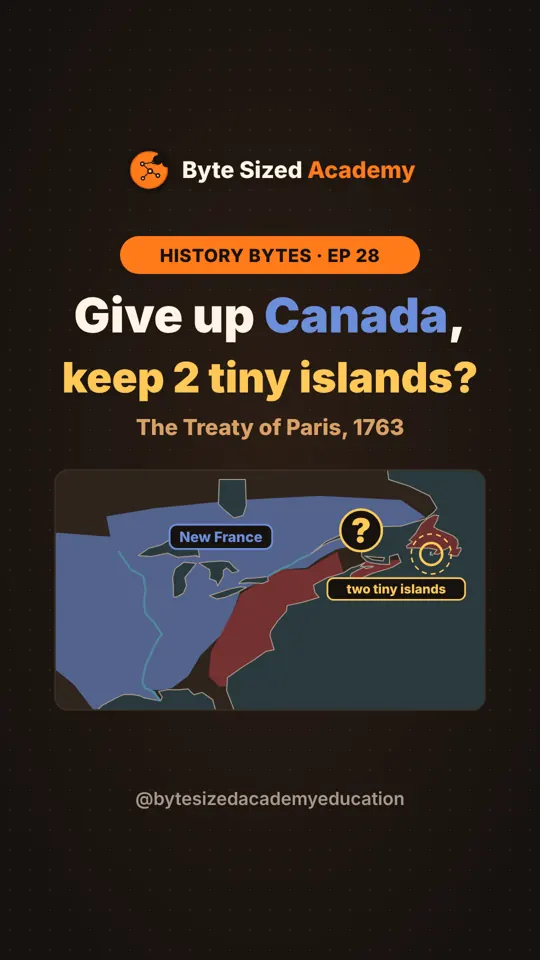 History Bytes · EP28h
The Treaty of Paris, 1763
The Treaty of Paris, signed in February 1763, ended the Seven Years' War. France handed Canada and its lands east of the Mississippi to Britain, Louisiana went to Spain, and France kept its rich Caribbean sugar islands and two tiny islands off Newfoundland for its cod fishers.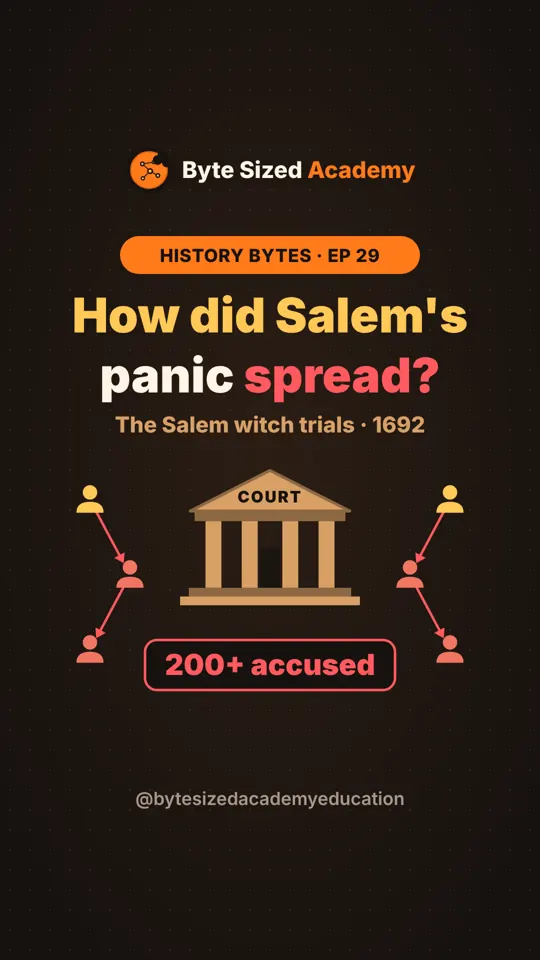 History Bytes · EP29h
The Salem witch trials
In 1692, a few girls in Salem Village, Massachusetts, had strange fits that a doctor blamed on witchcraft. Their accusations spread across the region until more than 200 people were accused, and a special court convicted people on "spectral evidence" from dreams and visions.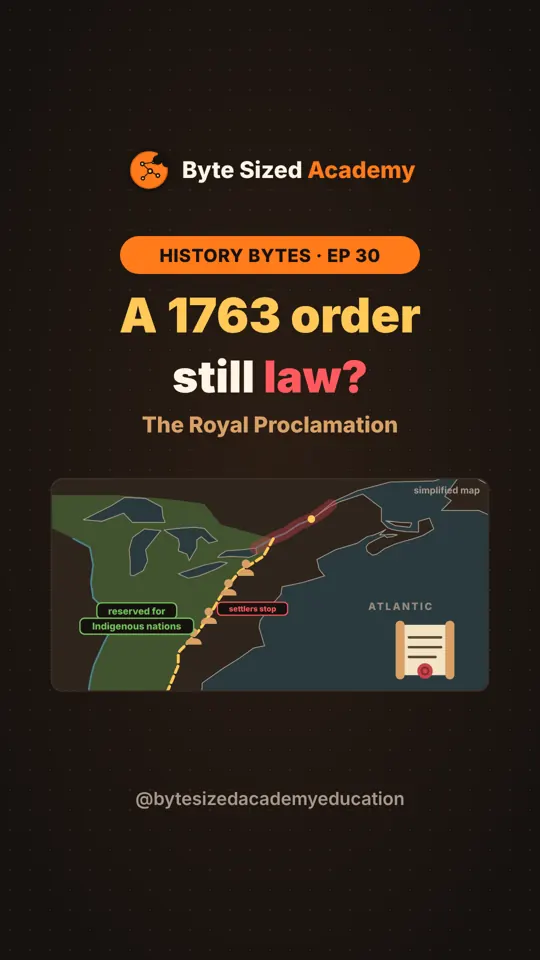 History Bytes · EP30h
The Royal Proclamation of 1763
After taking over New France, Britain issued the Royal Proclamation of 1763. It reserved a huge western area for Indigenous nations and ruled that only the Crown could buy Indigenous land, at a public meeting with the nation. That rule shaped Canada's later treaties and is still named in Canadian law.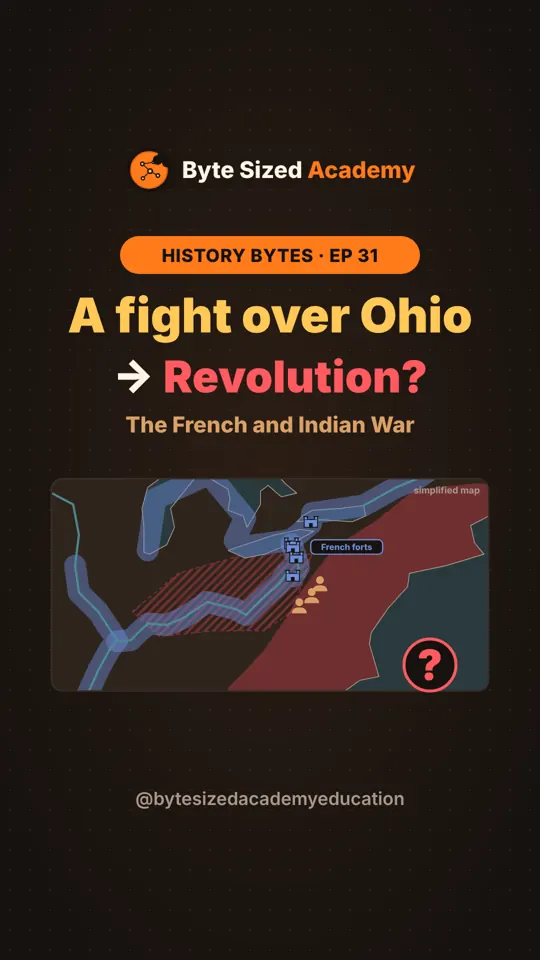 History Bytes · EP31h
The French and Indian War
In the 1750s, France and Britain both claimed the Ohio Valley. A 1754 clash in western Pennsylvania grew into a world war, the Seven Years' War. Britain won, but the war left it deep in debt, and the new taxes it placed on the colonists helped set the stage for the American Revolution.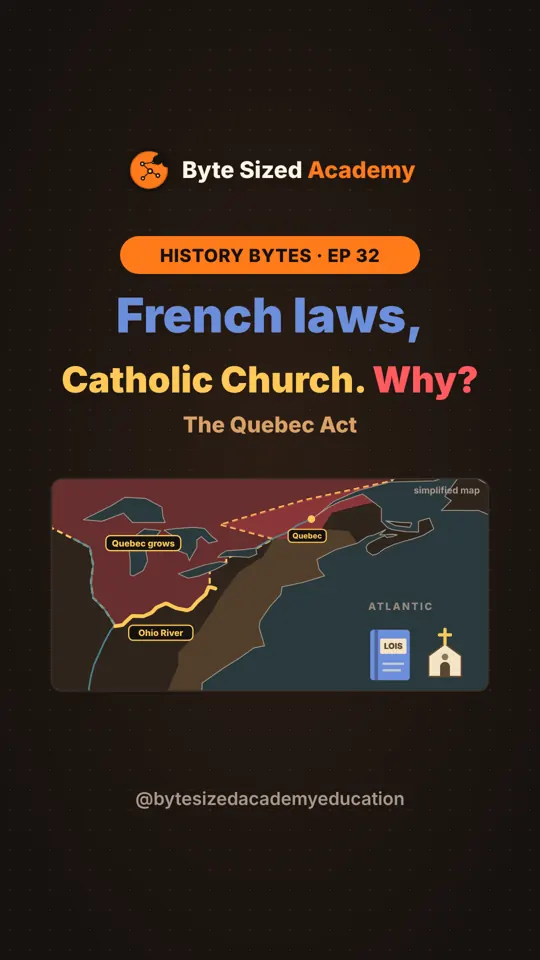 History Bytes · EP32h
The Quebec Act
After the conquest, Britain first tried to run Quebec with English law and kept Catholics out of office. The Quebec Act reversed course, keeping French civil law, protecting the Catholic Church and letting Catholics hold office, partly to keep Quebec loyal as the thirteen colonies grew restless.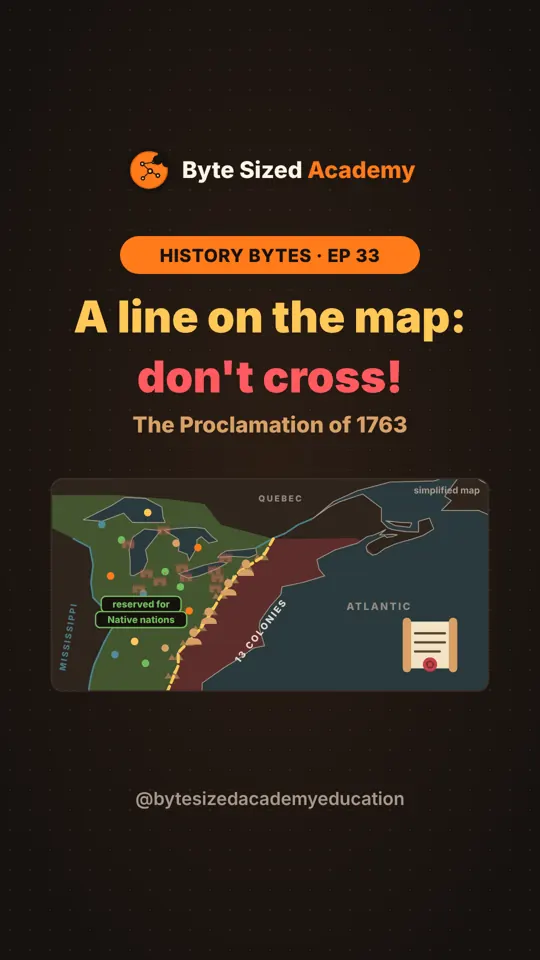 History Bytes · EP33h
The Proclamation of 1763
After the French and Indian War and Pontiac's War, Britain drew a line along a mountain range and reserved the land west of it for Native nations. Colonists who had fought for that land, and speculators like George Washington, were angry, and many settlers ignored the line.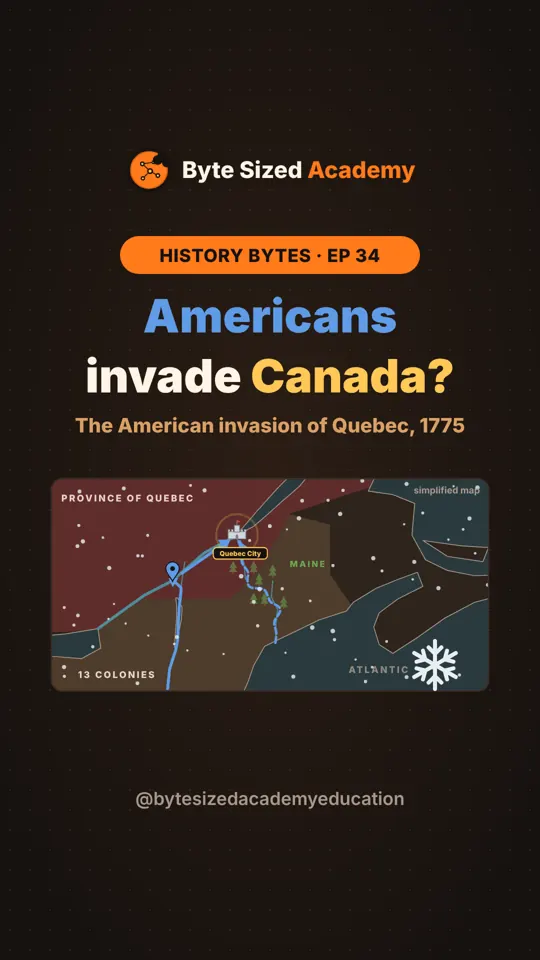 History Bytes · EP34h
The American invasion of Quebec, 1775
Early in the American Revolution, two American armies marched north to take the Province of Quebec. Their attack on Quebec City on December 31, 1775 failed in a snowstorm, and British ships arriving in spring 1776 forced the Americans to retreat.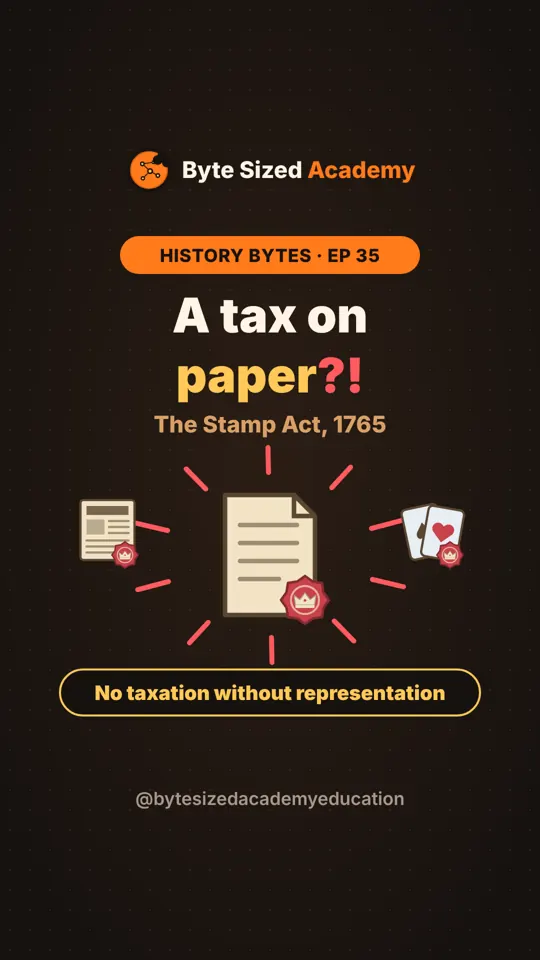 History Bytes · EP35h
The Stamp Act
In 1765, Parliament taxed newspapers, legal papers and even playing cards in the American colonies to help pay its war debt. Colonists, who had no members in Parliament, answered with "no taxation without representation," a Stamp Act Congress, boycotts and protests, and Parliament backed down while insisting on its power.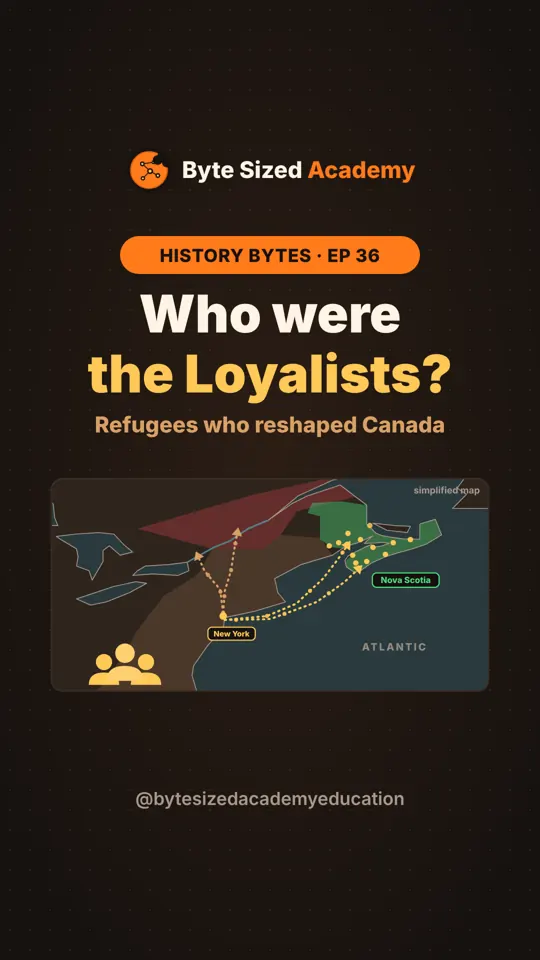 History Bytes · EP36h
The Loyalists arrive
During the American Revolution, many colonists stayed loyal to Britain. When Britain lost, tens of thousands of these Loyalists left, and many came north to Nova Scotia and Quebec, including Black Loyalists and Haudenosaunee allies, changing the map of what became Canada.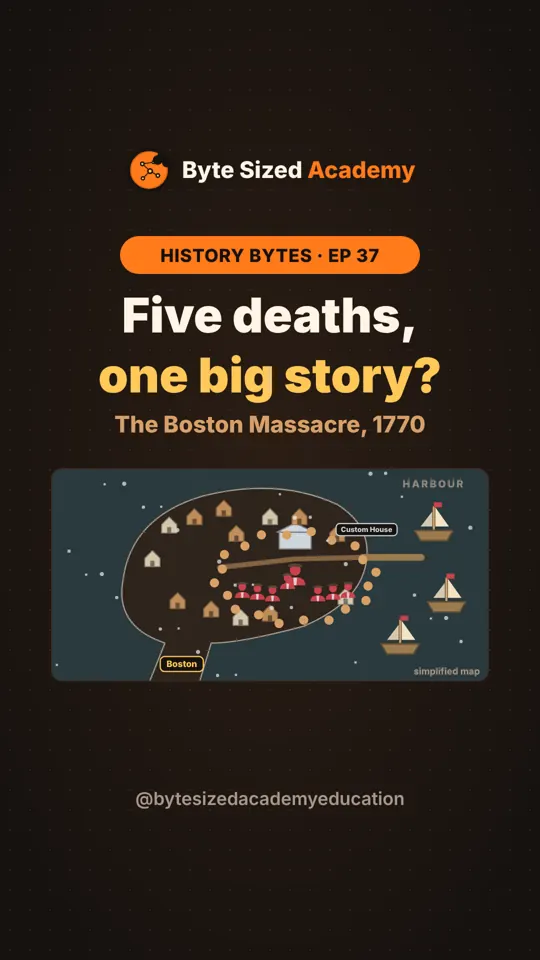 History Bytes · EP37h
The Boston Massacre
On a cold March night in 1770, British soldiers in Boston fired into a crowd that had surrounded a guard, and five people died. A one-sided engraving by Paul Revere turned the shooting into a story that spread across the colonies, even though most of the soldiers were later found not guilty.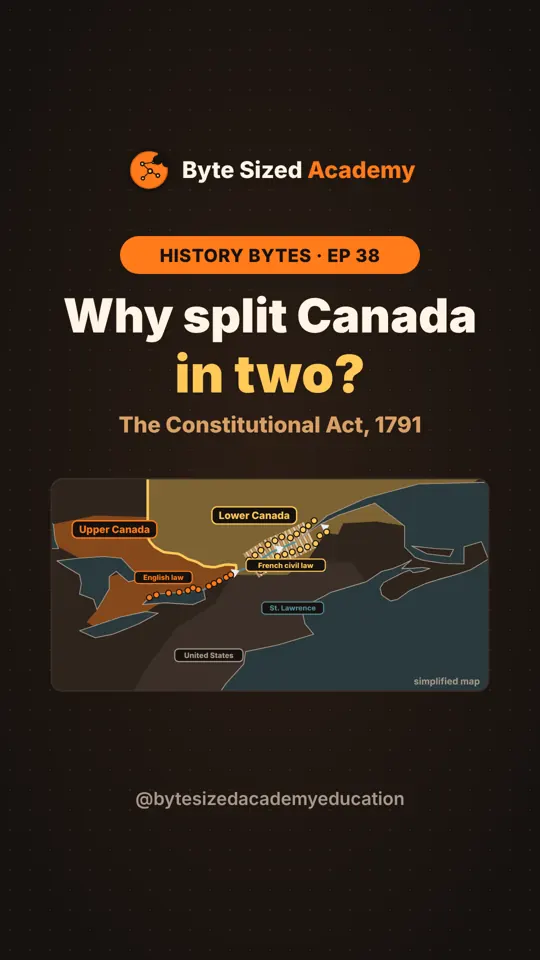 History Bytes · EP38h
Upper and Lower Canada, 1791
After the American Revolution, English-speaking Loyalists settled in the mostly French-speaking Province of Quebec. In 1791 Britain's Constitutional Act split the colony into Upper Canada and Lower Canada, each with its own laws and its first elected assembly.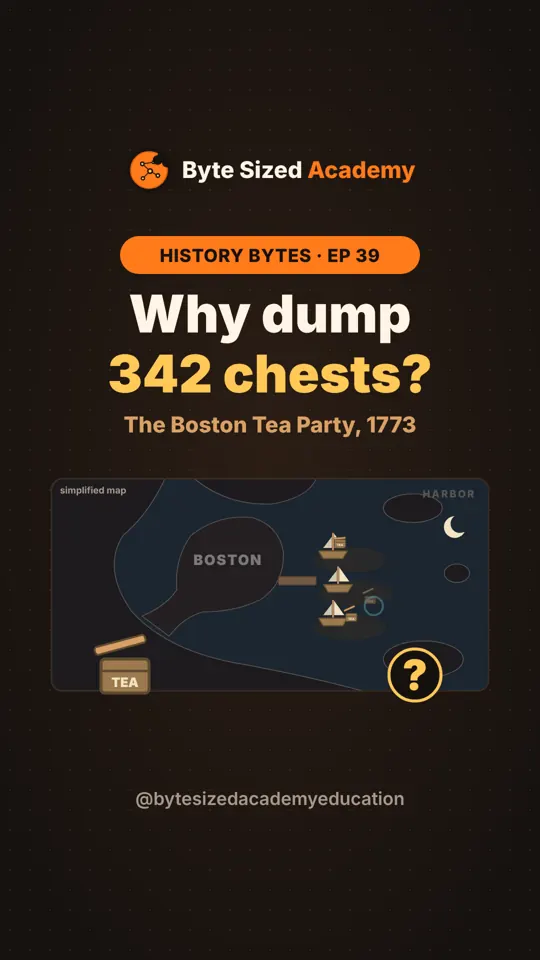 History Bytes · EP39h
The Boston Tea Party
In 1773, Parliament's Tea Act made tea cheaper in the colonies but kept a tax colonists had never agreed to and let only chosen merchants sell it. On December 16, 1773, men in disguise boarded three ships in Boston Harbor and dumped 342 chests of tea, and Britain struck back by closing Boston's port.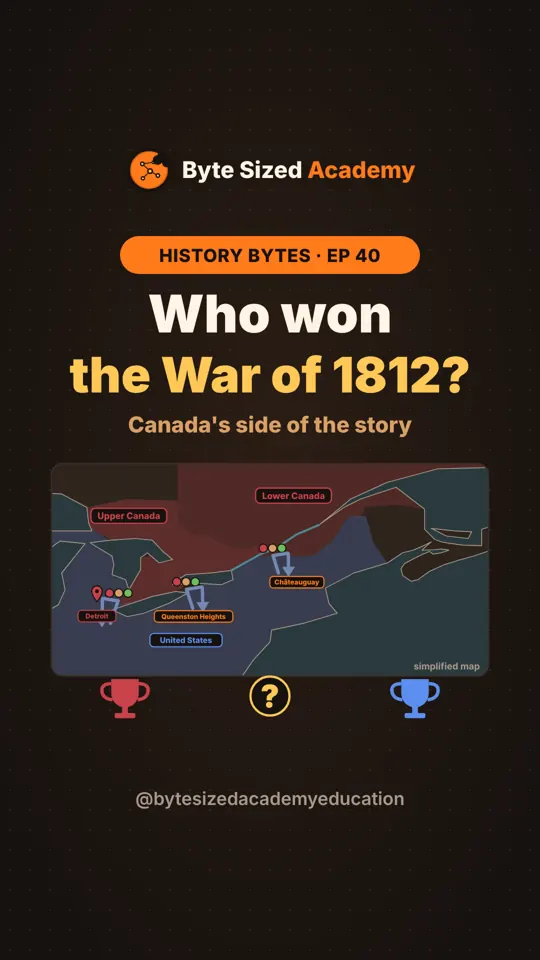 History Bytes · EP40h
The War of 1812 (Canada's side)
In 1812 the United States declared war on Britain and invaded the Canadas, expecting an easy win. British soldiers, Canadian militia and Indigenous allies turned the invasions back, the Treaty of Ghent put the borders back in 1814, and Indigenous nations lost the most.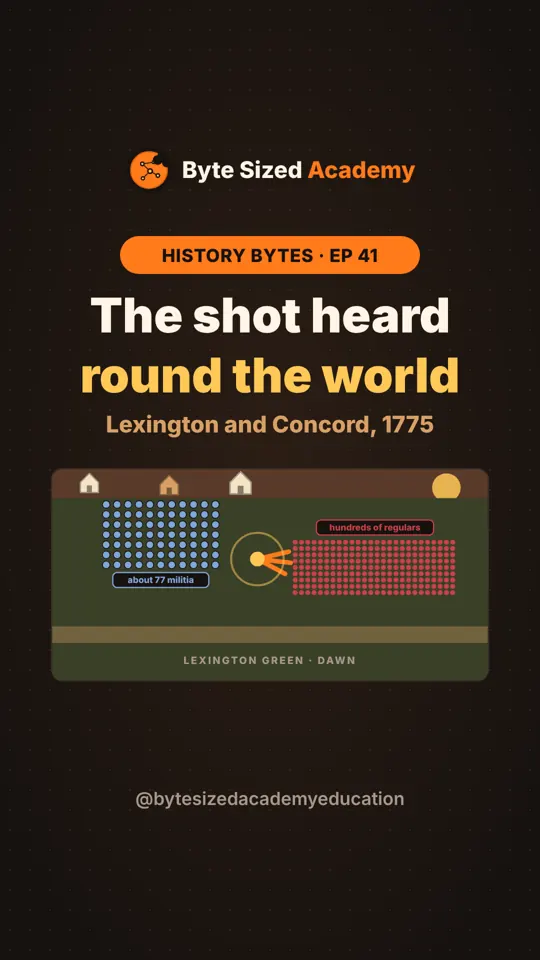 History Bytes · EP41h
Lexington and Concord
On April 19, 1775, British troops marched from Boston to seize colonial weapons at Concord. Shots at Lexington Green, a fight at Concord's North Bridge and a running battle back to Boston started the Revolutionary War.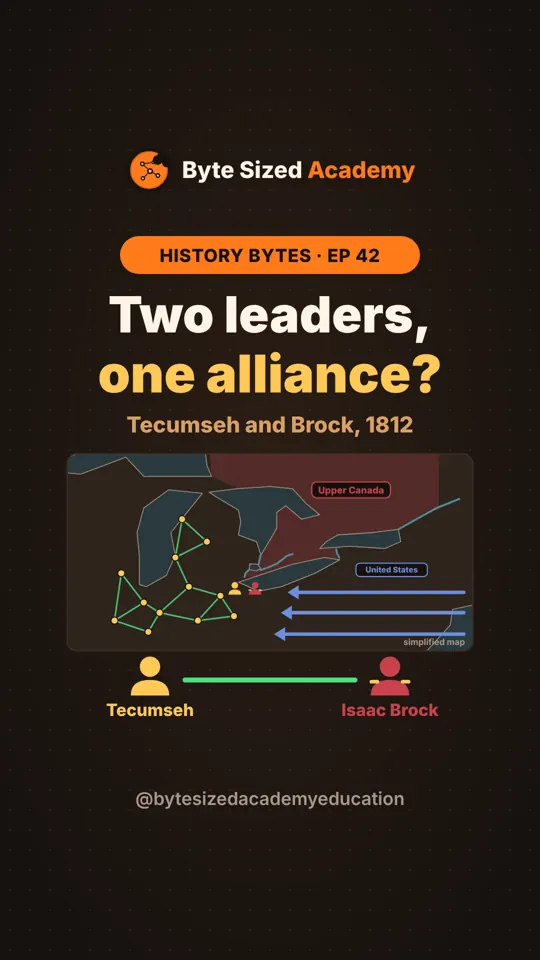 History Bytes · EP42h
Tecumseh and Brock
In the War of 1812, the Shawnee leader Tecumseh and the British general Isaac Brock joined forces to defend Upper Canada. Their bold plan in August 1812 forced an American army to surrender, but both leaders were killed within about a year, and Tecumseh's alliance fell apart.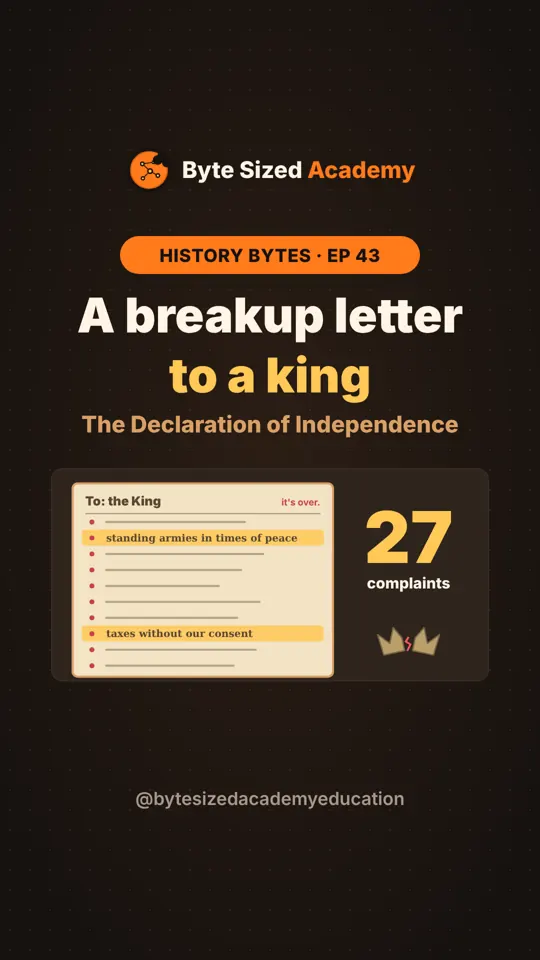 History Bytes · EP43h
The Declaration of Independence
In 1776, after a year of fighting, the Continental Congress voted for independence and approved the Declaration of Independence on July 4. Written mostly by Thomas Jefferson, it promised that all men are created equal, listed 27 complaints against King George III, and left many people out of its promise.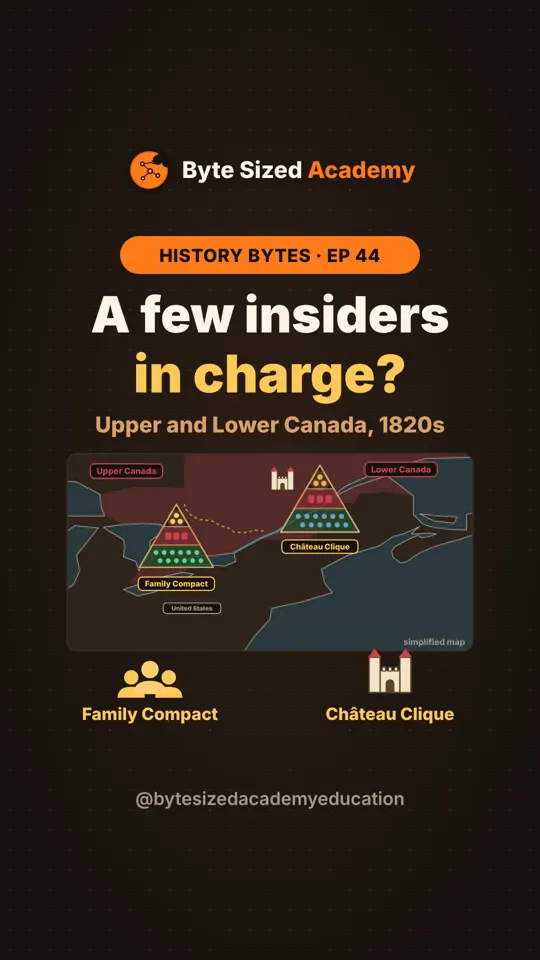 History Bytes · EP44h
The Family Compact and the Château Clique
Voters in Upper and Lower Canada elected assemblies, but the governor's appointed councils could block their laws. Small, wealthy elites took over those councils, the Family Compact in Upper Canada and the Château Clique in Lower Canada, and by the 1830s anger at them was boiling over.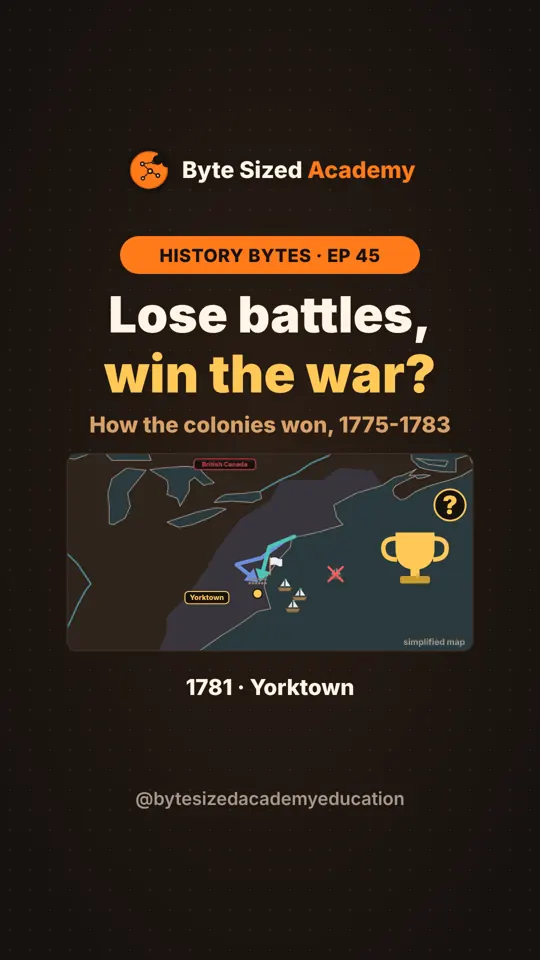 History Bytes · EP45h
How the colonies won
Britain had a huge navy and a professional army, yet the thirteen colonies won the Revolutionary War. Washington kept his army alive, a British surrender in 1777 brought France into the war, and in 1781 American and French forces trapped the British at Yorktown. The 1783 Treaty of Paris recognized American independence.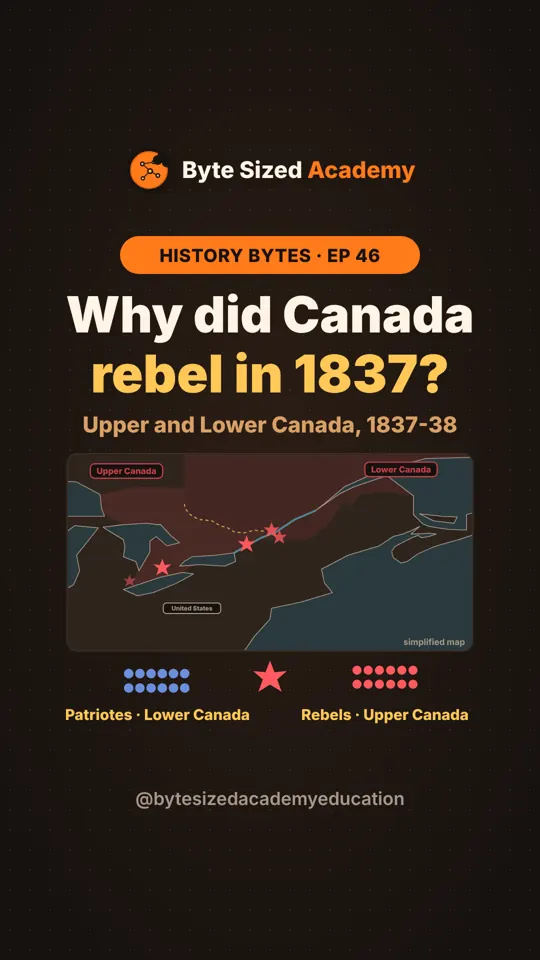 History Bytes · EP46h
The Rebellions of 1837-38
In 1837 rebels in both Upper and Lower Canada took up arms because their elected assemblies were blocked by the governor's appointed insiders. The Patriotes of Lower Canada won one battle and lost two, Mackenzie's rebels near Toronto were scattered in under an hour, and a second wave in 1838 also failed. Britain then sent Lord Durham to investigate.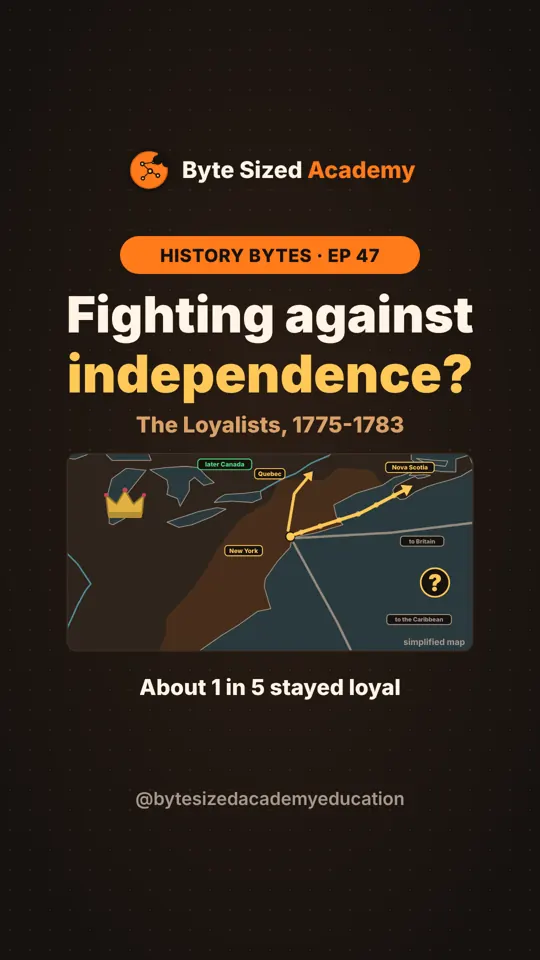 History Bytes · EP47h
The Loyalists
Not every colonist wanted independence. Historians estimate about one in five stayed loyal to Britain during the American Revolution. Officials, merchants and people who feared chaos stayed loyal, many enslaved people joined the British for a promise of freedom, and many Haudenosaunee sided with Britain. Patriots seized Loyalist property, families split, and about 60,000 Loyalists left when Britain lost, many for the British colonies that became Canada.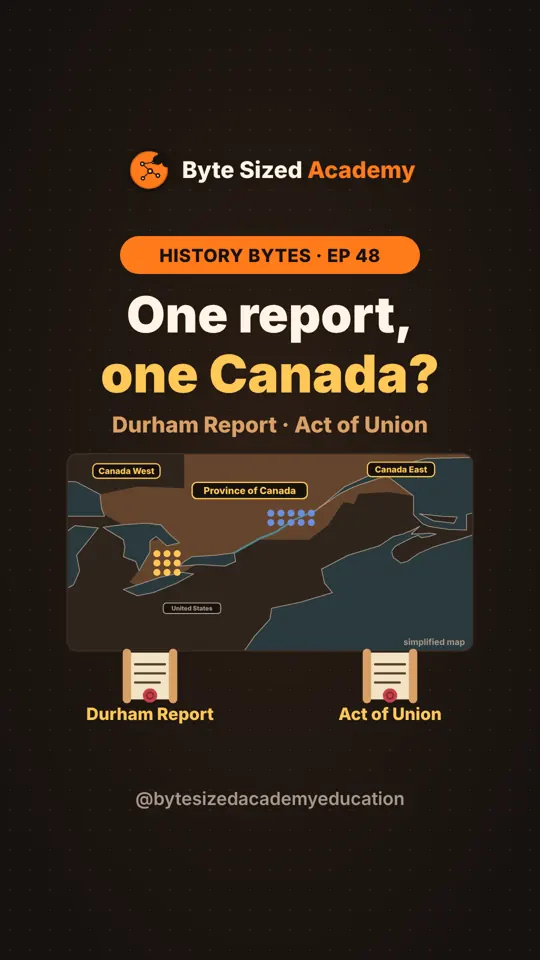 History Bytes · EP48h
The Durham Report and the Act of Union
After the rebellions of 1837-38, Lord Durham's 1839 report recommended responsible government and a union of Upper and Lower Canada. Britain took only the union: the Act of Union created the Province of Canada, gave Canada West and Canada East equal seats and made English the legislature's only official language.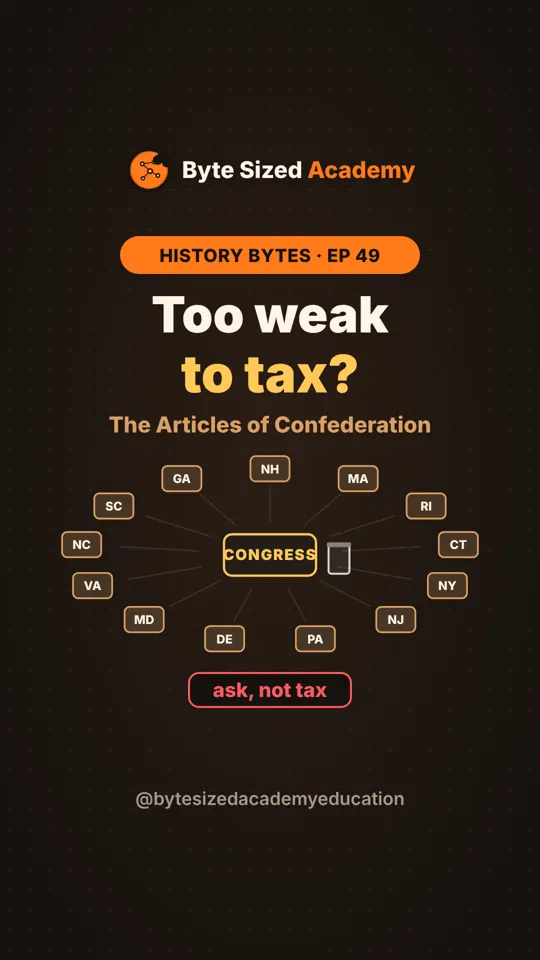 History Bytes · EP49h
The Articles of Confederation
America's first government, the Articles of Confederation, kept the center weak on purpose. Congress had no president, no national courts and no power to tax or control trade, and any change needed all thirteen states. Debts and soldiers went unpaid, Shays' Rebellion showed Congress had no army, and in 1787 leaders wrote a new Constitution.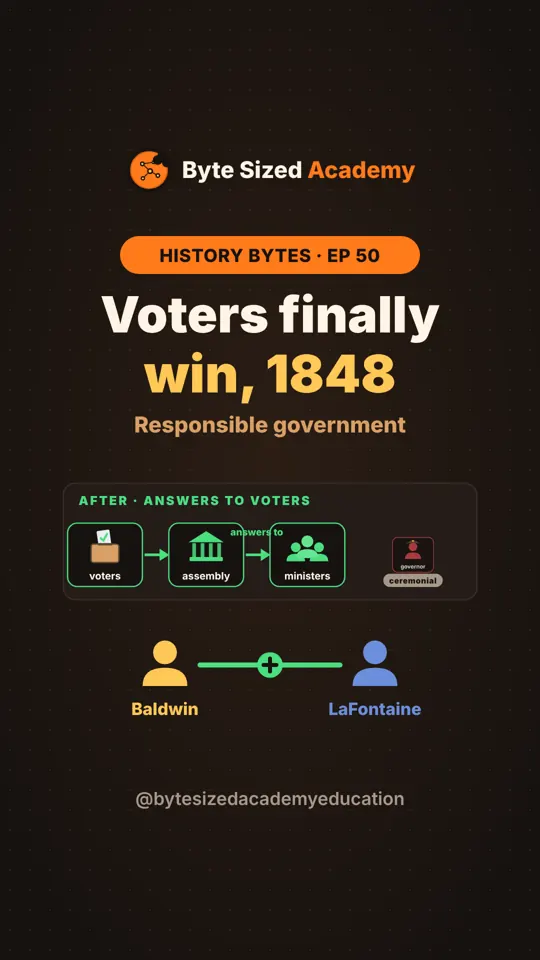 History Bytes · EP50h
Responsible Government, 1848
For decades, colonial governors chose their own ministers. Reformers Robert Baldwin and Louis-Hippolyte LaFontaine fought for responsible government, and in 1848 Lord Elgin asked them to govern because their side had won the election. When rioters burned the parliament in Montreal in 1849, Elgin stood firm, and the government answered to voters from then on.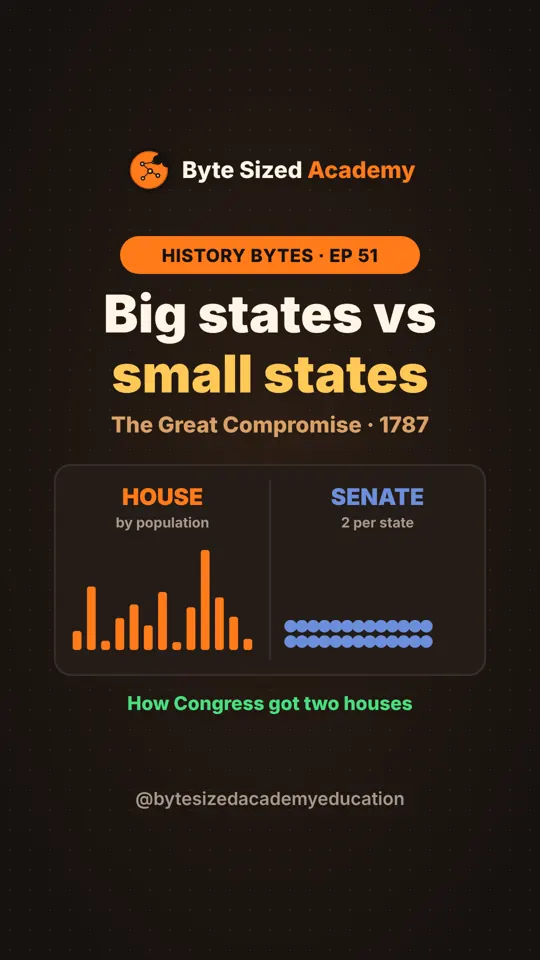 History Bytes · EP51h
The Great Compromise
At the 1787 Constitutional Convention, big and small states fought over how many votes each state should get in Congress. The Virginia Plan wanted representation by population; the New Jersey Plan wanted one state, one vote. Delegates Roger Sherman and Oliver Ellsworth proposed a mix, two houses, and it passed on July 16, 1787, by a single vote. It's called the Great Compromise, and Congress still works this way today.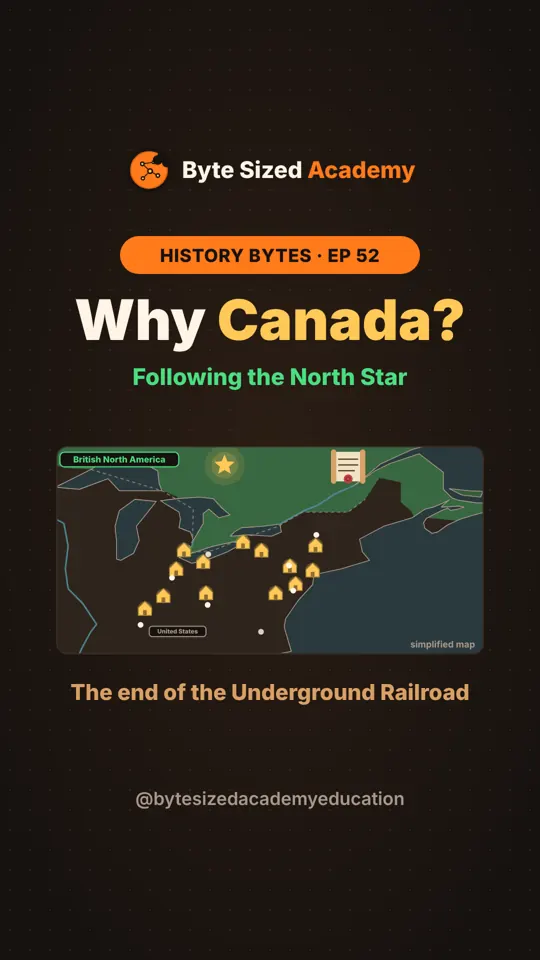 History Bytes · EP52h
Canada at the end of the Underground Railroad
The Underground Railroad was a secret network that helped enslaved people escape. Britain ended slavery across its empire in 1834, and after the US Fugitive Slave Act of 1850 made even free states unsafe, an estimated 30,000 to 40,000 freedom seekers reached British North America, many settling in today's Ontario. Canada was not free of racism, but under the law they were free.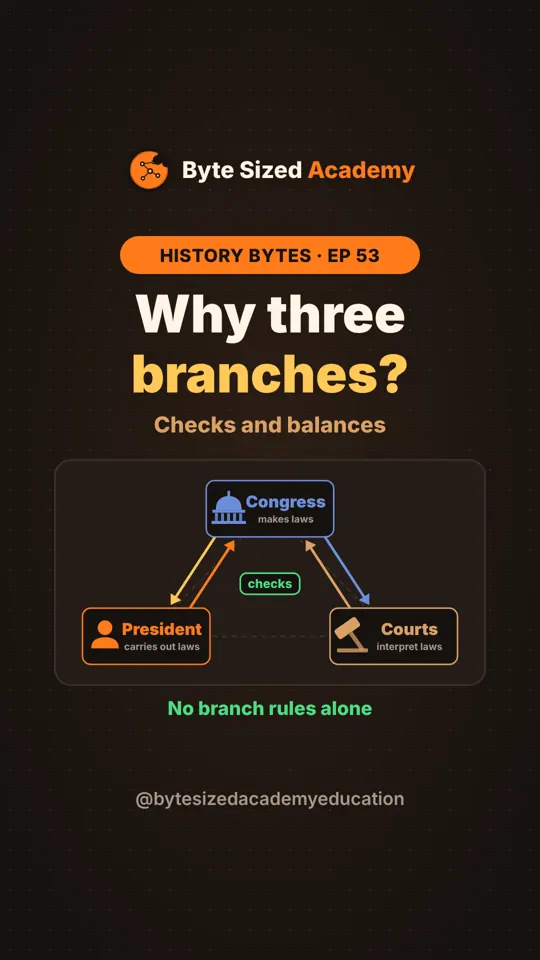 History Bytes · EP53h
Three branches, checks and balances
After fighting a king, the founders feared too much power in anyone's hands, so the US Constitution split power among three branches: Congress makes the laws, the president carries them out and the courts decide what they mean. Each branch can check the others, from the veto and the override to impeachment and judicial review. It's called checks and balances.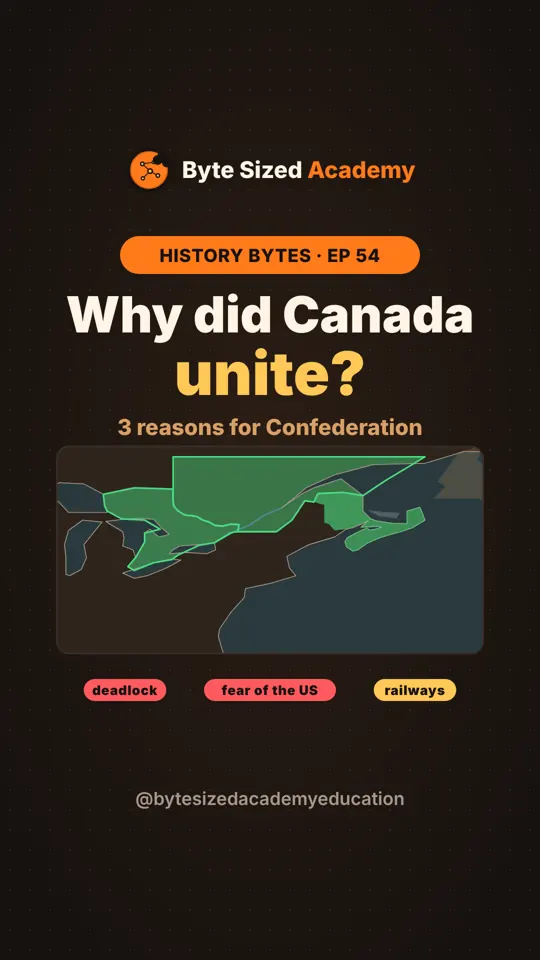 History Bytes · EP54h
Why Confederation?
Why did Britain's North American colonies decide to unite? Political deadlock in the Province of Canada, fear of the United States after its Civil War, and the need for trade and a costly railway to the Atlantic all pushed the colonies toward one country.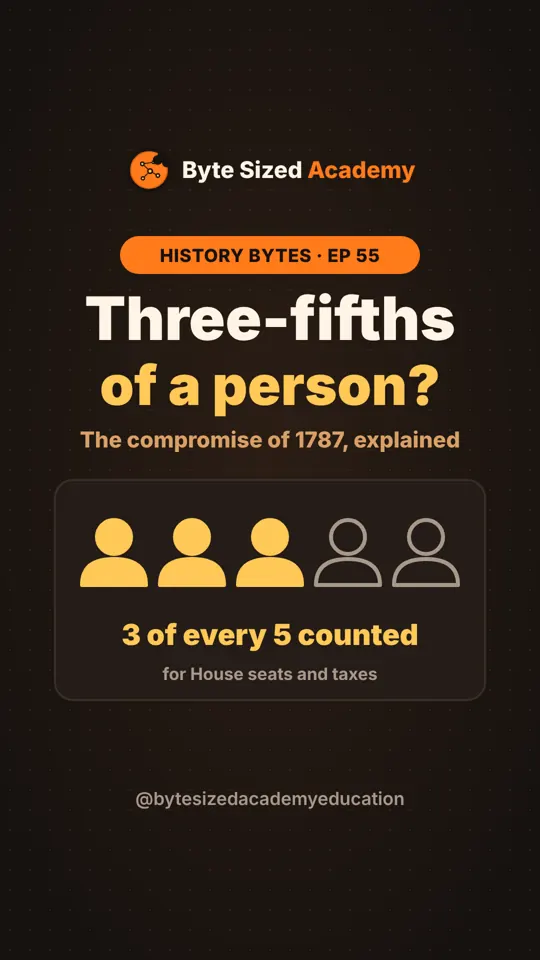 History Bytes · EP55h
The Three-Fifths Compromise
In 1787, House seats would follow population, so delegates fought over whether enslaved people counted. Southern states wanted them counted in full for more seats, though they could not vote; many Northern delegates said they should not count at all. The deal counted three of every five enslaved people for House seats and taxes, which gave slaveholding states extra power until an amendment after the Civil War ended it.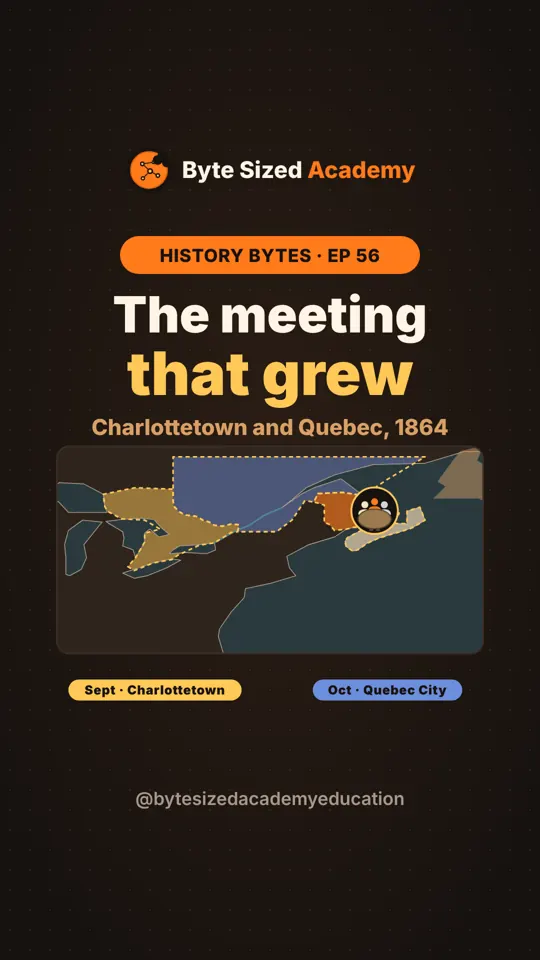 History Bytes · EP56h
The Charlottetown and Quebec conferences
In September 1864, Maritime leaders met in Charlottetown to discuss uniting their three colonies, but politicians from the Province of Canada arrived with a bigger idea. A month later, at Quebec City, delegates from five colonies wrote the blueprint for a new country that led to Confederation in 1867.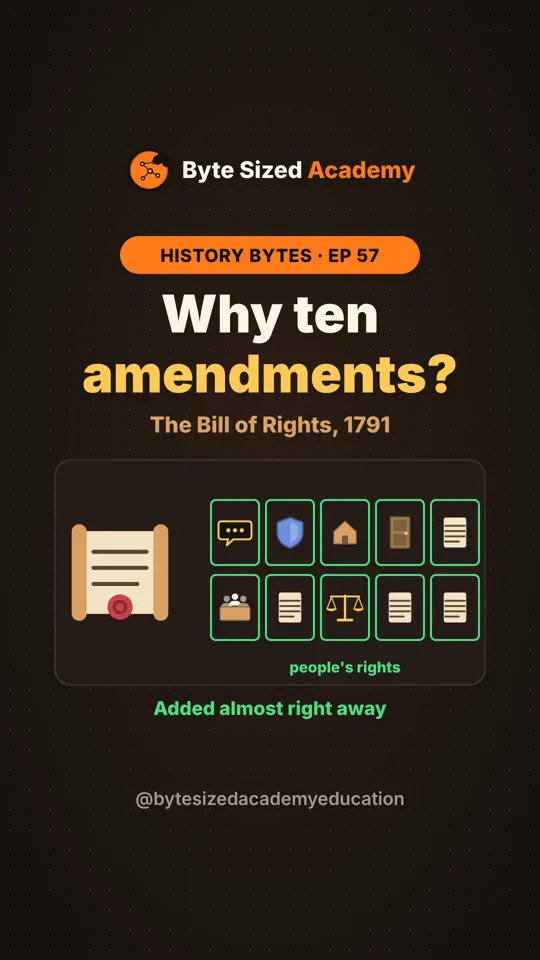 History Bytes · EP57h
The Bill of Rights
The 1787 Constitution made a stronger national government but had no list of people's rights. Anti-Federalists feared a new tyranny, so James Madison drafted amendments in 1789; Congress sent twelve to the states, and ten were ratified in 1791 as the Bill of Rights.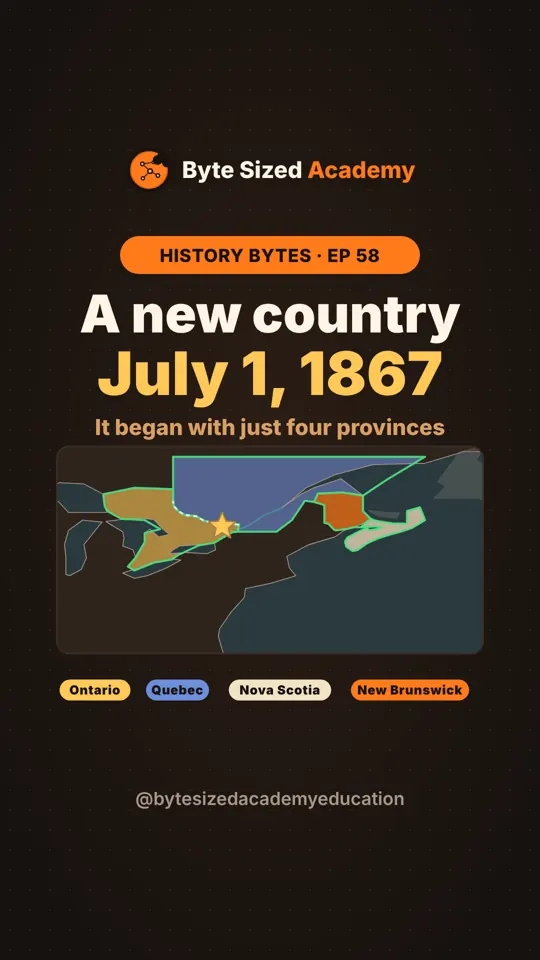 History Bytes · EP58h
Confederation, July 1, 1867
On July 1, 1867, the British North America Act took effect and created the Dominion of Canada from just four provinces. It set up a federation that split jobs between Ottawa and the provinces, though Nova Scotia voted against it and Canada was not yet fully independent.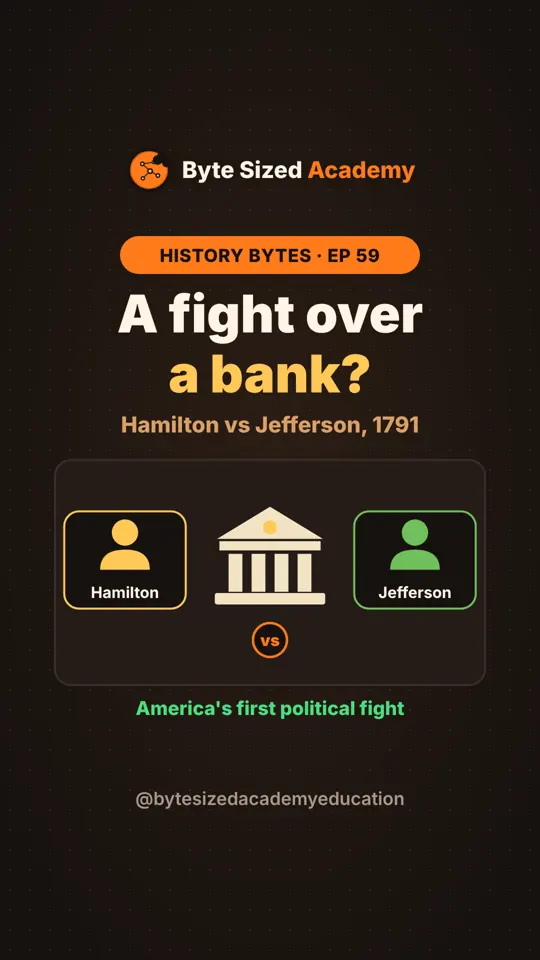 History Bytes · EP59h
Hamilton vs Jefferson
Alexander Hamilton wanted the national government to take over the states' war debts and create a national bank. Thomas Jefferson said the Constitution did not allow it; Hamilton pointed to the "necessary and proper" clause, Washington signed the bank bill in 1791, and the split grew into America's first political parties.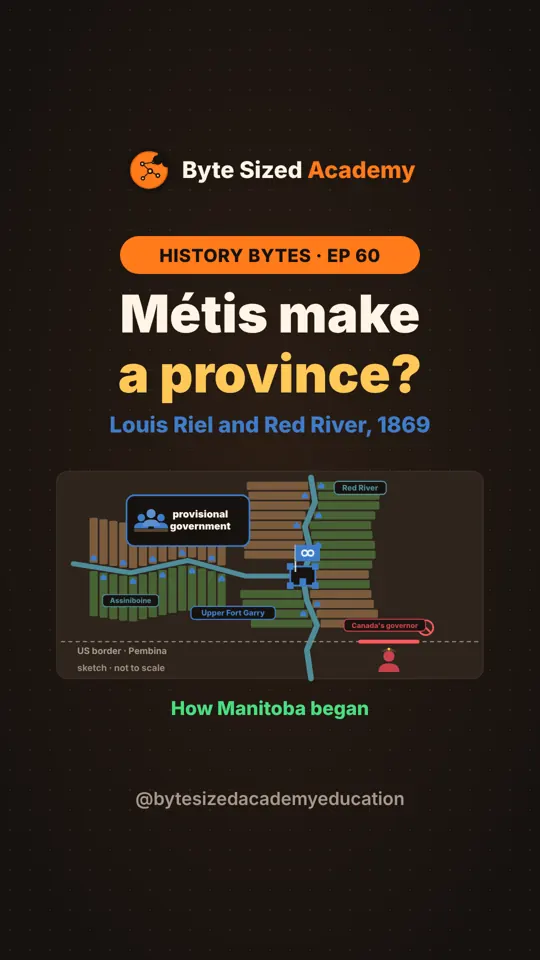 History Bytes · EP60h
Louis Riel and the Red River Resistance
In 1869, the Hudson's Bay Company agreed to sell Rupert's Land to Canada without asking the people who lived there. At Red River, the Métis, led by Louis Riel, stopped the surveyors, seized Upper Fort Garry and formed a provisional government to negotiate, which led to the Manitoba Act of 1870.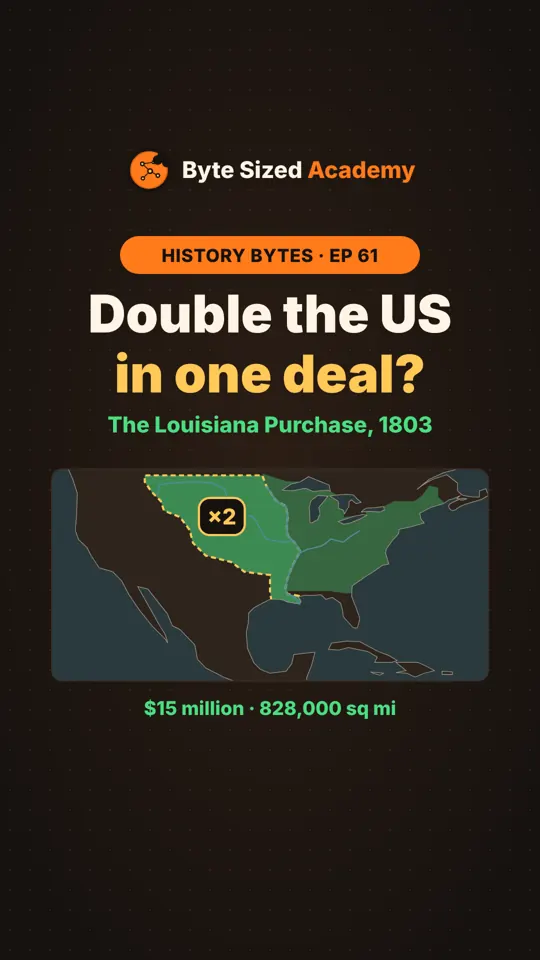 History Bytes · EP61h
The Louisiana Purchase
Jefferson sent diplomats to France to buy one port on the Mississippi. Napoleon, who had lost an army in Haiti and needed money for war with Britain, offered all of Louisiana instead, and in 1803 the US paid $15 million for about 828,000 square miles, roughly doubling the country. But France sold only a claim to land where Native nations already lived.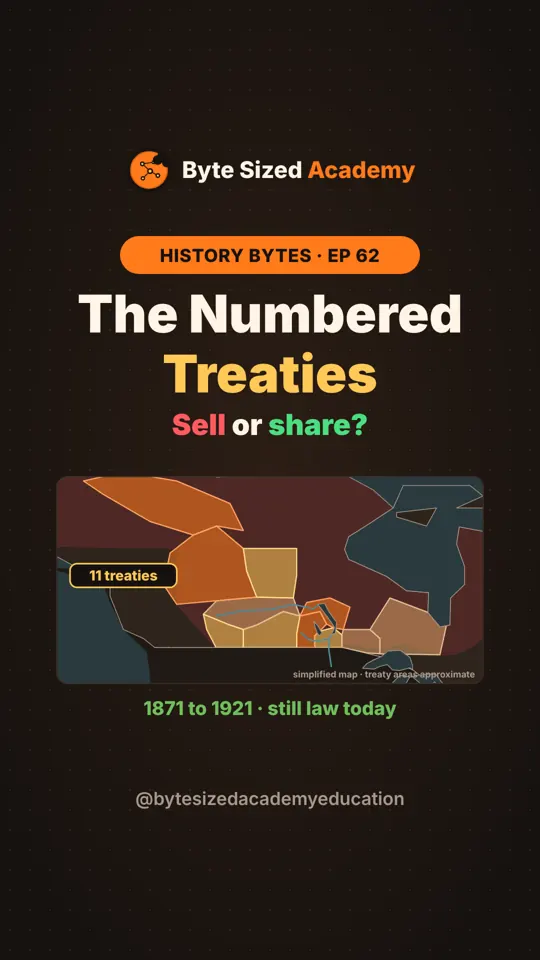 History Bytes · EP62h
The Numbered Treaties
Between 1871 and 1921, the Crown and First Nations signed eleven Numbered Treaties across the West and North. The written texts said the nations gave up the land, but many First Nations understood they had agreed to share it, and the treaties are still law today.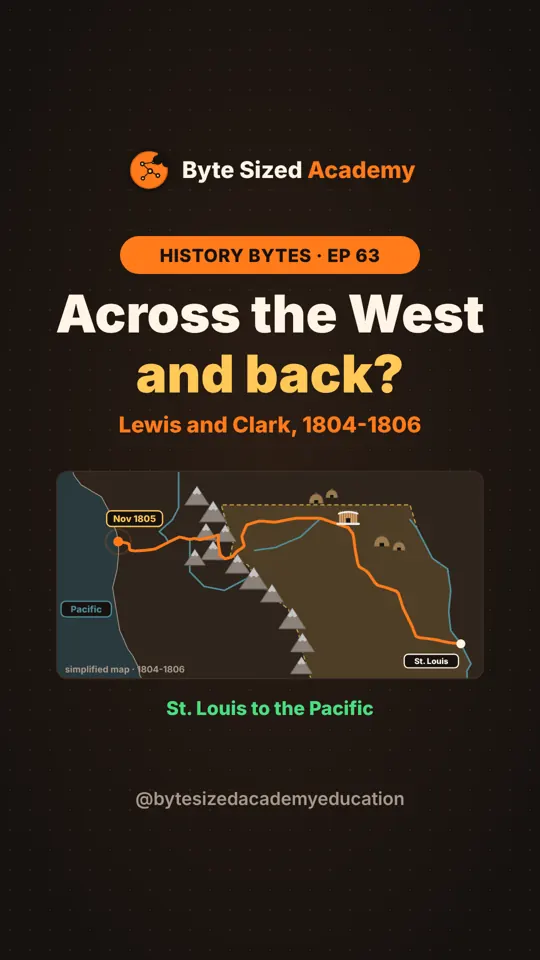 History Bytes · EP63h
Lewis and Clark
Jefferson sent Meriwether Lewis and William Clark to explore the Louisiana Purchase and look for a water route to the Pacific. With help from the Mandan, Hidatsa, Shoshone and Nez Perce, and from Sacagawea, they reached the Pacific in November 1805 and returned to St. Louis in 1806.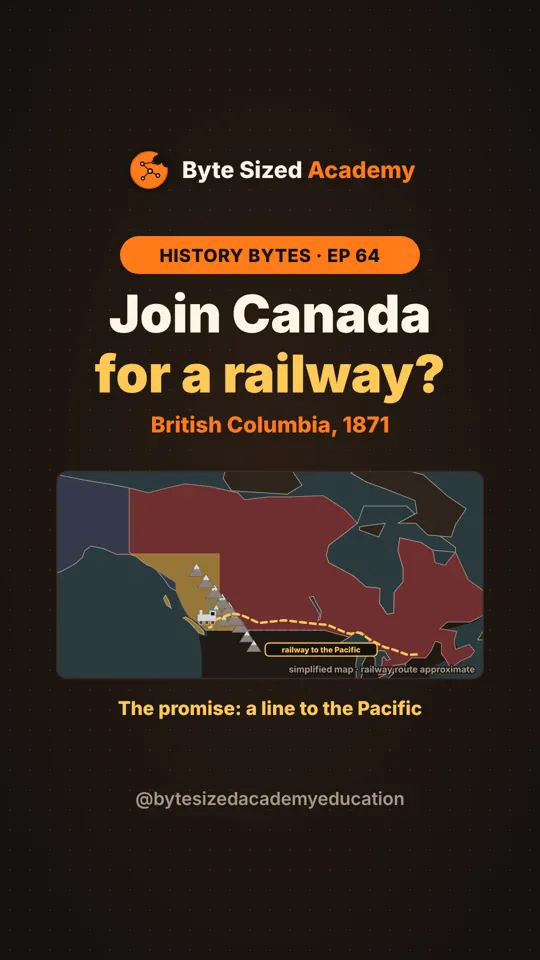 History Bytes · EP64h
British Columbia Joins for a Railway
Gold rushes left the colony of British Columbia deep in debt. Canada offered to take over the debt and build a railway to the Pacific, and B.C. joined on July 20, 1871, though the line was not finished until 1885. History Bytes · EP65h
The War of 1812 (US side)
In 1812 the United States declared war on Britain over seized sailors, blocked trade and British support for Native nations. US invasions of Canada failed, British troops burned Washington in 1814, and Fort McHenry held at Baltimore. The Treaty of Ghent changed no borders, but Americans felt they had won.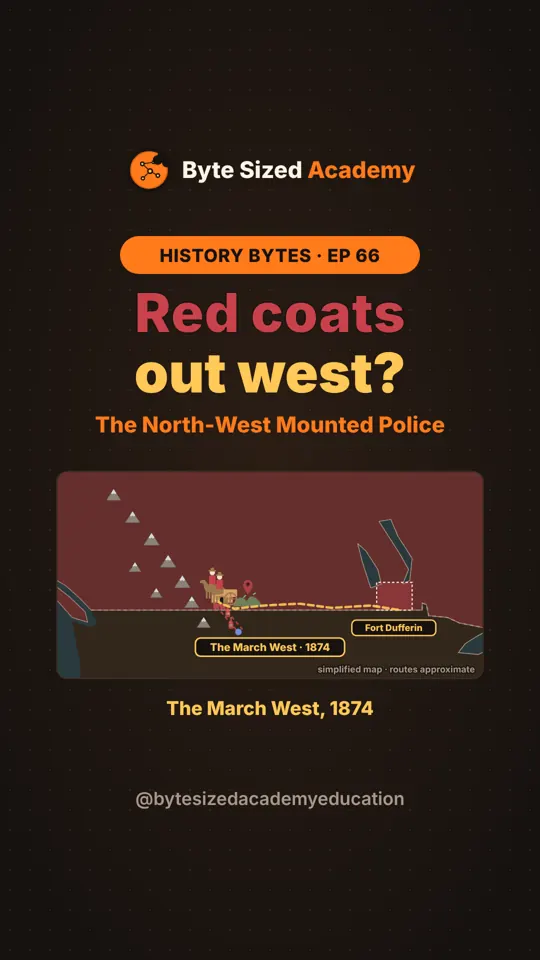 History Bytes · EP66h
The North-West Mounted Police
Canada claimed the North-West in 1870 but had almost no one there, and American whisky traders worked from posts like Fort Whoop-Up. After wolf hunters killed Nakoda people in the Cypress Hills in 1873, Ottawa hurried its new police force west. The 1874 March West ended the whisky trade, but the force also cleared the way for treaties, settlement and later harsh rules on First Nations.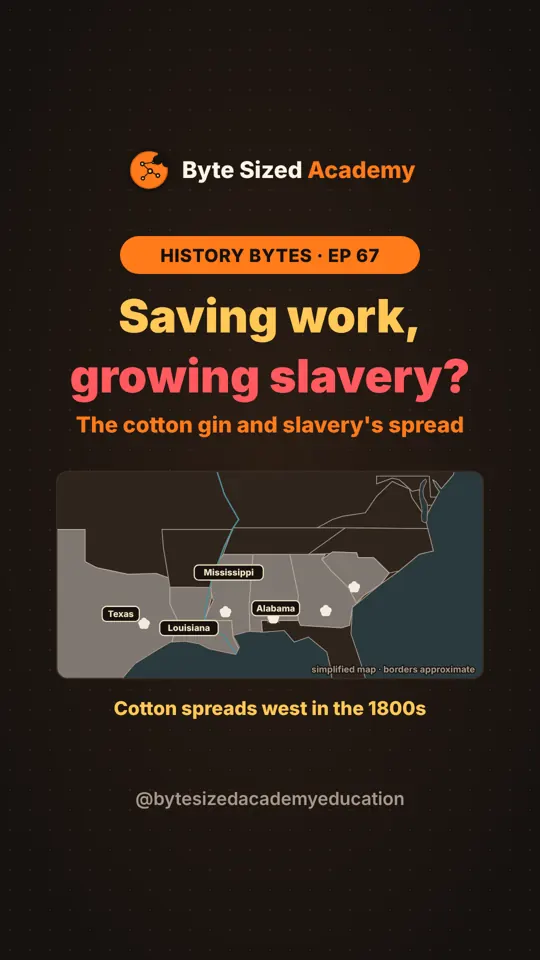 History Bytes · EP67h
The cotton gin and slavery's spread
In 1793 the cotton gin let one machine clean up to fifty pounds of cotton a day instead of about a pound by hand. Cotton suddenly paid, planters pushed west for more land and more enslaved workers, and the number of enslaved people in the United States grew from about 700,000 in 1790 to nearly four million by 1860. History Bytes · EP68h
The Indian Act, 1876
In 1876 Parliament put older colonial laws into one Indian Act, run from Ottawa, with the goal of assimilation. It decided who had status, took status from First Nations women who married men without it, put Indian agents in charge of reserves and replaced many traditional governments. Later changes banned ceremonies and forced children into residential schools. Many rules were removed, but the Act is still in force.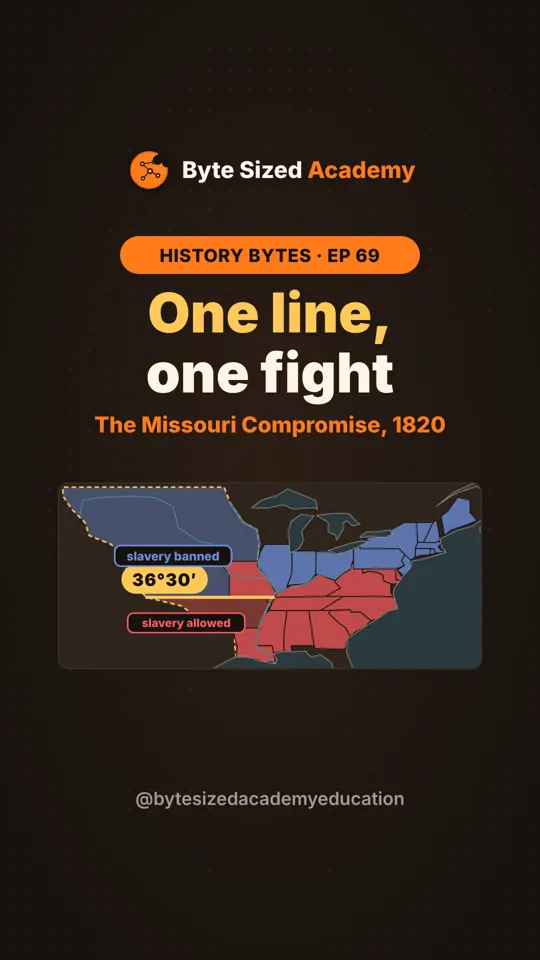 History Bytes · EP69h
The Missouri Compromise
In 1819 the Union had 11 free states and 11 slave states, so the Senate was evenly split. When Missouri asked to join as a slave state, Congress fought over it, and in 1820 it made a deal pushed by Henry Clay. Missouri entered as a slave state, a new free state split off from Massachusetts, and slavery was banned in the rest of the Louisiana Purchase north of 36°30′. The deal kept an uneasy peace for about thirty years.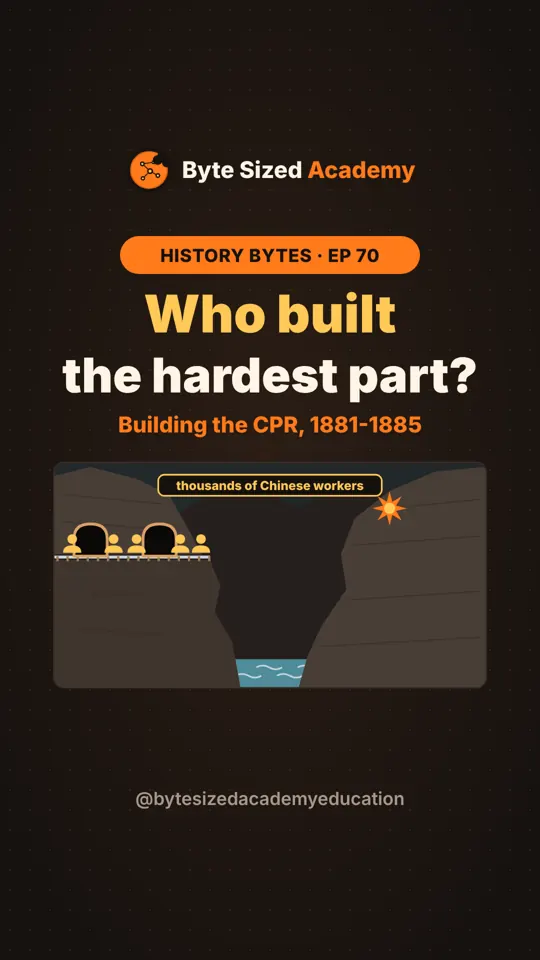 History Bytes · EP70h
Building the CPR
In 1881 the Canadian Pacific Railway began building the line Canada had promised British Columbia. In BC's mountains, contractor Andrew Onderdonk hired thousands of Chinese workers. They were paid about a dollar a day, far less than white workers, and did the most dangerous work; historians estimate at least 600 died. In 1885, as the line was finished, Canada passed a head tax to keep more Chinese immigrants out.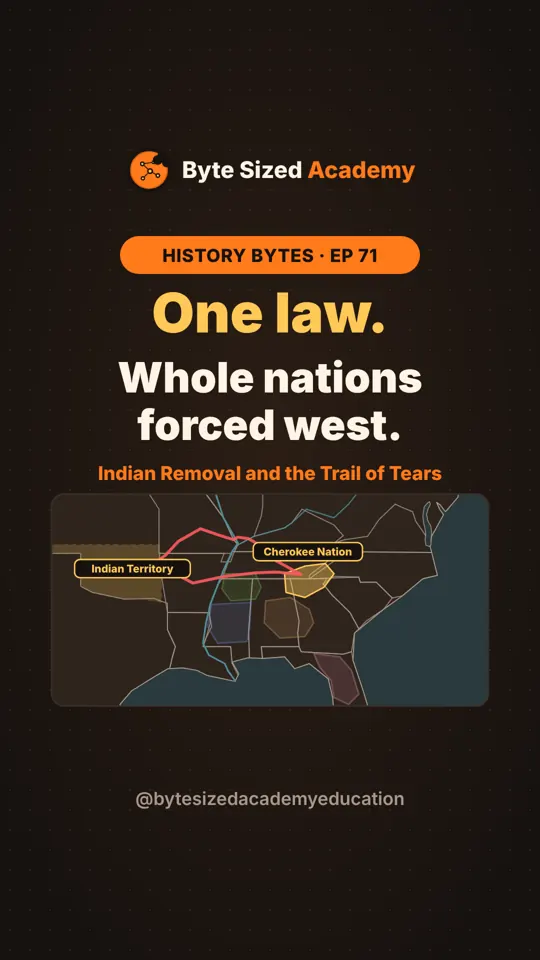 History Bytes · EP71h
Indian Removal and the Trail of Tears
In 1830 the Indian Removal Act set out to move the Cherokee, Muscogee Creek, Chickasaw, Choctaw and Seminole nations west of the Mississippi. The Cherokee won in the Supreme Court in 1832, but Georgia ignored the ruling. In 1838 soldiers forced about 16,000 Cherokee into camps and west to Indian Territory; thousands died on what the Cherokee call the Trail Where They Cried.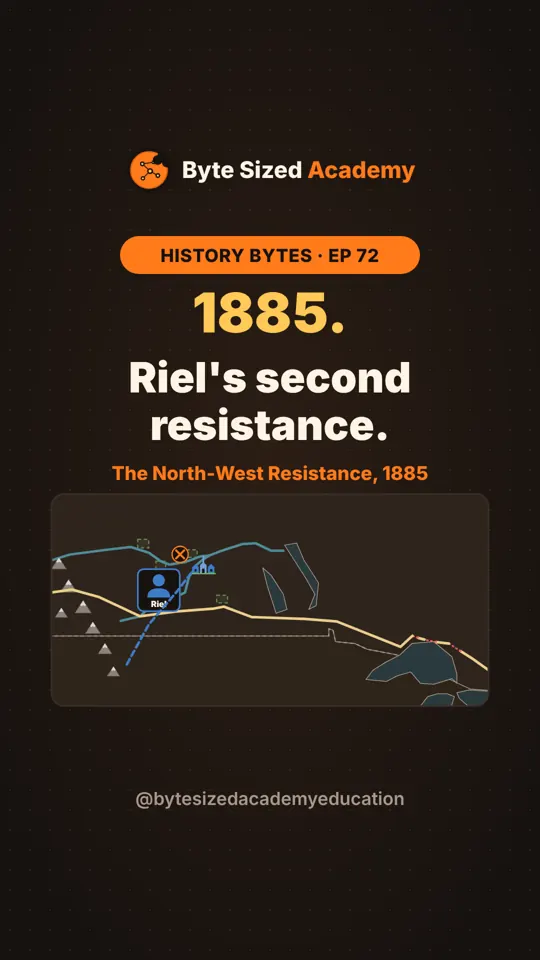 History Bytes · EP72h
The North-West Resistance, 1885
In 1885 Métis families on the South Saskatchewan River, ignored by Ottawa, brought Louis Riel back from Montana and formed a provisional government. Métis and Cree fighters defeated the North-West Mounted Police at Duck Lake, but Ottawa rushed about 5,000 soldiers west, partly by the unfinished railway, and the resistance was defeated in May. Riel was hanged for treason in Regina, and eight Cree and Nakoda men were hanged at Battleford.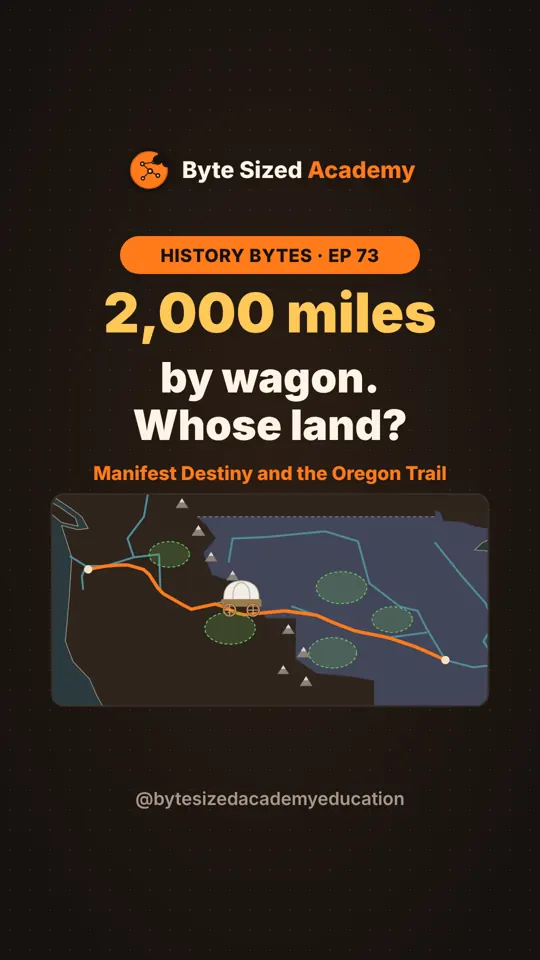 History Bytes · EP73h
Manifest Destiny and the Oregon Trail
In 1845 the editor John O'Sullivan wrote that it was America's "manifest destiny" to spread across the continent. From 1843, families in covered wagons left Missouri on the Oregon Trail, about 2,000 miles and four to six months, most of them walking. Disease was the biggest killer. The land was not empty: Native nations lived along the route and lost land and hunting grounds. In 1846 Britain and the United States split Oregon Country at the 49th parallel.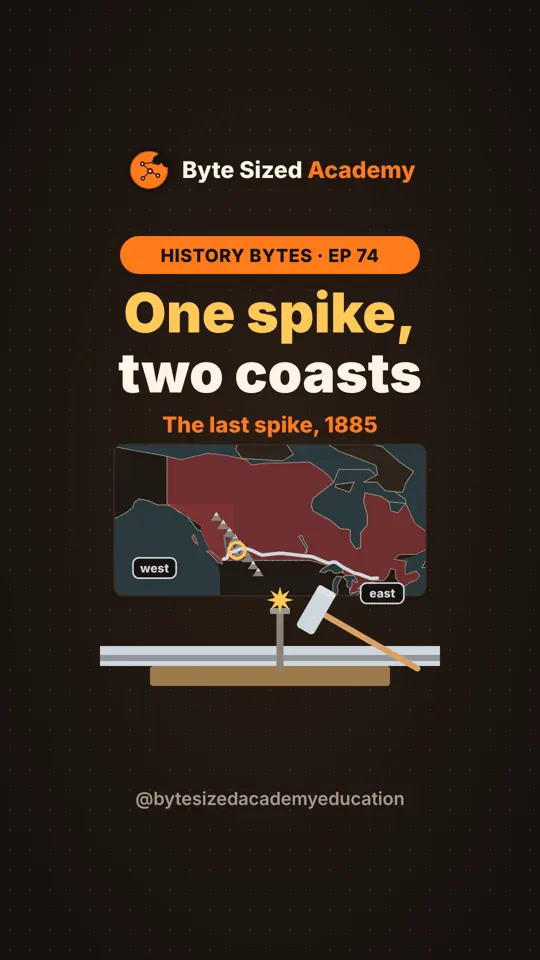 History Bytes · EP74h
The last spike, 1885
On November 7, 1885, the Canadian Pacific Railway's tracks from east and west met in British Columbia's mountains. The first blow bent the last spike, so workers set another, a plain iron one. Van Horne's speech was famously short, and the first passenger train crossed from Montreal to the Pacific in 1886. The famous photo of the day leaves out the Chinese workers who built the hardest stretch.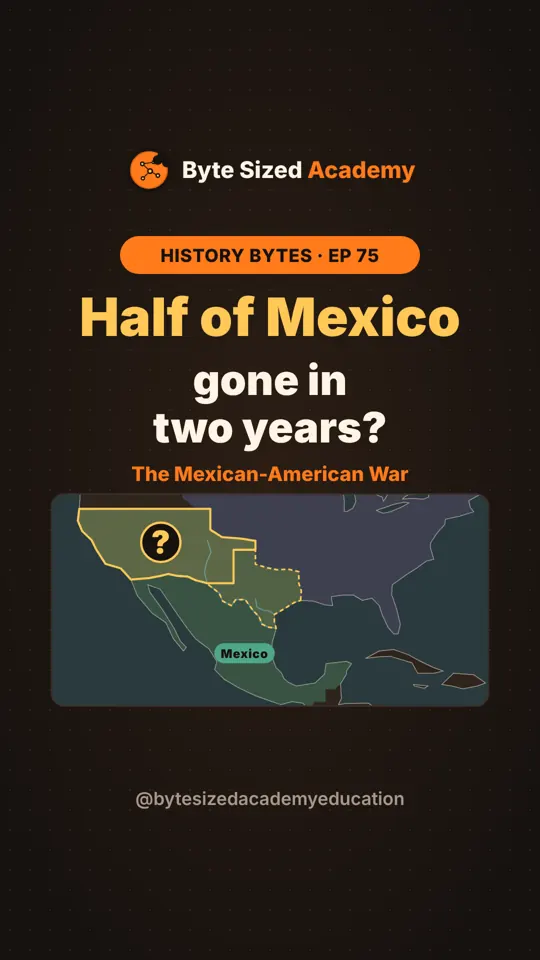 History Bytes · EP75h
The Mexican-American War
In 1845 the United States annexed Texas, and the US and Mexico disagreed on where Texas ended. After a clash in April 1846, Congress declared war. US forces took New Mexico and California and captured Mexico City in 1847. The 1848 Treaty of Guadalupe Hidalgo handed Mexico's northern lands to the US for $15 million, and the fight over slavery in that land grew fiercer.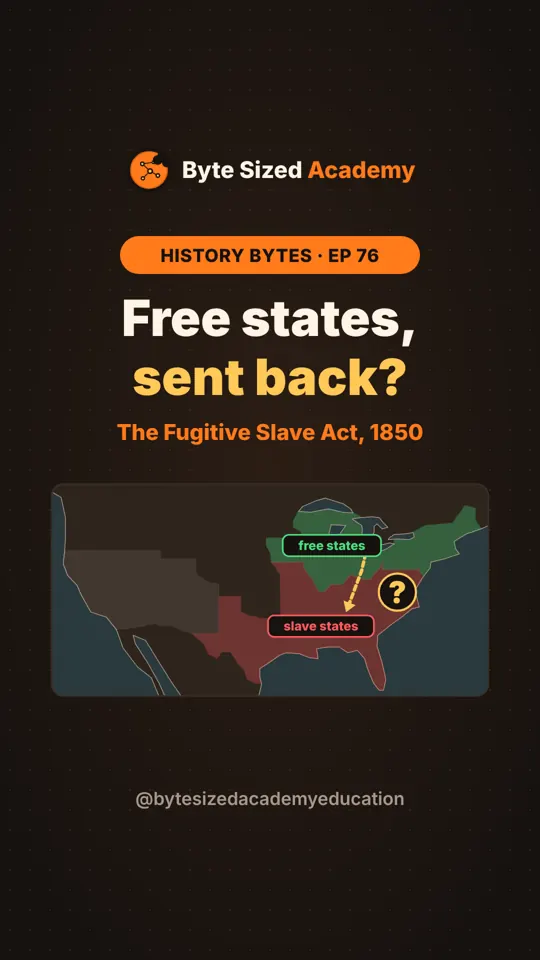 History Bytes · EP76h
The Fugitive Slave Act
In 1850, North and South were fighting over slavery in the land taken from Mexico. The Compromise of 1850 admitted a new free state and gave the South a harsh Fugitive Slave Act. People who escaped slavery had to be returned even from free states, citizens could be ordered to help, and accused people got no jury and could not testify. Free Black people were kidnapped, thousands fled to Canada, and the split over slavery grew deeper.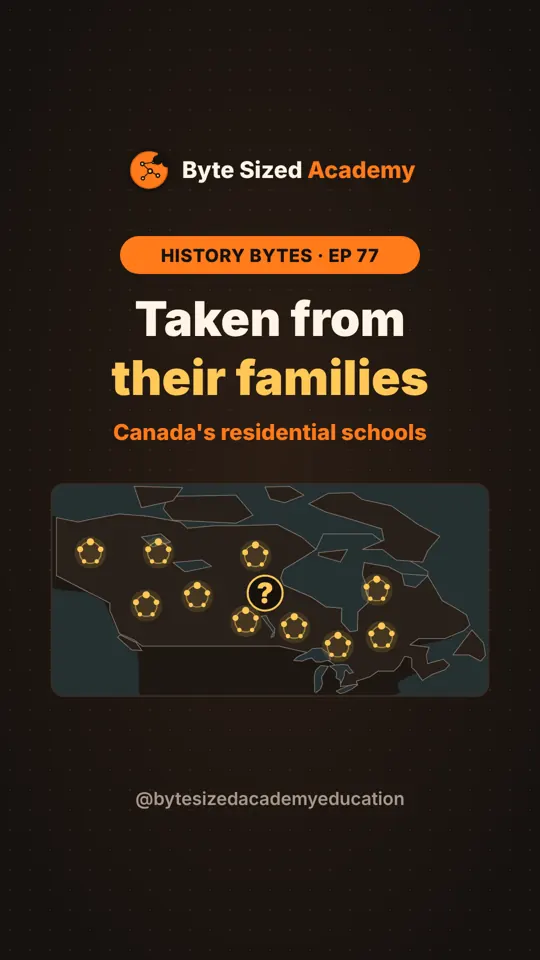 History Bytes · EP77h
Residential schools
For over a century, Canada's residential schools took First Nations, Inuit and Métis children from their families. Paid for by the federal government and run mostly by churches, the schools aimed at assimilation. More than 150,000 children went, many were punished for speaking their languages, and thousands never came home. The government apologized in 2008, and the harm is still felt today.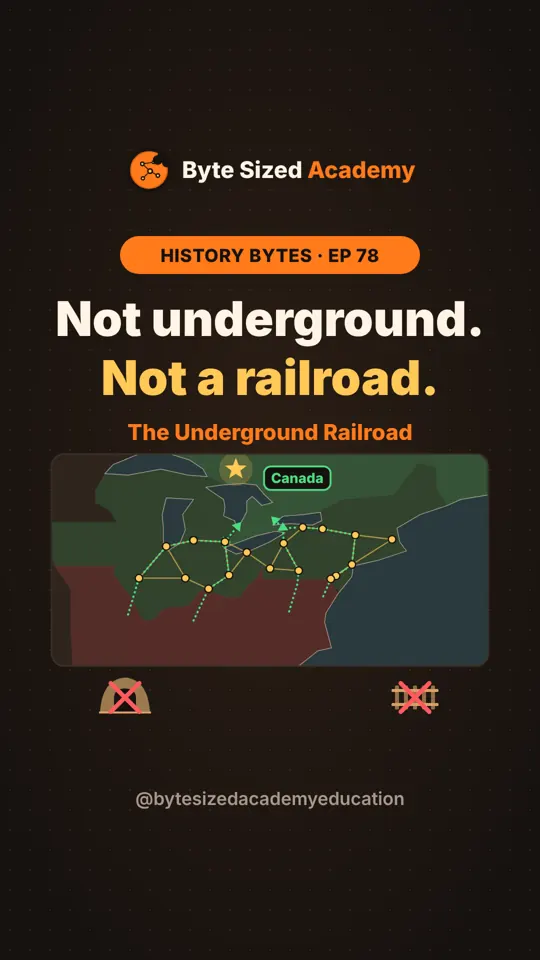 History Bytes · EP78h
The Underground Railroad
The Underground Railroad was neither underground nor a railroad. It was a secret network of people who helped enslaved people escape to freedom in the North and Canada, using railroad code words. Most freedom seekers escaped on their own or with help from other Black people, and white abolitionists, many of them Quakers, helped too. Harriet Tubman went back about 13 times and guided about 70 people. Helping was illegal, and after 1850 the penalties grew.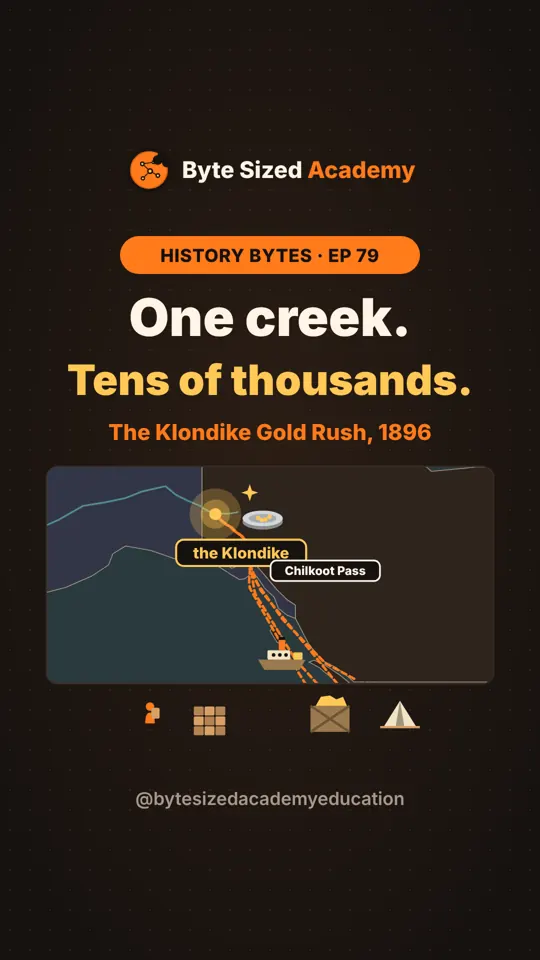 History Bytes · EP79h
The Klondike Gold Rush, 1896
In August 1896, Keish and Dawson Charlie, two Tagish men, and George Carmack found gold on Rabbit Creek in the Yukon. When gold ships reached Seattle and San Francisco in 1897, about 100,000 people set out for the Klondike, but only around a third arrived and few got rich. The rush pushed the Tr'ondëk Hwëch'in from their fish camp, and in 1898 Ottawa created the Yukon Territory.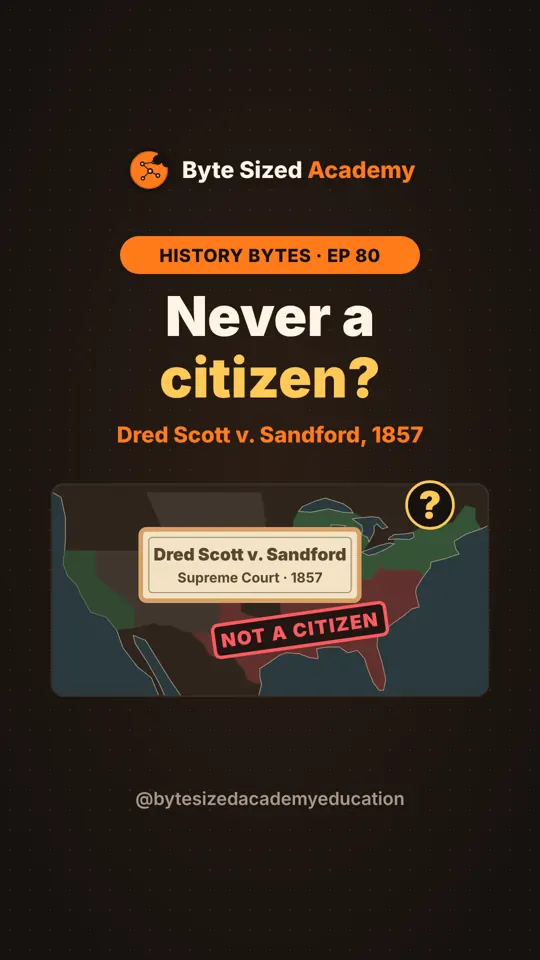 History Bytes · EP80h
Dred Scott
Dred Scott was an enslaved man who had been taken to live on free soil in Illinois and in a territory where slavery was banned. Back in Missouri, he and his wife Harriet sued for their freedom. In 1857 the Supreme Court ruled 7-2 against him. Chief Justice Roger Taney wrote that Black Americans, enslaved or free, could not be citizens and had no right to sue, and that Congress could not ban slavery in the territories. The ruling enraged the North and pushed the country toward war.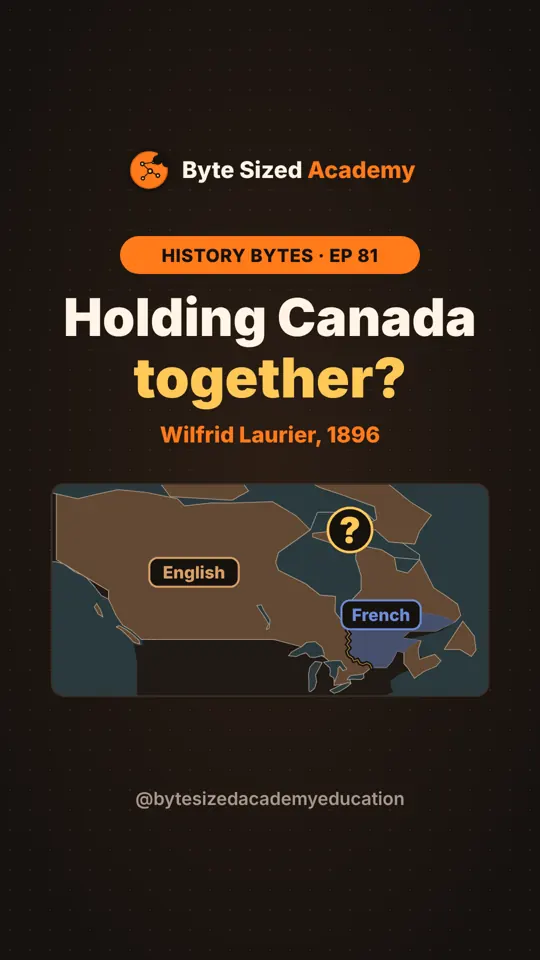 History Bytes · EP81h
Laurier, the first French-Canadian prime minister
In 1896 Wilfrid Laurier, born in Quebec and fluent in French and English, became Canada's first French-Canadian prime minister. He settled the Manitoba Schools Question with "sunny ways" and a compromise, and in 1899 sent only volunteers to the South African War. Compromise kept him in power for 15 years in a row, still a record, until he lost the 1911 election over a free trade deal with the United States.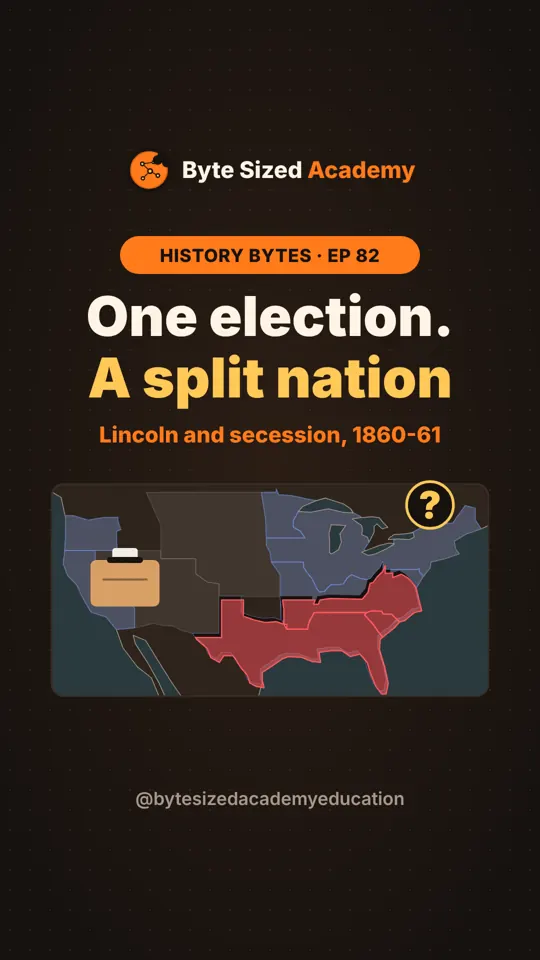 History Bytes · EP82h
Lincoln and secession
In 1860 Abraham Lincoln, a Republican who opposed spreading slavery into the western territories, won the presidency with Northern votes; he was not even on the ballot in most Southern states. Slave-state leaders feared his party would end slavery, and their own declarations named slavery as their reason for leaving. South Carolina seceded in December 1860, more Deep South states followed and formed the Confederacy, and Lincoln took office in March 1861 with the country already split. After Confederates fired on Fort Sumter in April 1861, more states left and the Civil War began.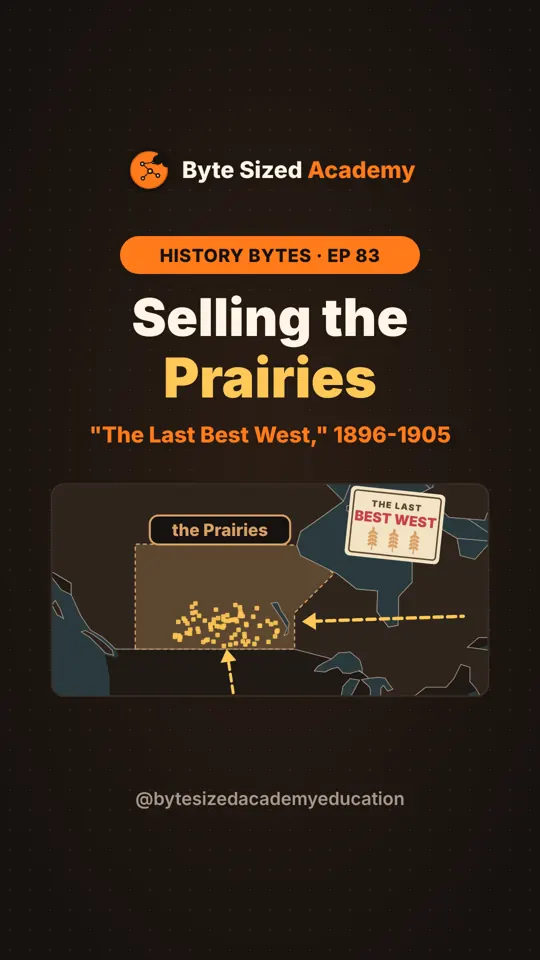 History Bytes · EP83h
'"The Last Best West": settling the Prairies'
From 1896, Clifford Sifton's Department of the Interior sold the Canadian Prairies as "the Last Best West," offered free homesteads for a $10 fee and recruited farmers from Britain, the United States and central and eastern Europe. Yearly immigration rose from about 17,000 to over 140,000 by 1905. The land was First Nations homelands, opened to settlers by the Numbered Treaties while First Nations were confined to reserves.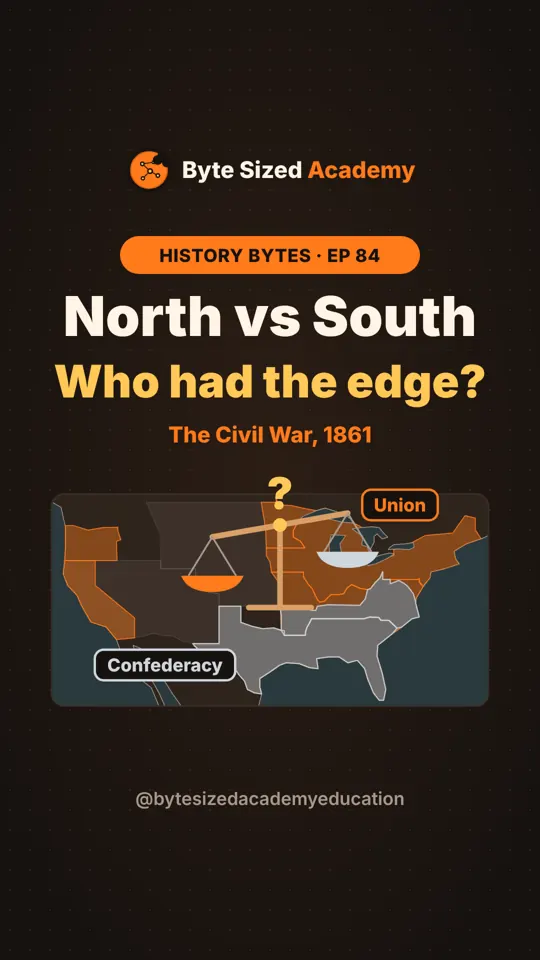 History Bytes · EP84h
"North vs South: who had the edge?"
When the Civil War began in 1861, the Union had about 22 million people to the Confederacy's 9 million (over a third of them enslaved), made about nine of every ten factory goods and had most of the railroads. The South only had to defend its land, had skilled generals like Robert E. Lee, and hoped Britain would step in, but Britain stayed neutral, and in a long war the North's people and factories wore the South down.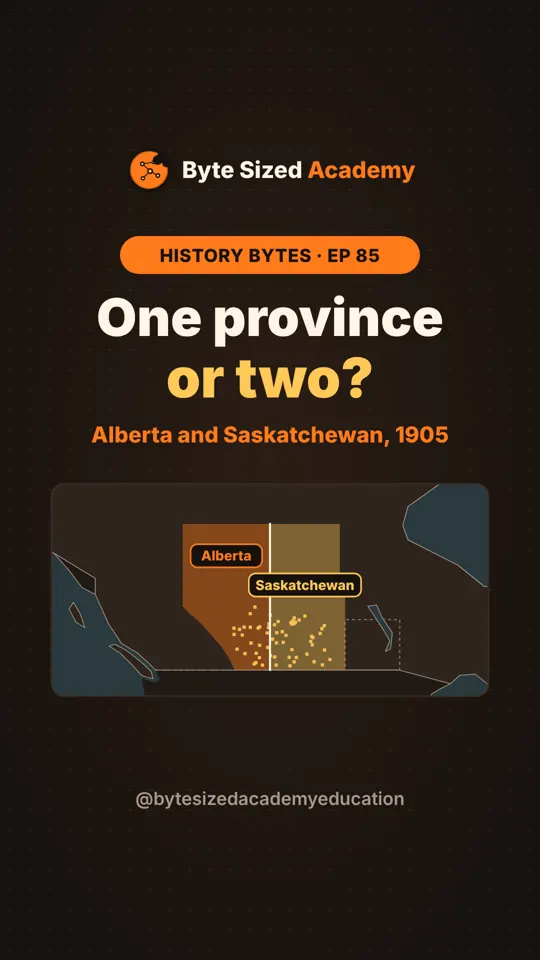 History Bytes · EP85h
"Alberta and Saskatchewan join, 1905"
By the early 1900s, settlers were pouring into the North-West Territories and wanted a provincial government with full powers and money for schools and roads. Territorial premier Frederick Haultain asked for one big province, but Wilfrid Laurier's government created two, Alberta and Saskatchewan, on September 1, 1905, split by a straight north-south line. Ottawa kept control of their land and natural resources until 1930, and the new provinces sat on First Nations and Métis homelands covered by the numbered treaties.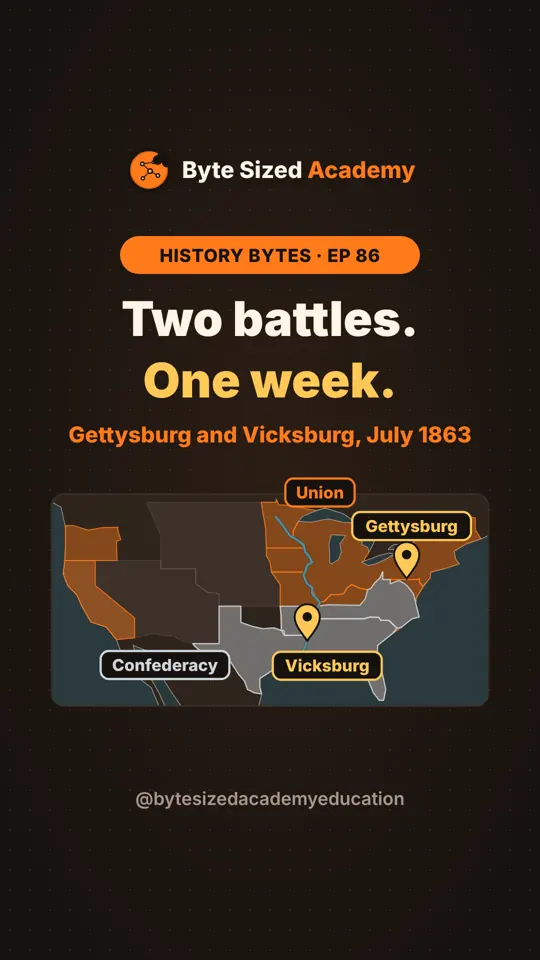 History Bytes · EP86h
"Gettysburg and Vicksburg"
In one week of July 1863, two Union victories turned the Civil War. Lee's invasion of the North failed at Gettysburg, Pennsylvania (July 1-3), and in the west Grant's six-week siege of Vicksburg ended with its surrender on July 4, soon giving the Union the whole river and splitting the Confederacy in two.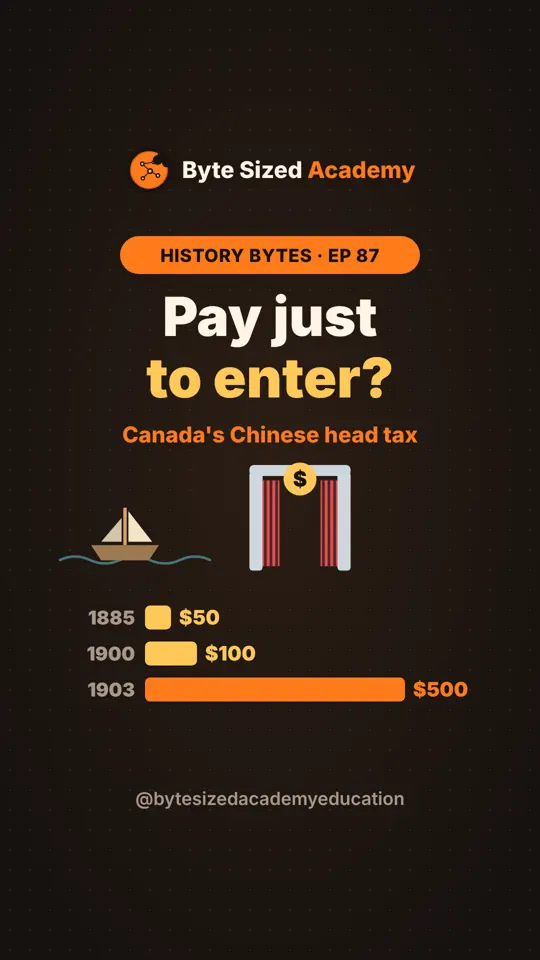 History Bytes · EP87h
"The Chinese head tax"
After Chinese workers helped build the Canadian Pacific Railway, Canada passed the Chinese Immigration Act of 1885, a racist law that charged Chinese newcomers a $50 head tax to enter. Pushed by British Columbia, the tax rose to $100 in 1900 and $500 in 1903, about two years' pay for many workers. Families were split for years, and the Chinese Immigration Act of 1923 shut out almost all Chinese immigrants until 1947. The Government of Canada later formally apologized.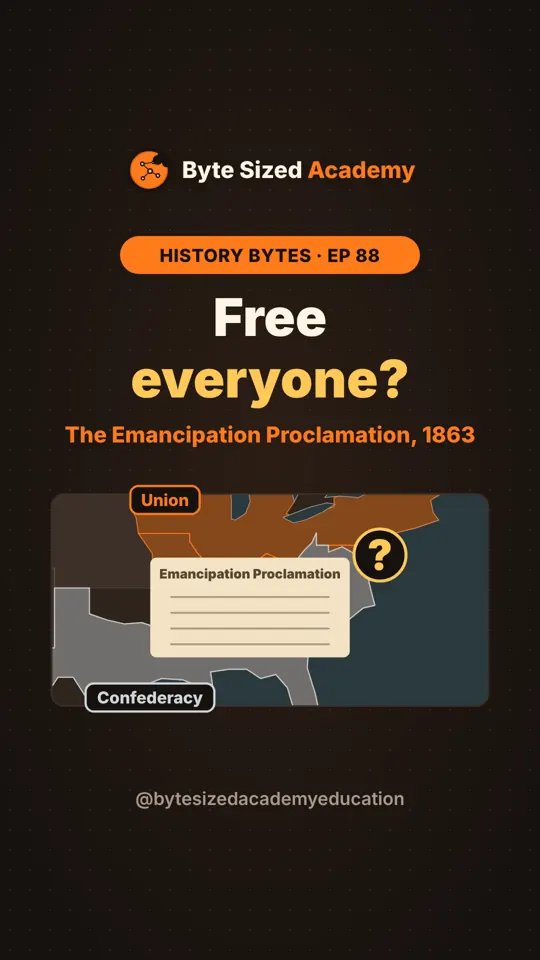 History Bytes · EP88h
"The Emancipation Proclamation"
On January 1, 1863, Abraham Lincoln issued the Emancipation Proclamation, declaring enslaved people in the rebelling states free. It covered only places still fighting the Union, so few were freed at first, but freedom spread with the Union army and with people who escaped to it, Black men could now enlist (almost 200,000 served), and ending slavery became a goal of the war.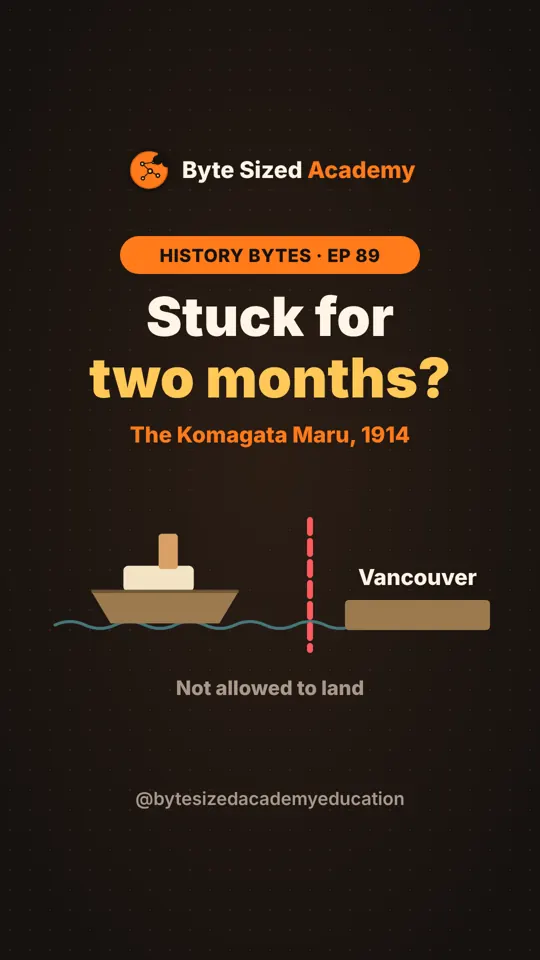 History Bytes · EP89h
"The Komagata Maru, 1914"
In 1908, Canada ruled that immigrants must arrive by one continuous journey from their home country. No ships sailed nonstop from India, so the racist rule kept South Asians out. In 1914, Gurdit Singh chartered the Komagata Maru to challenge it, and 376 passengers from Punjab, mostly Sikhs and all British subjects, sailed to Vancouver. Officials refused to let most of them land; they waited on board for two months, short of food and water, until a navy ship forced them out.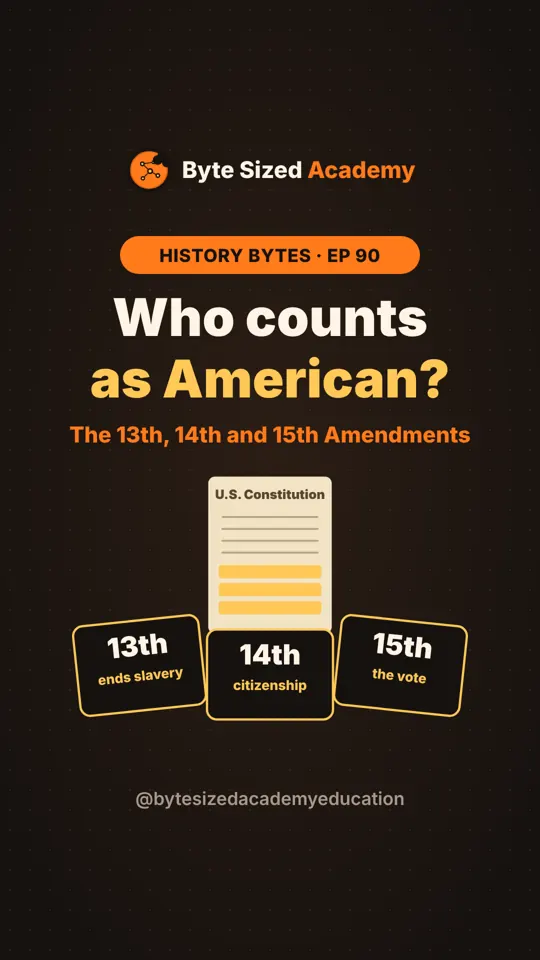 History Bytes · EP90h
"The 13th, 14th and 15th Amendments"
After the Civil War, three amendments to the Constitution rewrote who counts as American. The 13th (1865) ended slavery except as punishment for a crime, the 14th (1868) made people born in the U.S. citizens and promised equal protection of the laws, and the 15th (1870) said no one could be denied the vote because of race. Women were left out, and many states soon blocked Black voters; most of these promises were not enforced until the 1960s.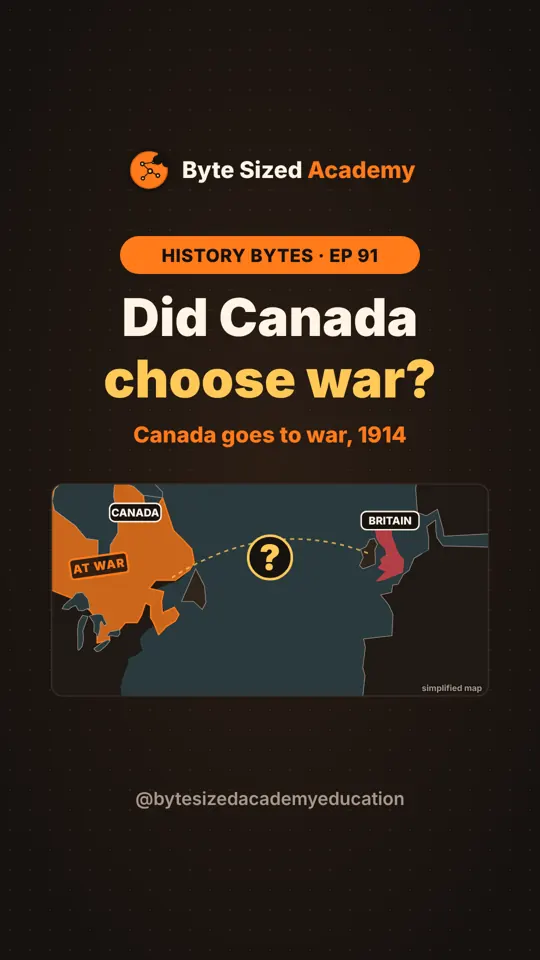 History Bytes · EP91h
"Canada goes to war, 1914"
When Britain declared war on Germany on August 4, 1914, Canada was at war automatically, because Britain still ran Canada's foreign policy. Canada could only choose how much to help. With about 3,000 full-time soldiers, it raised a volunteer army at Valcartier, near Quebec City, sent over 30,000 troops to Britain on October 3, and passed the War Measures Act.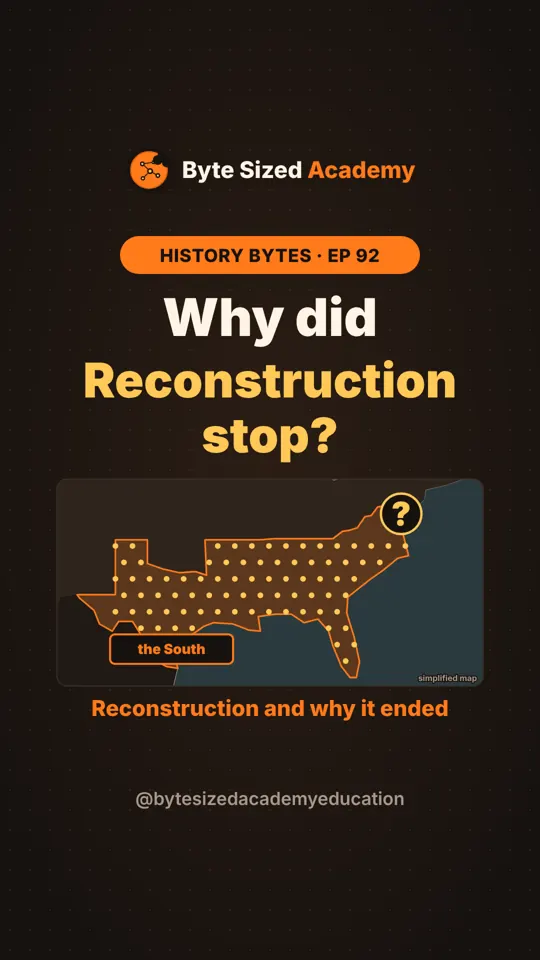 History Bytes · EP92h
"Reconstruction and why it ended"
After the Civil War, about four million formerly enslaved people were free. Federal troops stayed in the South, the Freedmen's Bureau opened schools, and Black men voted and won seats in Congress. Violence by groups like the Ku Klux Klan, a North that grew tired of the effort and a disputed 1876 election ended Reconstruction in 1877, and Black Americans soon lost many of their new rights.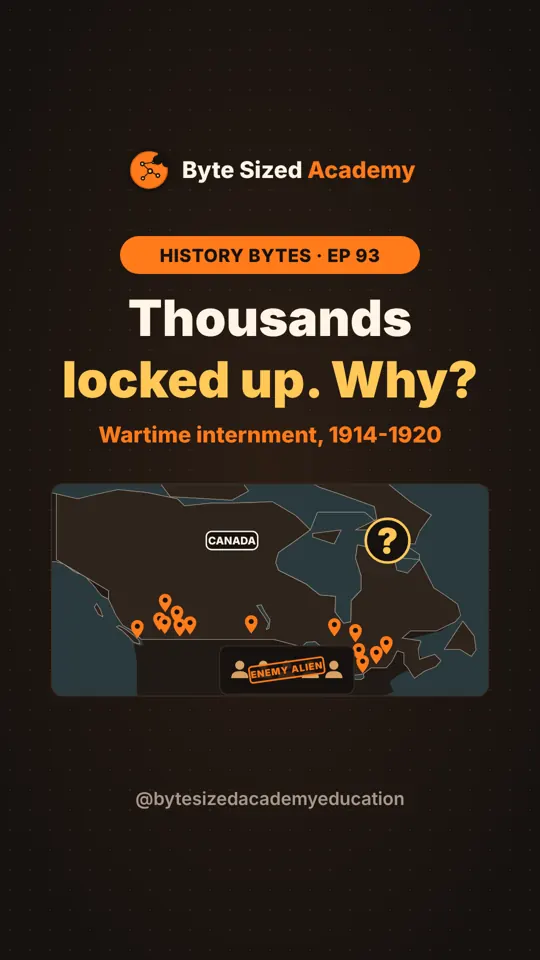 History Bytes · EP93h
"Wartime internment, 1914-1920"
When the First World War began in 1914, people in Canada from enemy countries were labelled "enemy aliens." Many were Ukrainians from Austria-Hungary, and most had done nothing wrong. Under the War Measures Act, tens of thousands had to register and report to police, and more than 8,000 were sent to internment camps, where they were forced to work. Some camps stayed open until 1920. Today, Canada recognizes this injustice. History Bytes · EP94h
"In Flanders Fields"
The red poppy of Remembrance Day comes from a poem. In 1915 John McCrae, a Canadian doctor and soldier serving in Belgium, wrote "In Flanders Fields" after a close friend was killed. The British magazine Punch printed it that December, and after the war the poppy became a symbol of remembrance. Canada adopted it in 1921. History Bytes · EP95h
"The Gilded Age"
The name "Gilded Age" comes from an 1873 novel by Mark Twain and Charles Dudley Warner. Gilded means covered with a thin layer of gold over something cheaper. In the late 1800s America looked golden, with railroads, factories and huge fortunes, but underneath many workers earned little for long, dangerous days, families crowded into tenements, and bribes and big company power shaped politics.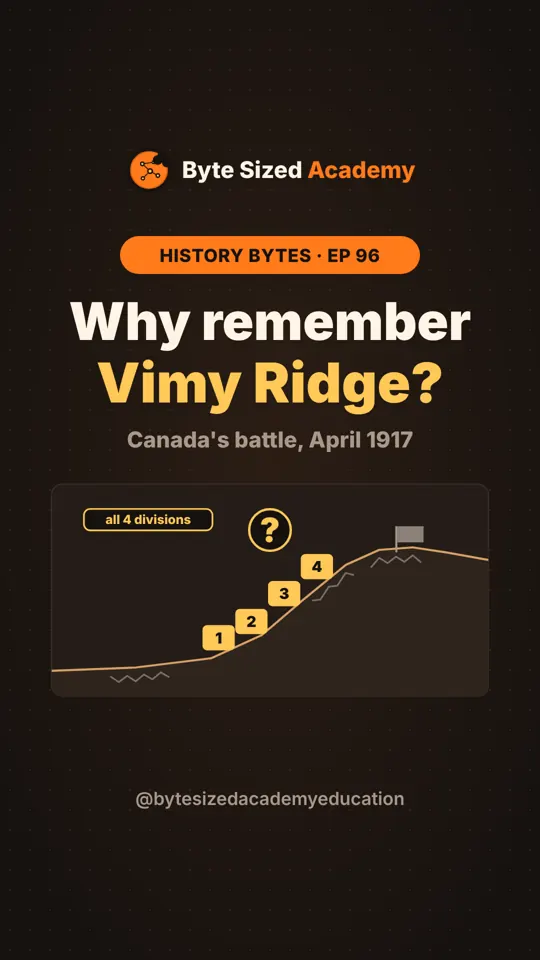 History Bytes · EP96h
"Vimy Ridge, 1917"
In April 1917, all four Canadian divisions attacked together for the first time and took Vimy Ridge in northern France, high ground that earlier British and French attacks had failed to capture. Careful preparation and a creeping barrage made the difference, but more than 10,600 Canadians were killed or wounded. Many see the battle as a moment when Canada began to see itself as a nation. History Bytes · EP97h
"Carnegie, Rockefeller and big business"
In the late 1800s, Andrew Carnegie built a steel empire by owning every step of production, from iron mines to railroads, while John D. Rockefeller's Standard Oil bought up rival refineries until it refined about nine in ten barrels of American oil. Fans called them captains of industry and critics called them robber barons. Carnegie later gave most of his fortune away, paying for thousands of libraries.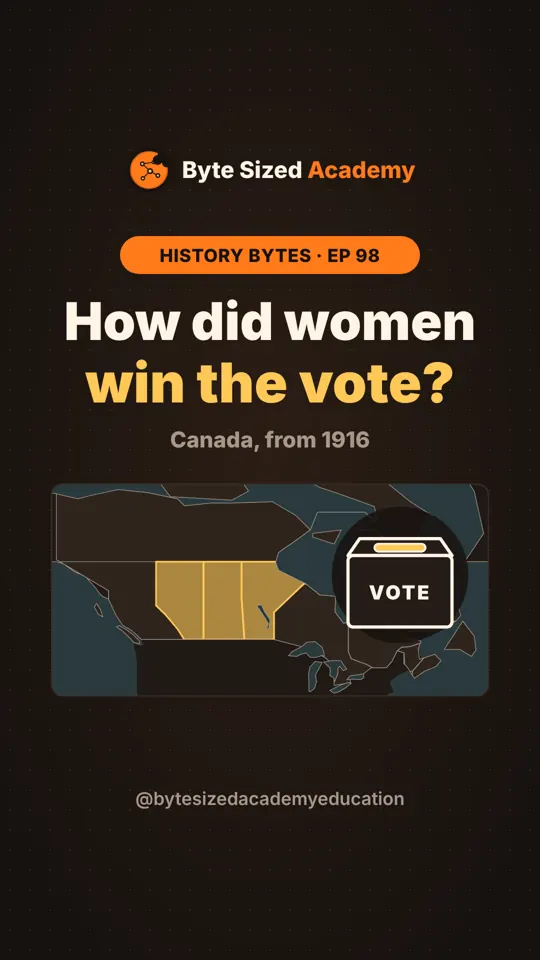 History Bytes · EP98h
"Women win the vote"
Suffragists in Canada campaigned with petitions, speeches and even a pretend parliament. In January 1916 Manitoba became the first province where most women could vote, Saskatchewan and Alberta soon followed, and most women got the federal vote in 1918. But many Asian Canadian, First Nations and Inuit women were still shut out for decades. History Bytes · EP99h
"The Chinese Exclusion Act, 1882"
Chinese immigrants came to California for the gold rush in the 1850s and helped build the first transcontinental railroad. When jobs got scarce in the 1870s, many politicians and labor groups blamed them for low wages. In 1882 Congress passed the Chinese Exclusion Act, stopping Chinese laborers from coming and barring Chinese immigrants from citizenship. It was the first major US law to shut out one group by nationality, and it was openly racist.Company Bytes
58 lessons · swipe for moreHow famous companies really grew, one confirmed story at a time.
 Company Bytes · EP01k
Nintendo's Playing Cards
Before video games, Nintendo made playing cards. The company dates its start to 1889 in Kyoto, Japan, when Fusajiro Yamauchi made hanafuda, small flower-covered cards. It moved into toys in the 1960s and released a home video game machine, the Color TV-Game, in 1977.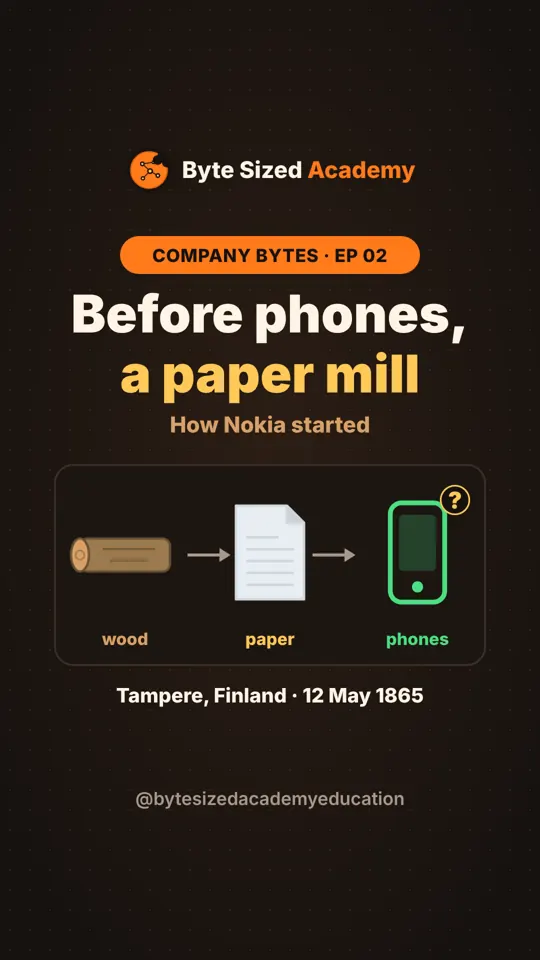 Company Bytes · EP02k
Nokia's Paper Mill
Before phones, Nokia made paper. On 12 May 1865, Fredrik Idestam got permission to build a groundwood pulp mill in Tampere, Finland, the date Nokia counts as its founding. A second mill opened near the town of Nokia in 1868, and the company took the town's name in 1871.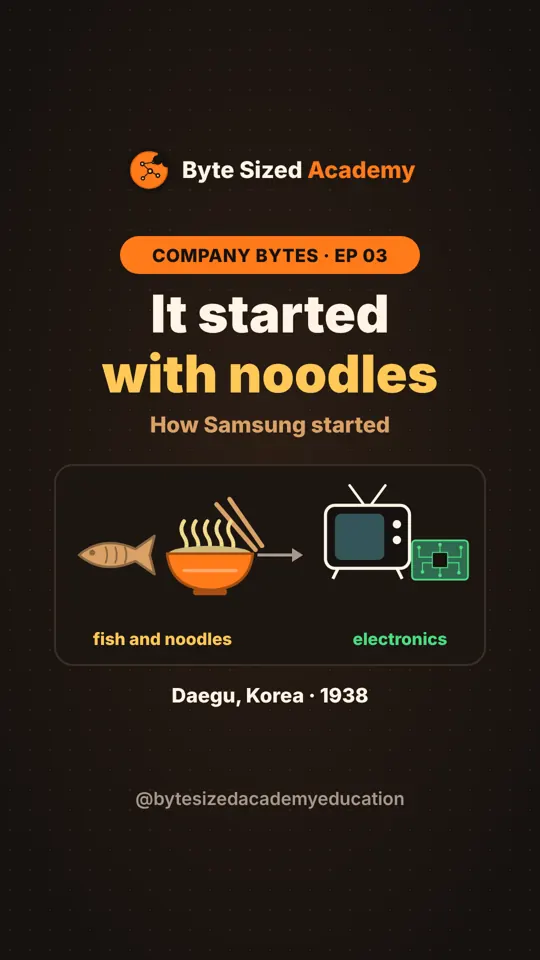 Company Bytes · EP03k
Samsung's Noodle Start
Samsung began in 1938 as Samsung Sanghoe, a small trading company in Daegu, Korea, founded by Lee Byung-chul. With about 40 employees, it traded dried fish, local groceries and noodles. The head office moved to Seoul in 1947, and Samsung entered electronics in the late 1960s.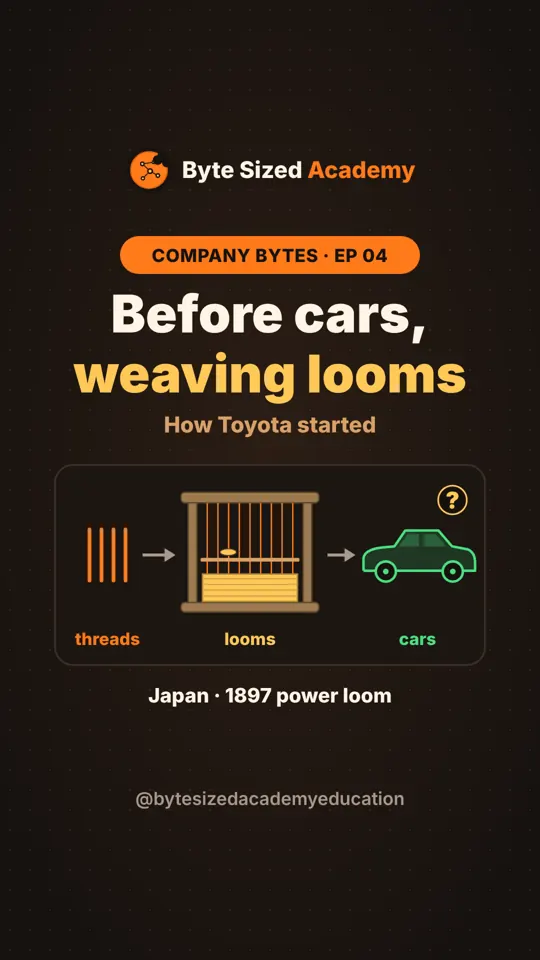 Company Bytes · EP04k
Toyota's Weaving Machines
Before cars, the Toyoda family built looms, the machines that weave threads into cloth. Sakichi Toyoda made the first Japanese-designed power loom in 1897, went on to invent automatic looms and founded Toyoda Automatic Loom Works. In the 1930s his son Kiichiro started car research inside the loom works, and that research grew into the Toyota car company.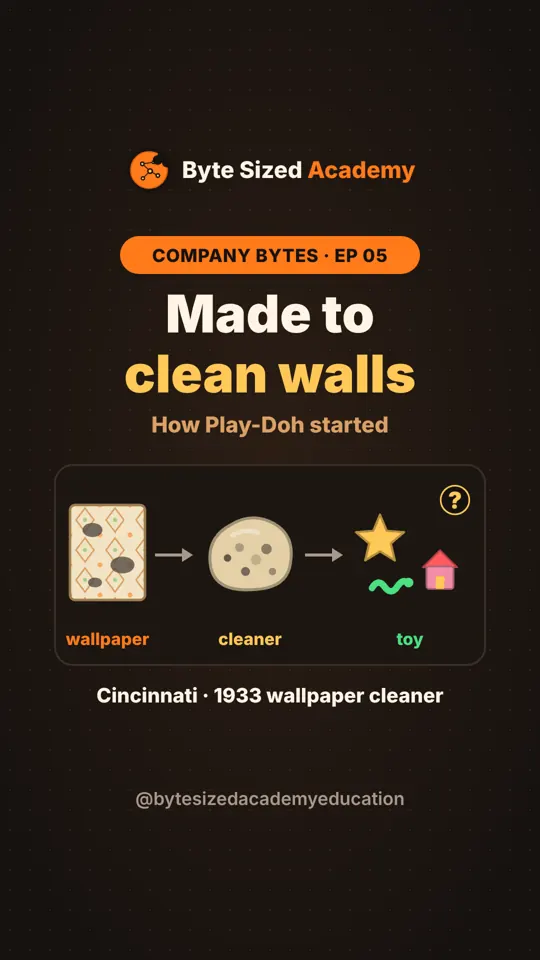 Company Bytes · EP05k
Play-Doh's Wall Cleaner
Play-Doh began as a wallpaper cleaner. From 1933, Kutol Products of Cincinnati made a soft dough for rolling coal soot off wallpaper. As homes switched away from coal heating, sales fell, and a schoolteacher in the family, Kay Zufall, suggested selling it as a toy. It became Play-Doh in 1956 and entered the National Toy Hall of Fame in 1998. Company Bytes · EP06k
Bubble Wrap's Wallpaper Plan
Bubble Wrap was meant to go on walls. In 1957, Alfred Fielding and Marc Chavannes sealed two plastic sheets together to make textured wallpaper. It didn't sell, and greenhouse insulation didn't work out either. They founded Sealed Air in 1960, and packaging turned out to be the right job. Company Bytes · EP07k
Avon's Free Gift
Avon started as a free gift with a book. Door-to-door book salesman David McConnell handed out free perfume samples, and his customers liked the perfume more than the books. In 1886 he switched to perfume and started the California Perfume Company, which later became Avon. Company Bytes · EP08k
Wrigley's Free Gum
Wrigley gum began as a free extra. In 1891, William Wrigley Jr. was selling soap in Chicago with free baking powder as a bonus. The baking powder was popular, so he sold it too, with free chewing gum as the new bonus. People wanted the gum most of all, and in the early 1890s he switched to selling gum. Company Bytes · EP09k
YouTube's Dating Site Idea
YouTube was first planned as a video dating site. Co-founder Jawed Karim has said the idea was for people to upload videos about themselves, and that even a $20 offer to upload a dating video found no takers. Instead, people uploaded all kinds of videos, and the first video ever posted, "Me at the zoo," went up on April 23, 2005. Company Bytes · EP10k
Shopify's Snowboard Shop
Shopify started because a snowboard shop needed a website. In 2004, Tobi Lütke started an online snowboard store in Ottawa called Snowdevil. He thought the store software out there was bad, so he built his own. Other shop owners asked to use it, and in 2006 it launched as a new company, Shopify. Company Bytes · EP11k
Post-it Notes' Weak Glue
Post-it Notes came from a glue that didn't stick well enough. In 1968, 3M scientist Spencer Silver made a weak adhesive that stuck, peeled off easily and could stick again, and for years he looked for a use. Art Fry's bookmarks kept falling out of his choir hymnal, and a bookmark with that weak glue would stay put and peel off without tearing the page. It first launched as Press 'n Peel, and in 1980 Post-it Notes reached the public. Company Bytes · EP12k
WD-40's Fortieth Try
WD-40 is named after the fortieth try. In 1953, the Rocket Chemical Company in San Diego started working on a formula to stop rust by pushing water away from metal. WD stands for Water Displacement, and 40 means it was the 40th formula. Its first job was protecting the outside of the Atlas missile, and it reached stores in 1958. NASA did not invent it. Company Bytes · EP13k
Coca-Cola's Pharmacy Start
Coca-Cola was invented by a pharmacist. On May 8, 1886, John Pemberton made a new syrup in Atlanta, and it was sold at Jacobs' Pharmacy for five cents a glass. His bookkeeper, Frank Robinson, came up with the name and wrote it out in the flowing handwriting that became famous. Later, Asa Candler bought control of the company and grew it far beyond one pharmacy. Company Bytes · EP14k
Dyson's 5,127 Prototypes
James Dyson says he built 5,127 prototypes before his bagless vacuum worked. His idea spun the air in a cyclone so the dust flies out, with no bag. In 1993, his bagless cyclone vacuum, the DC01, went on sale. Company Bytes · EP15k
LEGO's Wooden Ducks
LEGO started with wooden toys. In 1932, a carpenter named Ole Kirk Christiansen started making wooden toys in Billund, Denmark, like a little duck on wheels you pull along on a string. The name LEGO comes from two Danish words, "leg godt," which mean "play well." LEGO says the name was adopted in January 1936, which makes it 90 years old in 2026. Company Bytes · EP16k
Nike's Waffle Iron Sole
A famous running shoe started in a waffle iron. In 1964, Phil Knight and his coach, Bill Bowerman, started Blue Ribbon Sports, selling running shoes imported from Japan from Knight's car at track meets. Bowerman poured rubber into his wife's waffle iron to make a grippier sole, and in 1971 Blue Ribbon Sports became Nike. Company Bytes · EP17k
Slack's Failed Game
Slack came out of a video game that didn't catch on. A company called Tiny Speck made an online game called Glitch, and it shut down in December 2012. While building the game, the team had made a chat tool so people in different offices could work together. The chat tool still worked and was useful, so they turned it into a product, and it launched as Slack in August 2013. Company Bytes · EP18k
Twitter's Podcast Side Project
Twitter began as a side project at Odeo, a podcast company whose business struggled after iTunes added podcasts. Engineer Jack Dorsey pitched short status updates by text message, a small team at Odeo built it, and it launched to the public on July 15, 2006. Company Bytes · EP19k
Instagram's Burbn Start
Instagram started as an app called Burbn. Kevin Systrom built Burbn to do a bit of everything: check-ins, making plans with friends, and sharing photos. He and Mike Krieger cut it down to just photo sharing and launched the simpler app as Instagram in October 2010. In April 2012, Facebook agreed to buy it for about $1 billion in cash and stock. Company Bytes · EP20k
Airbnb's Cereal Boxes
Airbnb stayed alive by selling cereal. The founders first rented out air mattresses in their own apartment to guests who needed a place to stay. In 2008, during the US presidential election, they made special cereal boxes for both candidates, "Obama O's" and "Cap'n McCain's," sold them for $40 each, and raised about $30,000, money that helped keep the company going. Company Bytes · EP21k
Nvidia's Denny's Booth
One of the world's biggest chip companies started at a Denny's. In 1993, three engineers, Jensen Huang, Chris Malachowsky and Curtis Priem, started meeting at a Denny's in San Jose, California, and over meals there they planned a new company to make computer chips: Nvidia. Huang has said their very first chip was a failure that nearly bankrupted the company, but the company made it through and grew into one of the biggest chip companies in the world. Company Bytes · EP22k
Amazon Was Almost Cadabra
Amazon was almost called Cadabra. In July 1994, Jeff Bezos started a new company in the garage of a rented house in Bellevue, Washington, as an online bookstore. His first name for it was Cadabra, but when he said it out loud his lawyer kept hearing "cadaver," a word for a dead body, so Bezos changed the name to Amazon. Company Bytes · EP23k
Netflix's $50 Million Offer
In 2000, Netflix was still a small, young company and Blockbuster was a giant in movie rentals. Co-founders Marc Randolph and Reed Hastings offered to sell Netflix to Blockbuster for $50 million, and Blockbuster said no. Randolph wrote about the meeting in his 2019 book, That Will Never Work. To be fair to Blockbuster, Netflix was losing money back then, so the buy looked risky. Company Bytes · EP24k
Microsoft's Big DOS Deal
Microsoft's big break was software it bought from a nearby company. In 1981, IBM needed an operating system for its new personal computer, the IBM PC. Microsoft licensed 86-DOS, also known as QDOS, from Seattle Computer Products, then bought it outright in July 1981, renamed it MS-DOS and licensed it to IBM. The IBM PC went on sale in August 1981. Company Bytes · EP25k
Google Started as BackRub
Google's first name was BackRub. At Stanford University in California, Larry Page and Sergey Brin built a search engine called BackRub that ranked web pages by their links. In August 1998 they got a check for $100,000 to build their company and moved into a garage in Menlo Park, California, owned by Susan Wojcicki, who later became employee number 16 and, years after that, YouTube's CEO. Company Bytes · EP26k
The Brothers Behind Adidas and Puma
Adi and Rudolf Dassler ran a shoe company together in Herzogenaurach, Germany. In 1948 the brothers split up, and no one knows exactly why. Adi founded Adidas and Rudolf founded Puma, and the whole town split too, with separate bars and bakeries on each side. Decades later, workers from both companies met for a friendly football match to make peace. Company Bytes · EP27k
Marvel's Movie Rights Sale
In 1996, Marvel, the comic book company, went bankrupt. Around that time it licensed the film rights to some of its heroes cheaply, so other movie studios could make the movies: the X-Men went to Fox and Spider-Man went to Sony. A 1997 deal with a toy company called Toy Biz helped save Marvel, and later on Marvel started making its own films. Company Bytes · EP28k
Pixar's Start at Lucasfilm
Pixar started as a computer graphics group inside Lucasfilm, a film company. In 1986 the group left and became its own company, called Pixar, funded by Steve Jobs, who paid $5 million to Lucasfilm and put another $5 million into Pixar. At first Pixar made and sold computers and made short films to show what they could do; in 1995 came Toy Story, the first fully computer-animated feature film. Company Bytes · EP29k
What IKEA's Name Means
IKEA's name is a founder's initials, plus a farm and a village. In 1943, a 17-year-old in Sweden named Ingvar Kamprad founded his own business and called it IKEA. I and K are his initials, E is for Elmtaryd, the farm where his family lived, and A is for Agunnaryd, the village nearby. Company Bytes · EP30k
The Hockey Player's Donut Shop
Tim Hortons was started by an NHL defenceman. Tim Horton played defence for the Toronto Maple Leafs, and he teamed up with a partner, Jim Charade, to open a shop of their own. The first store opened on May 17, 1964, in a converted garage on Ottawa Street North in Hamilton, Ontario. Later, a businessman named Ron Joyce helped grow that one shop into a chain of stores all across Canada. Company Bytes · EP31k
Starbucks' Bean Shop
The first Starbucks opened in 1971 at Pike Place Market in Seattle, selling fresh-roasted coffee beans, tea and spices for people to take home, not cups of coffee. Howard Schultz joined in 1982, visited espresso bars in Milan, Italy, in 1983, and wanted to bring that café culture back home. The founders didn't want cafés at first, so he started his own café, Il Giornale. In 1987 he bought Starbucks and turned it into a chain of espresso bars. Company Bytes · EP32k
McDonald's Speed System
McDonald's speed system was invented by two brothers, not Ray Kroc. In 1948, Richard and Maurice McDonald cut their San Bernardino restaurant's menu down to hamburgers, fries and shakes and set up the Speedee Service System. Ray Kroc, a milkshake-mixer salesman, became their franchise agent in 1954 and bought the company in 1961 for $2.7 million. Company Bytes · EP33k
Lamborghini's Tractors
Lamborghini made tractors before it made supercars. Ferruccio Lamborghini built a successful tractor business, owned Ferraris and complained about their clutches. As he told it, he said the clutch in his Ferrari was like the ones in his tractors. In 1963 he started his own car company, Automobili Lamborghini.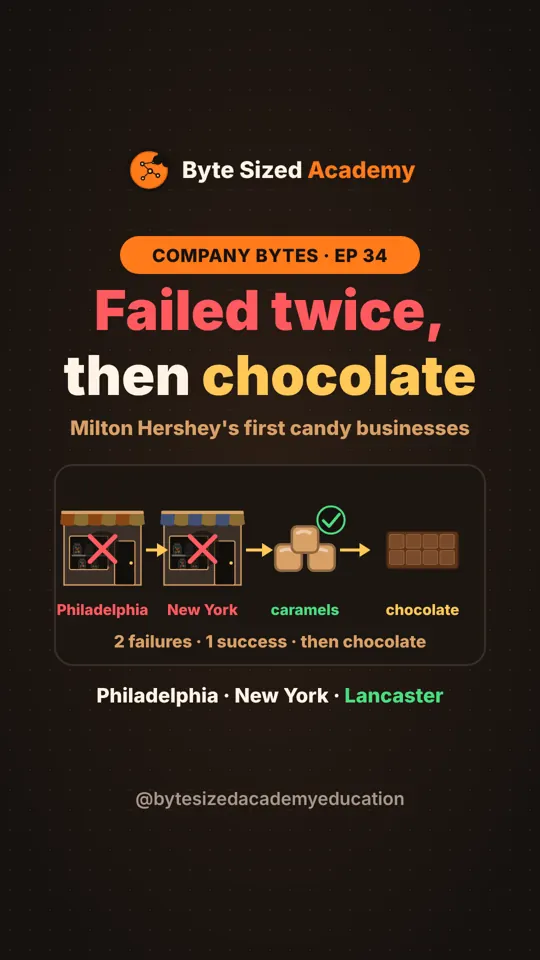 Company Bytes · EP34k
Hershey's Two Failures
Milton Hershey's first candy businesses failed. In 1876, a young candy maker named Milton Hershey opened his own candy shop in Philadelphia, and it failed. He tried again in New York City, and that candy business failed too. Then he started the Lancaster Caramel Company, and this time it was a big success. In 1900 he sold it for $1 million (a 1900 figure) and put all his focus on milk chocolate.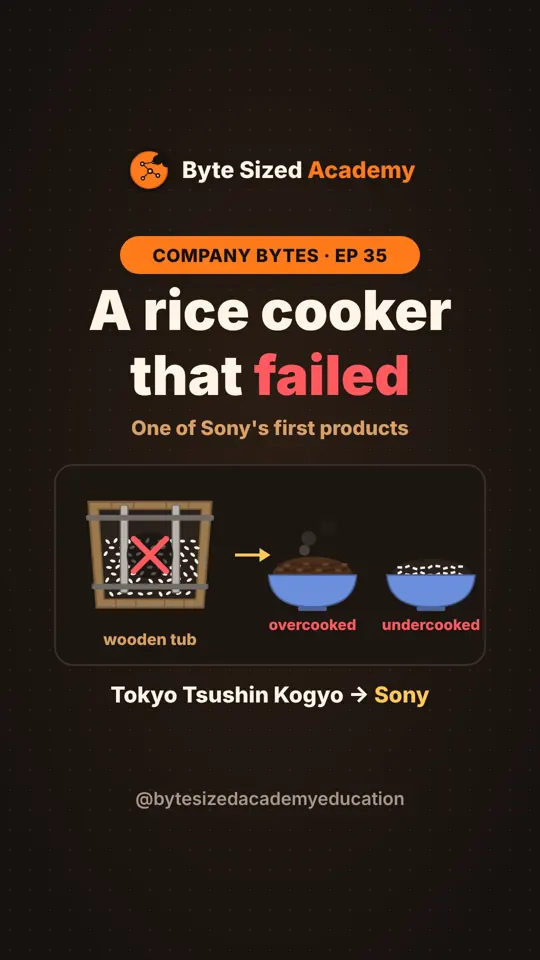 Company Bytes · EP35k
Sony's Rice Cooker
One of Sony's first products was a rice cooker that didn't work. In May 1946, Masaru Ibuka and Akio Morita started a small company in Tokyo on borrowed money, called Tokyo Tsushin Kogyo. One of their first products was an electric rice cooker: a simple wooden tub with metal parts called electrodes inside. It overcooked or undercooked the rice and never sold. Later, they renamed the company Sony, a short name that was easier to sell abroad.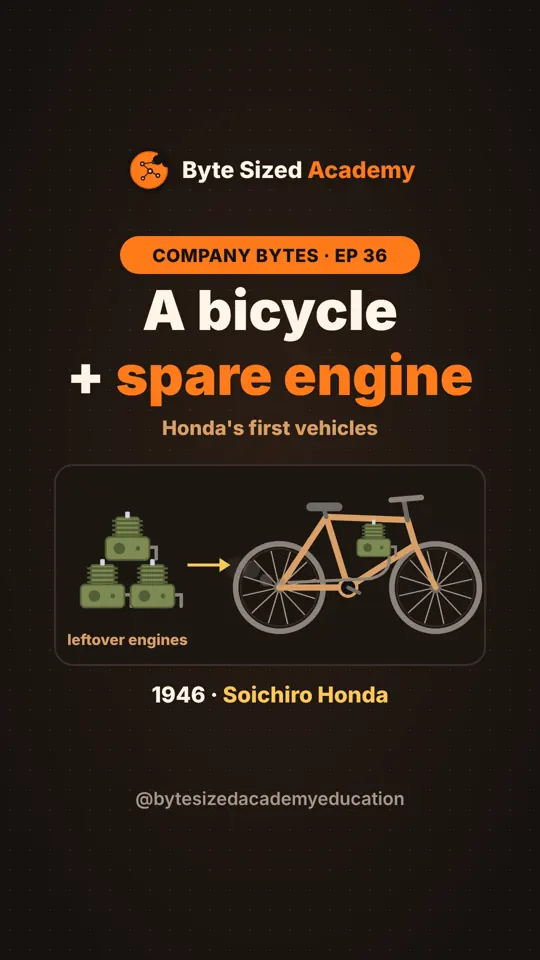 Company Bytes · EP36k
Honda's Motor Bicycles
Honda's first vehicles were bicycles with spare radio engines. In 1946, Soichiro Honda opened a small workshop in Hamamatsu, Japan, called the Honda Technical Research Institute, with about a dozen people. He fitted small leftover army engines, made to power radio generators, onto ordinary bicycles. When those ran out, he built his own engine, the A-Type. The little research institute later became Honda Motor Company.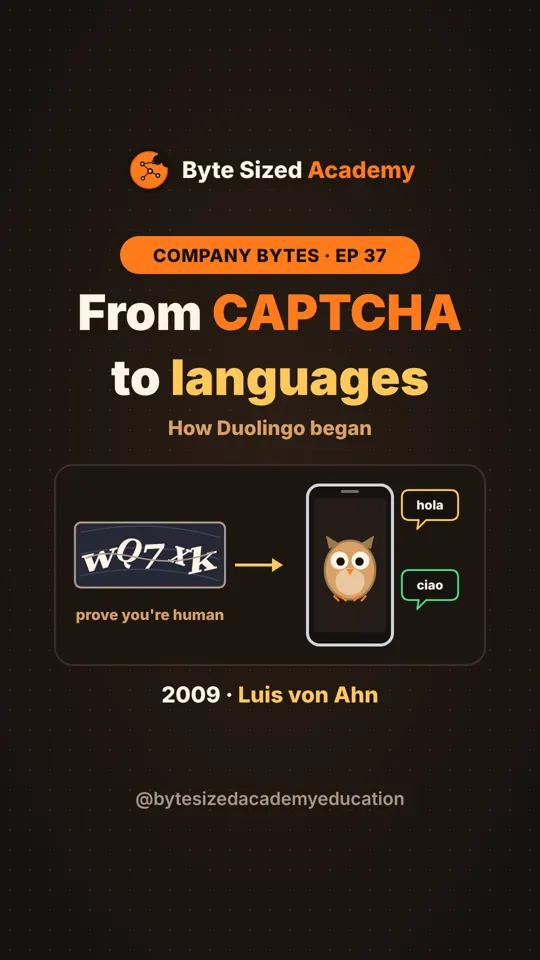 Company Bytes · EP37k
Duolingo and CAPTCHA
The language app Duolingo was started by one of the people who invented CAPTCHA. Luis von Ahn, a professor at Carnegie Mellon University known for CAPTCHA and reCAPTCHA, grew up in Guatemala, where English classes were expensive, and wanted anyone to be able to learn a language for free. In 2009 he started Duolingo with his graduate student, Severin Hacker, and on June 19, 2012, it opened to everyone. Company Bytes · EP38k
Spanx's Scissors
Spanx began with a snip of the scissors. In 1998, Sara Blakely was selling fax machines door to door. She wanted something smooth to wear under white pants, so she cut the feet off a pair of pantyhose. She has said she wasn't the first person to do that, but she saw a business idea in it. She put $5,000 of her savings into it, researched patents at a library and wrote her own patent application. That idea grew into Spanx, a billion-dollar company. Company Bytes · EP39k
Hasbro's Fabric Scraps
Hasbro began by selling leftover cloth. In 1923, three brothers, Henry, Hillel and Herman Hassenfeld, started a business in Providence, Rhode Island, selling textile remnants. Then they moved into pencil cases and school supplies, and by the 1940s they were making toys. In 1952 they bought Mr. Potato Head from its inventor, George Lerner, and it became one of the first toys advertised on TV. Company Bytes · EP40k
BlackBerry from Waterloo
Before the iPhone, the world's favourite smartphone came from Waterloo, Ontario. In 1984, Mike Lazaridis, from the University of Waterloo, and Douglas Fregin, from the University of Windsor, started Research In Motion as an electronics consulting company. Years later it made the BlackBerry, a handheld email device with a little keyboard that became a must-have for business people and leaders. Then the iPhone and Android phones took over, and in 2013 the company renamed itself BlackBerry. Company Bytes · EP41k
Pepsi's First Name
Pepsi was first called Brad's Drink. In 1893, pharmacist Caleb Bradham mixed up a drink at his pharmacy in New Bern, North Carolina, and named it after the first part of his own last name. On August 28, 1898, he renamed it Pepsi-Cola, and in 1902 the Pepsi-Cola Company was incorporated. Company Bytes · EP42k
Mattel's Picture Frames
Mattel started out making picture frames. Harold "Matt" Matson and Ruth and Elliot Handler founded the company in Los Angeles in 1945, Elliot turned the leftover frame scraps into dollhouse furniture, and the company soon turned from frames to toys. Company Bytes · EP43k
Yamaha's Broken Organ
Yamaha began with a repair job. In 1887, in Hamamatsu, Japan, Torakusu Yamaha was asked to repair a broken reed organ. He then built his own, one of the first reed organs made in Japan, and Yamaha traces its start to that 1887 repair. Company Bytes · EP44k
HP's Coin Toss
HP's name was picked with a coin toss. Bill Hewlett and Dave Packard started out in a one-car garage in Palo Alto, California, with $538. When they formed their partnership on January 1, 1939, a coin toss decided whose name went first, and the name became Hewlett-Packard. Company Bytes · EP45k
Ski-Doo's Typo
The Ski-Doo snowmobile was almost called the Ski-Dog. Bombardier, from Quebec, Canada, launched its first Ski-Doo in 1959 to replace sleds pulled by dogs, so the plan was to call it the Ski-Dog. A typo turned the name into Ski-Doo, and the new name stuck. Company Bytes · EP46k
Kellogg's Forgotten Wheat
The story goes that flaked cereal began in 1894 with a batch of boiled wheat that sat too long. At the Battle Creek Sanitarium in Michigan, brothers John Harvey and Will Kellogg rolled it, and it broke into flakes instead of dough. They toasted the flakes and served them to patients; a patent followed in 1896, and in 1906 Will started his own company to sell corn flakes.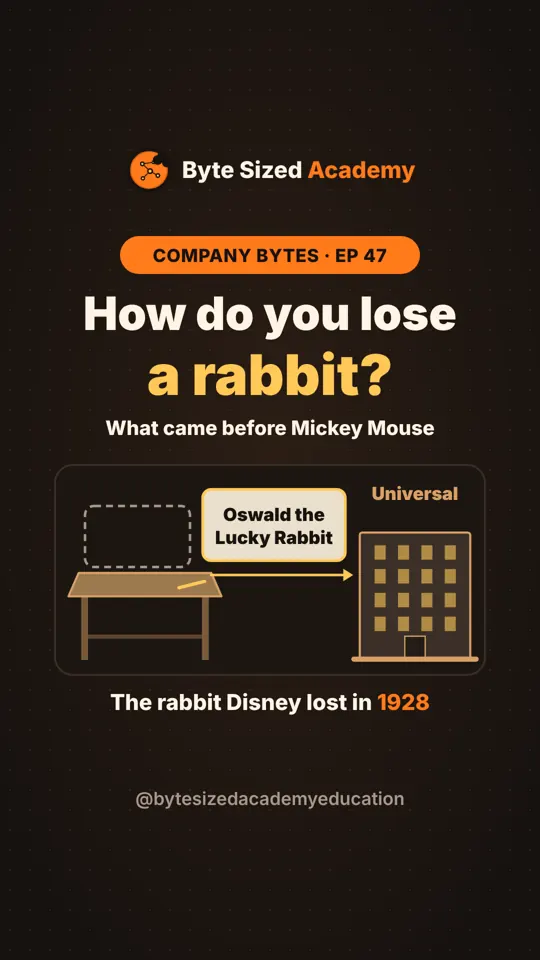 Company Bytes · EP47k
Disney's Lost Rabbit
In 1927, Walt Disney and animator Ub Iwerks created a cartoon character called Oswald the Lucky Rabbit. In 1928, after a contract dispute, the rights to Oswald stayed with Universal, so Disney and Iwerks made a brand-new character, Mickey Mouse, who debuted in "Steamboat Willie" on November 18, 1928. Disney got Oswald back in 2006.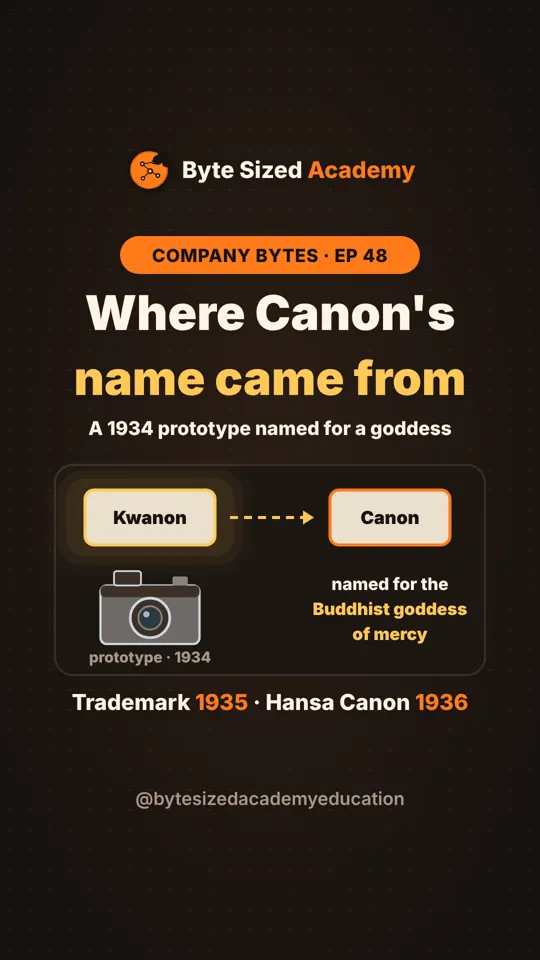 Company Bytes · EP48k
Canon's Goddess Camera
A small lab in Tokyo set out to build a camera to rival Germany's Leica. In 1934 it made a prototype called the Kwanon, named after the Buddhist goddess of mercy. The name Canon was registered as a trademark in 1935, the Hansa Canon, its first production camera, came in 1936, Canon counts 1937 as its founding year, and the company became Canon Camera in 1947.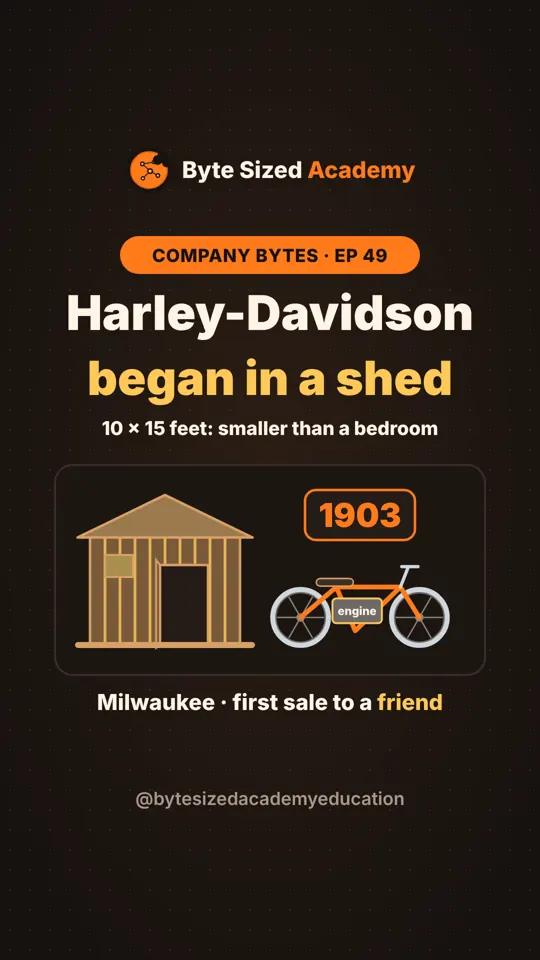 Company Bytes · EP49k
Harley-Davidson's Shed
Harley-Davidson says it began in 1903 in Milwaukee, Wisconsin, where the founders built a wooden shed just 10 feet by 15 feet. Their very first machine couldn't climb Milwaukee's small hills unless the rider pedaled, but they sold their first motorcycle to a friend, Henry Meyer. In 1906 they built a factory on Chestnut Street, now Juneau Avenue, which is still the company's headquarters.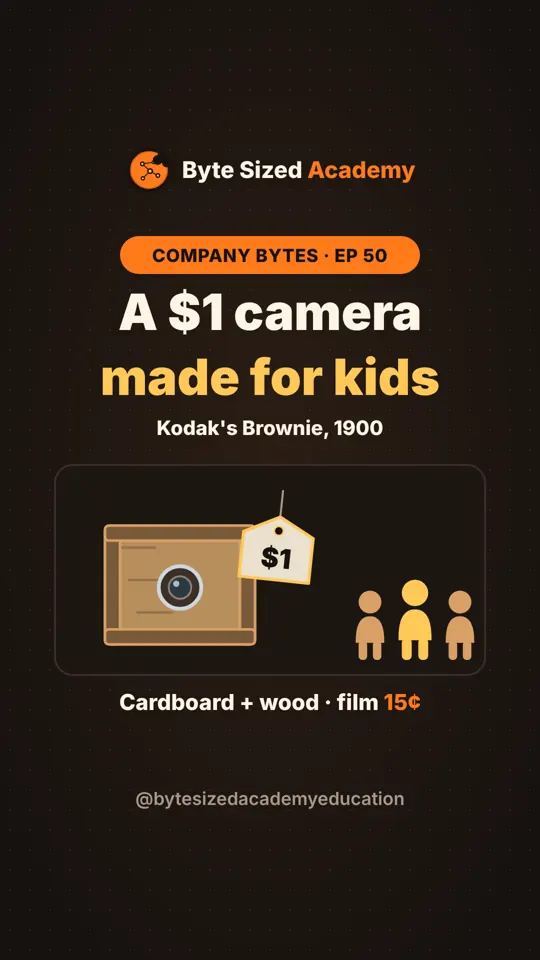 Company Bytes · EP50k
Kodak's One-Dollar Camera
In 1900, George Eastman's company, Kodak, launched the Brownie, a one-dollar camera aimed at children. It was a simple box camera made of cardboard and wood, and replacement film cost 15 cents. Kodak already had a famous slogan, first used with its 1888 camera: "You press the button, we do the rest." Company Bytes · EP51k
Michelin's Food Guide
In 1900, French tire makers André and Édouard Michelin made a free guide for drivers, full of maps and handy tips, so people would drive more and need more tires. Sources say about 35,000 copies were printed. In 1926, the guide began giving a star to great restaurants, and later it added a second and a third star. Company Bytes · EP52k
Peugeot's Pepper Mills
Peugeot started in France in 1810 making iron tools. In 1840 it made its first coffee grinder, in the 1850s it got a lion as its trademark, and in 1874 it made its first pepper mill. Peugeot pepper mills are still sold today, more than 150 years after the first one. Company Bytes · EP53k
Goodyear's Borrowed Name
Frank Seiberling and his brother Charles founded Goodyear in Akron, Ohio, on August 29, 1898. Frank named it after Charles Goodyear, the inventor who discovered how to vulcanize rubber and who had died in 1860, 38 years before the company opened. Company Bytes · EP54k
Crayola's Nickel Box
Binney & Smith began by making charcoal and black pigment. In June 1903 it sold the first box of Crayola crayons, eight colors for a nickel. The name came from Alice Binney, who joined "craie," French for chalk, with "ola," from oily. Company Bytes · EP55k
Heinz's Second Try
Henry J. Heinz started selling horseradish in clear glass bottles in 1869. The business went bankrupt in 1875, but he started again with his family and added ketchup in 1876. By the 1890s the company's slogan was "57 Varieties," even though it already sold more than 60 products. Company Bytes · EP56k
Apple's First Order
Steve Jobs, Steve Wozniak and Ronald Wayne founded Apple on April 1, 1976. Paul Terrell of the Byte Shop offered to buy 50 Apple I computers at $500 each, but only fully assembled. Jobs sold his van, Wozniak sold his calculator, Jobs bought parts on credit using the order, and the computers were put together at Jobs's family home. Company Bytes · EP57k
Rolex's London Start
In 1905, Hans Wilsdorf and Alfred Davis started a company in London called Wilsdorf and Davis, selling watches whose movements came from Switzerland. In 1908, Wilsdorf registered the name "Rolex" as a trademark, and in 1919 the company moved from London to Geneva, Switzerland. Company Bytes · EP58k
Colgate's Toothpaste Jars
In 1806, William Colgate started a soap and candle business on Dutch Street in New York City. In 1873, the company began selling toothpaste in jars, and in 1896 Colgate introduced toothpaste in a collapsible tube.Money Bytes
13 lessons · swipe for moreMoney Bytes explains personal finance, investing and the economy in one-minute lessons, from what money is to how to grow it.
 Money Bytes · EP01m
What is money, really?
A $20 bill is just paper, so why does everyone take it? Money solves the problems of barter, and today's dollar is fiat money, backed by taxes, the law and trust instead of gold. Money Bytes · EP02m
Inflation
Inflation means prices across the economy rise over time, so each dollar buys a little less. Here is what causes it, how it is measured, and why central banks aim for about 2%. Money Bytes · EP03m
Interest: renting money
Interest is rent for money. Borrowers pay it to use someone else's money, savers earn it when the bank uses theirs, and the interest rate says how big the rent is each year.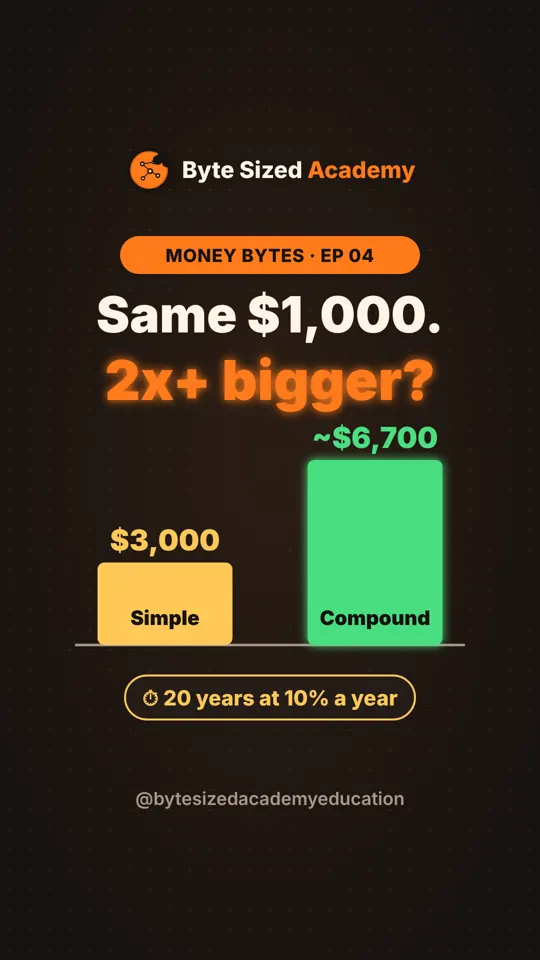 Money Bytes · EP04m
Simple vs compound interest
Simple interest pays only on the money you started with. Compound interest pays interest on your interest too, so the same money at the same rate can end up more than twice as big. Money Bytes · EP05m
The Rule of 72
Divide 72 by a yearly rate to estimate how many years it takes to double. Here is how the shortcut works for savings, credit card debt and inflation, and how close it gets. Money Bytes · EP06m
Assets vs liabilities
An asset is something you own that's worth money; a liability is money you owe. Here is how to sort what you have, why some assets pay you while debts cost you, and why a car can be both. Money Bytes · EP07m
Net worth
Net worth is everything you own minus everything you owe. Here is how to add it up, why it is often negative at first, and how it climbs. Money Bytes · EP08m
Opportunity cost
Every choice has a hidden price tag: the best thing you gave up to make it. Here is how a $5 daily coffee adds up, and what else that money could do. Money Bytes · EP09m
Gross vs net pay
Gross pay is everything you earn before anything comes out. Net pay, or take-home pay, is what actually lands in your bank account, and it's the number to budget with. Money Bytes · EP10m
What comes out of your paycheck
Five things usually come out of a US paycheck before you get paid: federal income tax, Social Security, Medicare, state and local tax, and the benefits you signed up for. Money Bytes · EP11m
Tax brackets (the myth)
Moving into a higher tax bracket doesn't raise the tax on all your income. Only the dollars inside the higher bracket pay the higher rate, so a raise always leaves you with more. Money Bytes · EP12m
The 50/30/20 budget
The 50/30/20 budget splits your take-home pay into three buckets: 50% for needs, 30% for wants and 20% for savings and extra debt payoff. Money Bytes · EP13m
Pay yourself first
Paying yourself first means a set amount moves to savings the moment your paycheck lands, before anything else, and you budget with the rest. Making it automatic keeps it going.Math Bytes
5 courses · swipe for moreMath explained simply in one minute, from algebra to calculus.
 18 lessonsHigh school
Algebra 1
Foundations · Algebraic expressions · Linear equations and inequalities · Graphing lines and slope · Systems of equations · Expressions with exponents · Quadratics and polynomials 31 lessonsAP and college
Calculus
Limits and continuity · Derivatives: definition and basic rules · "Derivatives: definition and basic rules" · "Derivatives: chain rule and advanced topics" · Applications of derivatives · Analyzing functions · Integrals · Integration techniques · Differential equations (intro) · Applications of integrals · Parametric, polar and vector functions (BC) · Infinite sequences and series (BC) 8 lessonsAP and college
Multivariable calculus
Multivariable functions · Derivatives of multivariable functions · Applications of multivariable derivatives · Integrating multivariable functions · "Green's, Stokes' and the divergence theorems" 5 lessonsAP and college
Differential equations
First-order equations · Second-order linear equations · Laplace transform 6 lessonsAP and college
Linear algebra
Vectors and spaces · Matrix transformations · Alternate coordinate systems (bases)Code Bytes
4 courses · swipe for moreLearn to code from zero, one tiny idea at a time.
 8 lessons
"Start Here: What Is Coding?"
The big picture · Thinking like a coder 17 lessons
"Intro to Programming"
What code is · Data · Decisions and loops · Functions and lists · Debugging 8 lessons
"How Computers Work"
Bits and bytes · Hardware · Software layers 5 lessons