
High school · 18 lessons
Algebra 1
One idea per video, in order. Start at the top and work your way across.
Foundations
3 lessons · swipe for more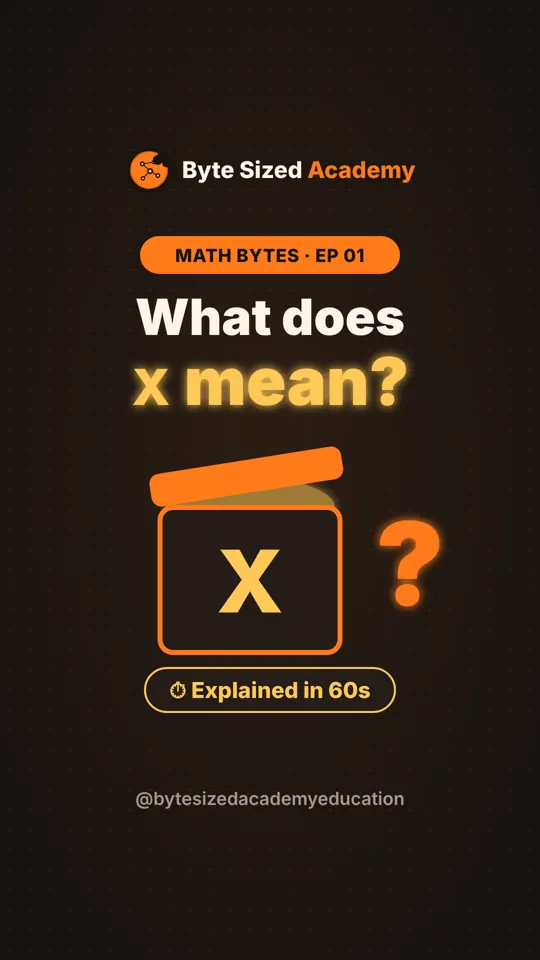 Algebra 1 · EP1
What a variable is
In algebra, a letter like x is a variable: it stands for a number we don't know yet, or a number that can change. Think of it as a box with a number hiding inside.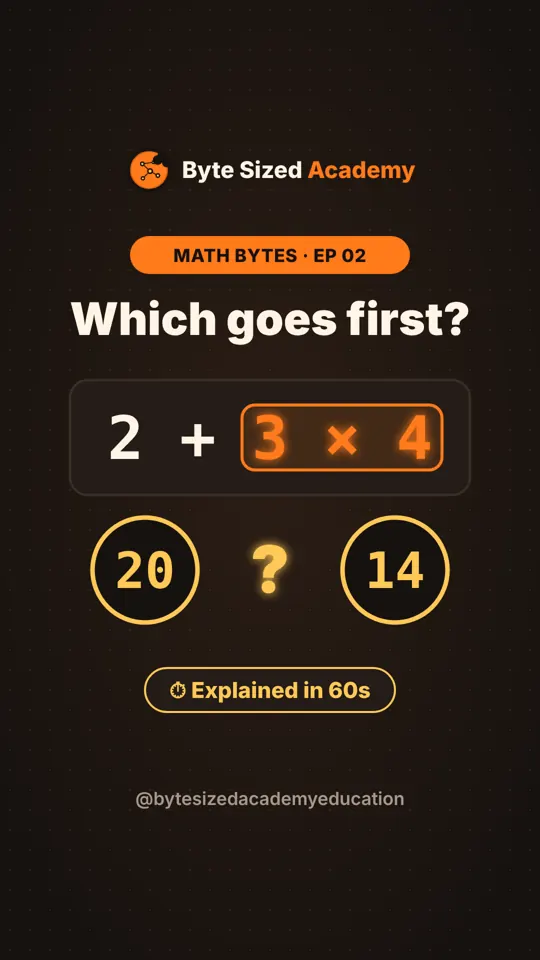 Algebra 1 · EP2
Order of operations
Is 2 + 3 × 4 equal to 20 or 14? The order of operations says multiply and divide before you add and subtract, so it's 14. Parentheses always go first, and PEMDAS helps you remember the order.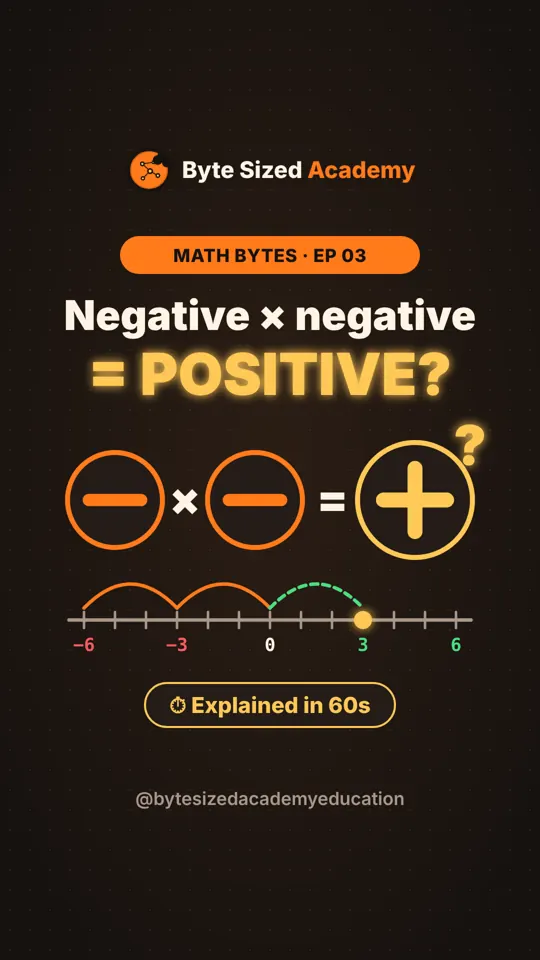 Algebra 1 · EP3
Negative numbers
Negative numbers sit below zero, to the left on a number line. A simple multiplication pattern shows why a negative times a negative has to be positive: same signs give a positive, different signs give a negative.Algebraic expressions
2 lessons · swipe for more Algebra 1 · EP4
Combining like terms
Terms with the same letter and the same power are like terms, and you combine them by adding the numbers in front, so 3x + 4x = 7x. Terms with different powers, like 3x and 2x², stay separate.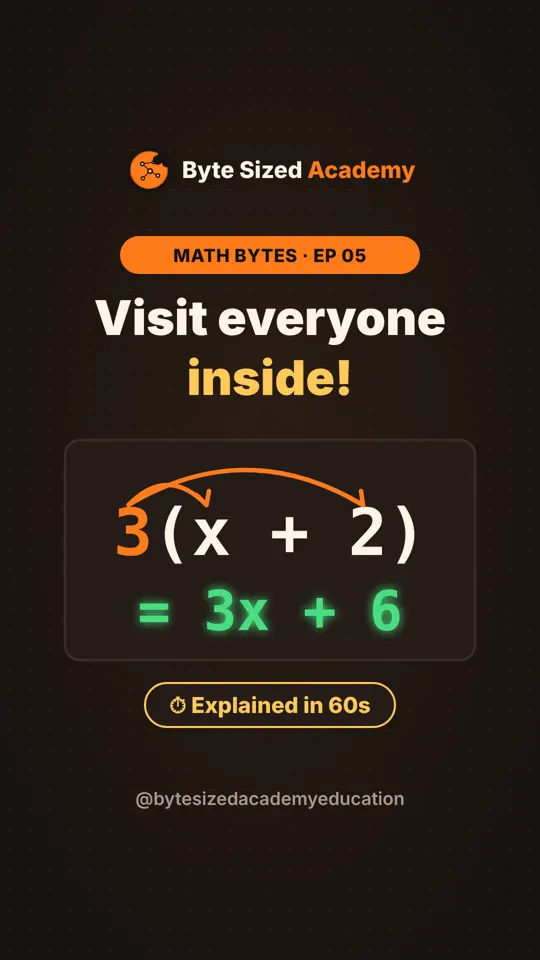 Algebra 1 · EP5
The distributive property
To multiply a number by something in parentheses, multiply it by every term inside, so 3(x + 2) = 3x + 6. That's the distributive property, and the classic mistake is forgetting the second term.Linear equations and inequalities
3 lessons · swipe for more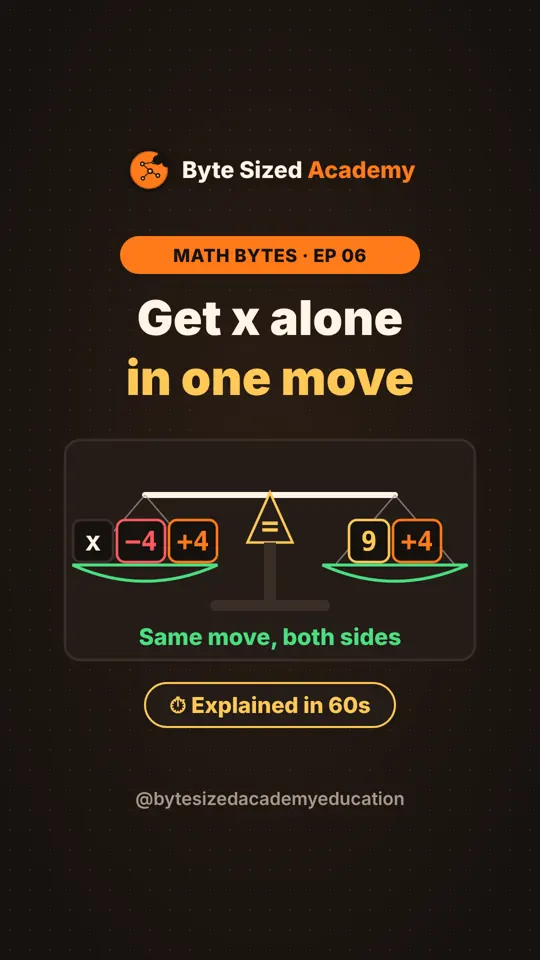 Algebra 1 · EP6
Solving one-step equations
An equation is like a balance scale, so whatever you do to one side you do to the other. Undo what is being done to x, on both sides, and x is left alone: x − 4 = 9 gives x = 13, and 3x = 15 gives x = 5.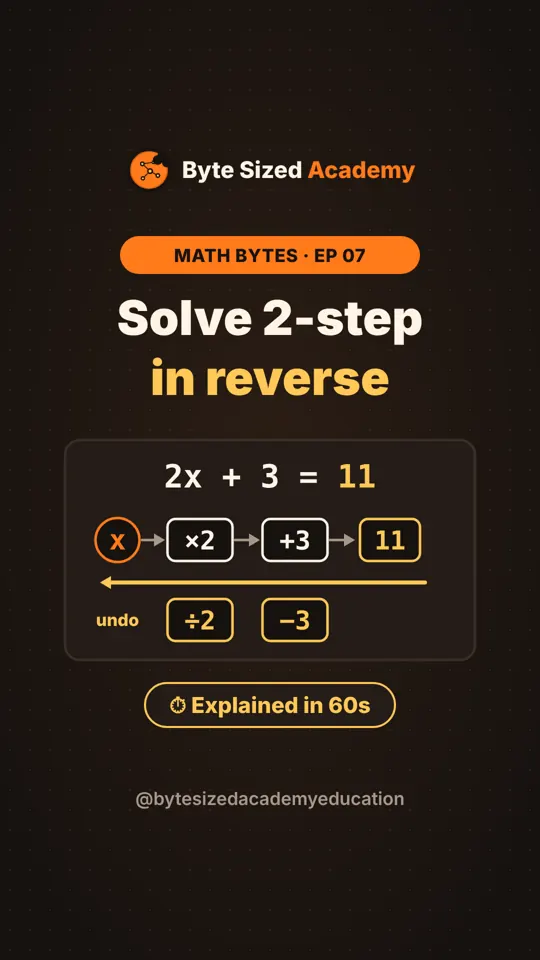 Algebra 1 · EP7
Solving two-step equations
A two-step equation like 2x + 3 = 11 did two things to x, so you undo them in reverse order, like taking off shoes before socks. Subtract 3 from both sides to get 2x = 8, then divide both sides by 2 to get x = 4.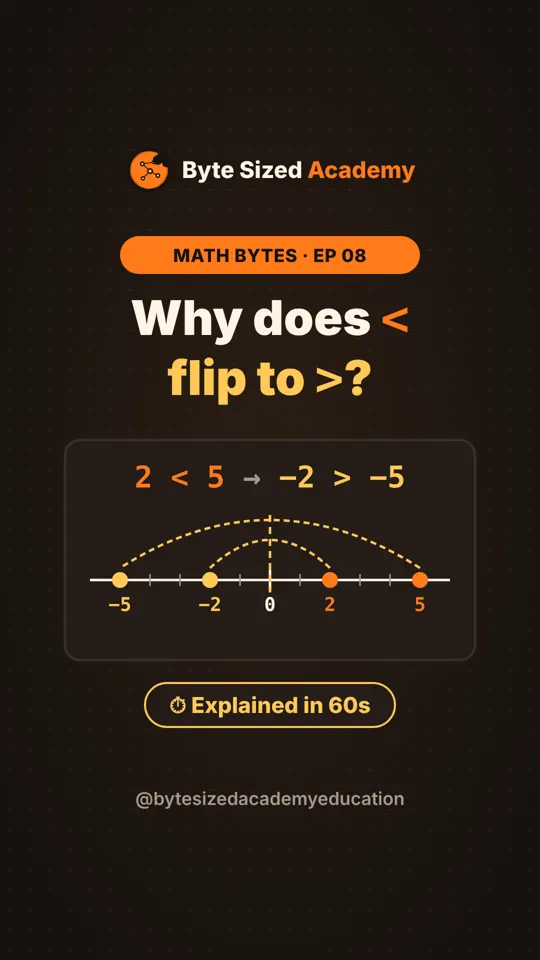 Algebra 1 · EP8
Inequalities and the flip rule
When you multiply or divide both sides of an inequality by a negative number, the inequality sign flips. Multiplying by −1 mirrors the number line around zero, so 2 < 5 becomes −2 > −5. Example: −2x < 6 becomes x > −3.Graphing lines and slope
3 lessons · swipe for more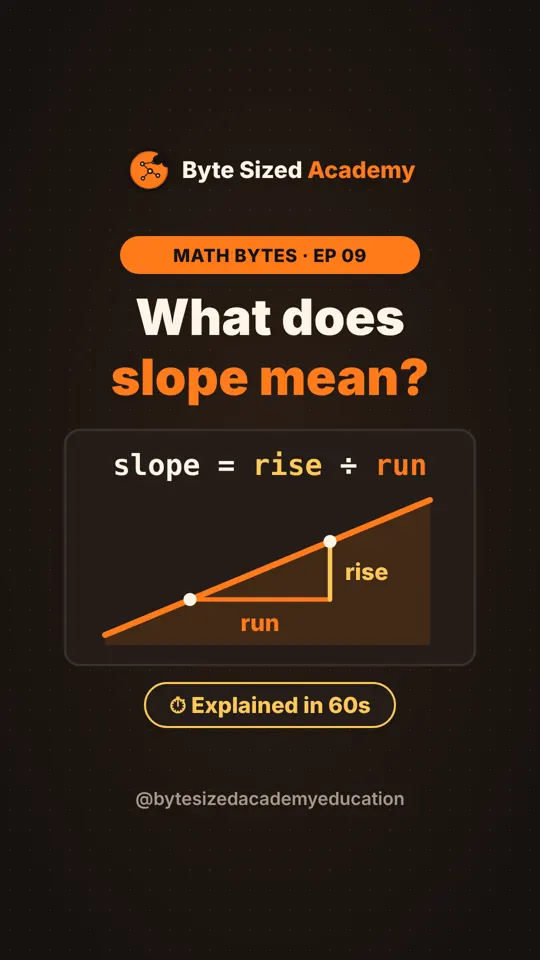 Algebra 1 · EP9
What slope means
Slope measures how steep a line is. Slope = rise ÷ run, where rise is how far up you go and run is how far right you go. Example: from (0, 1) to (2, 7) the line rises 6 and runs 2, so the slope is 6 ÷ 2 = 3.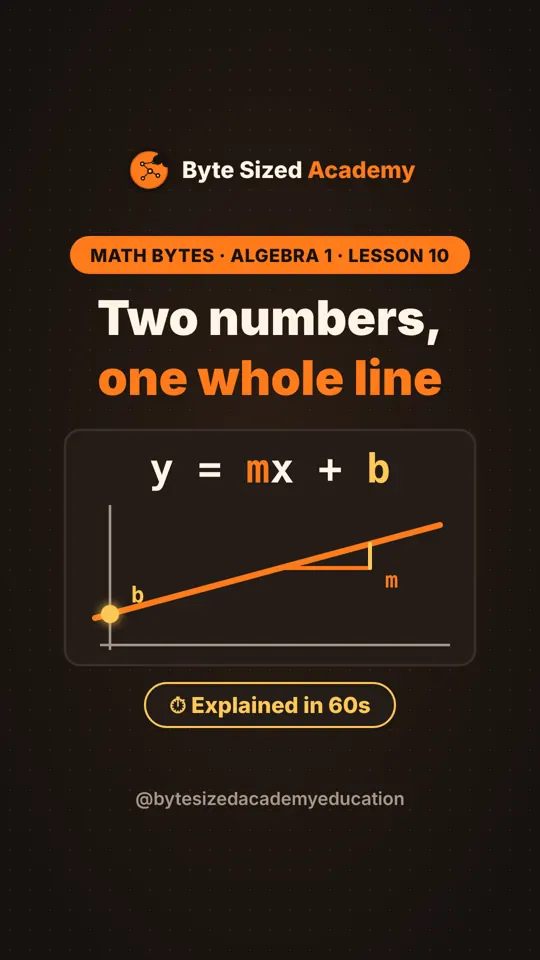 Algebra 1 · EP10
y = mx + b
Most straight lines can be written as y = mx + b, where m is the slope (how steep the line is) and b is the y-intercept (where the line crosses the y-axis). Example: to graph y = 2x + 1, start at (0, 1), then go up 2 and right 1. Algebra 1 · EP11
Parallel and perpendicular lines
Parallel lines have the same slope, so they never meet. Perpendicular lines meet at a right angle, and their slopes are flipped with the sign changed (negative reciprocals), so the two slopes multiply to −1. Example: y = 2x + 1 and y = −½x + 1 are perpendicular.Systems of equations
3 lessons · swipe for more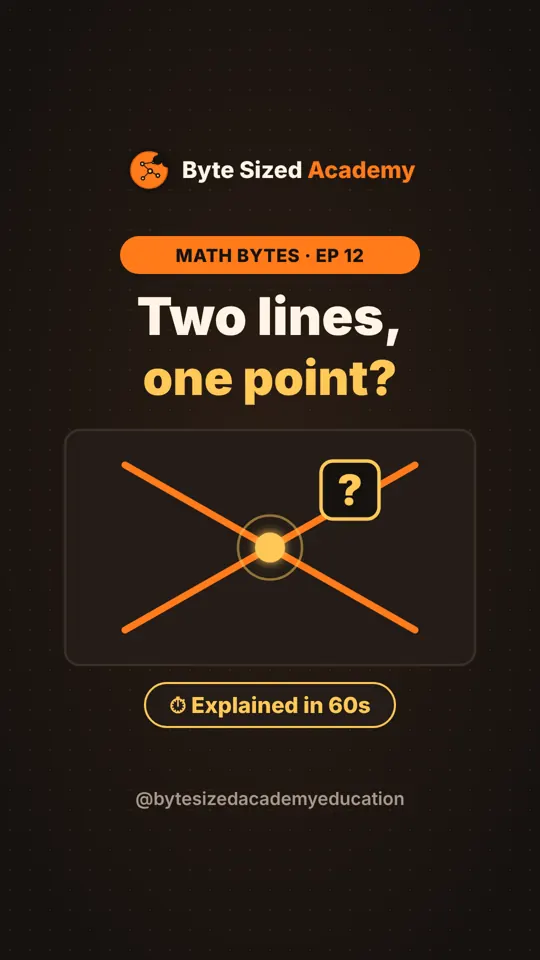 Algebra 1 · EP12
What a system is
A system of equations is two equations that must both be true for the same x and y. Its solution is the point that works in both, which on a graph is where the two lines cross. Example: y = x + 1 and y = −x + 5 cross at (2, 3).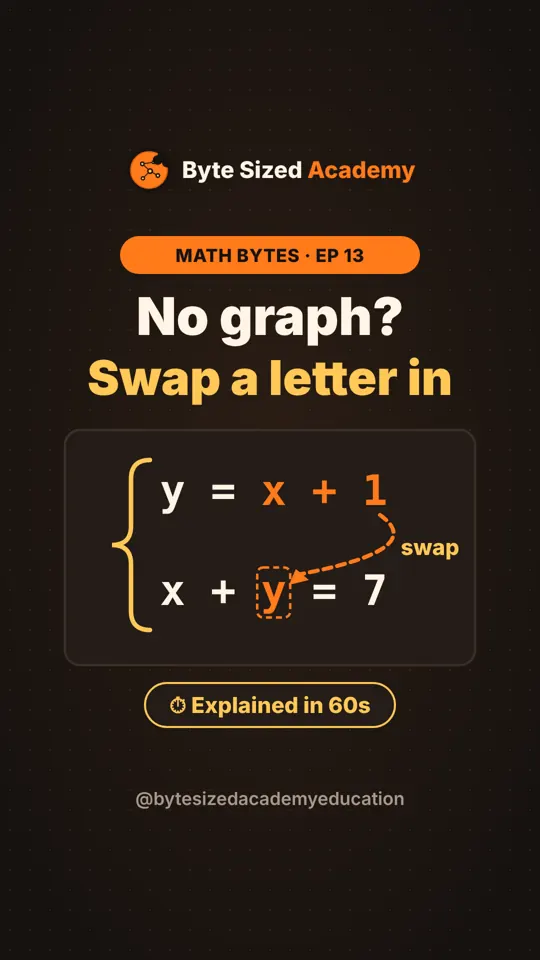 Algebra 1 · EP13
Solving by substitution
Substitution solves a system of equations without a graph. Take an equation that says what one letter is, swap that into the other equation, solve for the one letter left, then put it back in. Example: y = x + 1 and x + y = 7 give (3, 4).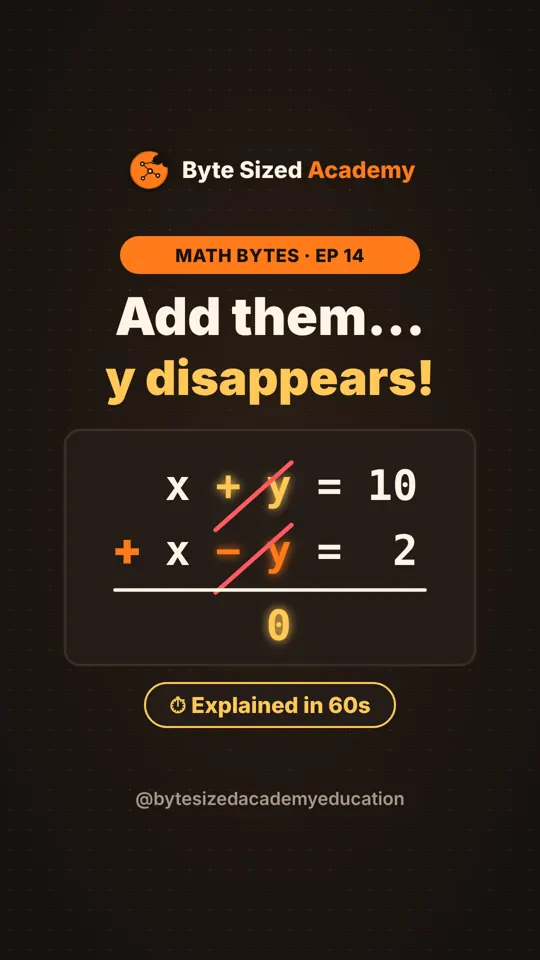 Algebra 1 · EP14
Solving by elimination
Elimination solves a system of equations by adding the equations so one letter cancels out. Solve for the letter that is left, then put it back in to find the other. Example: x + y = 10 and x − y = 2 give (6, 4).Expressions with exponents
3 lessons · swipe for more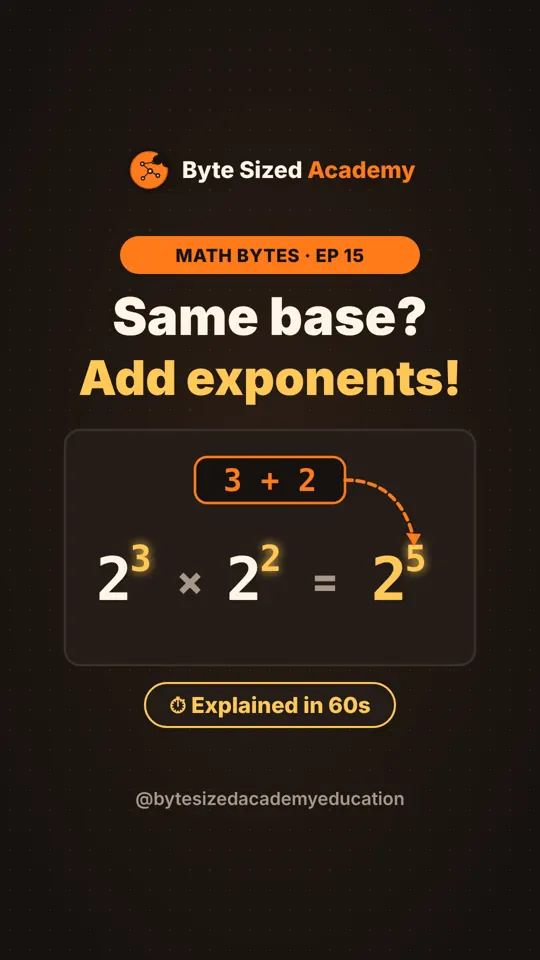 Algebra 1 · EP15
Exponent rules
An exponent counts how many of a number you multiply. To multiply powers of the same base, add the exponents. Example: 2³ × 2² = 2⁵, and 8 × 4 = 32 = 2⁵. The bases must match.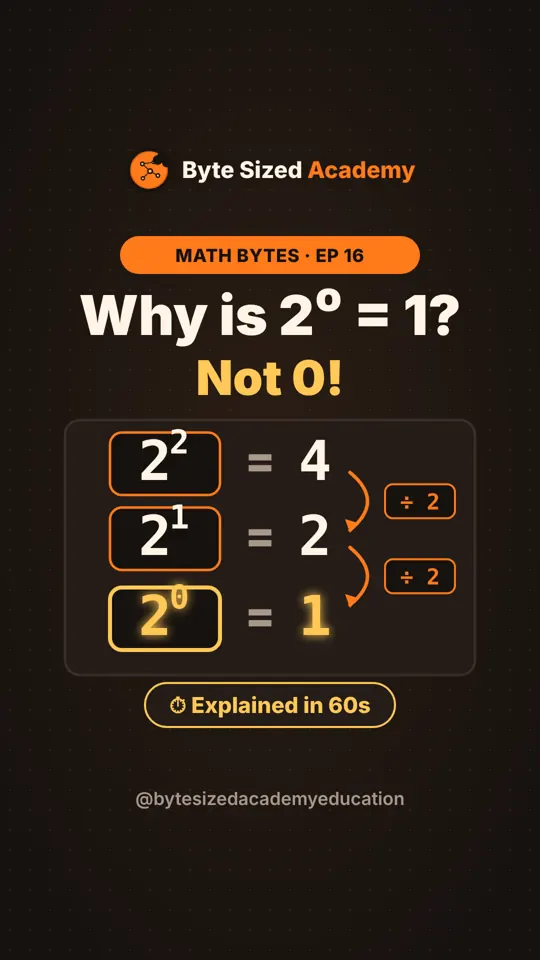 Algebra 1 · EP16
Zero and negative exponents
Each time an exponent drops by one, the value is divided by the base. Follow the pattern and 2⁰ = 1, 2⁻¹ = ½ and 2⁻² = ¼ = 1 / 2². Any nonzero base to the zero is 1, and negative exponents make fractions, not negative numbers.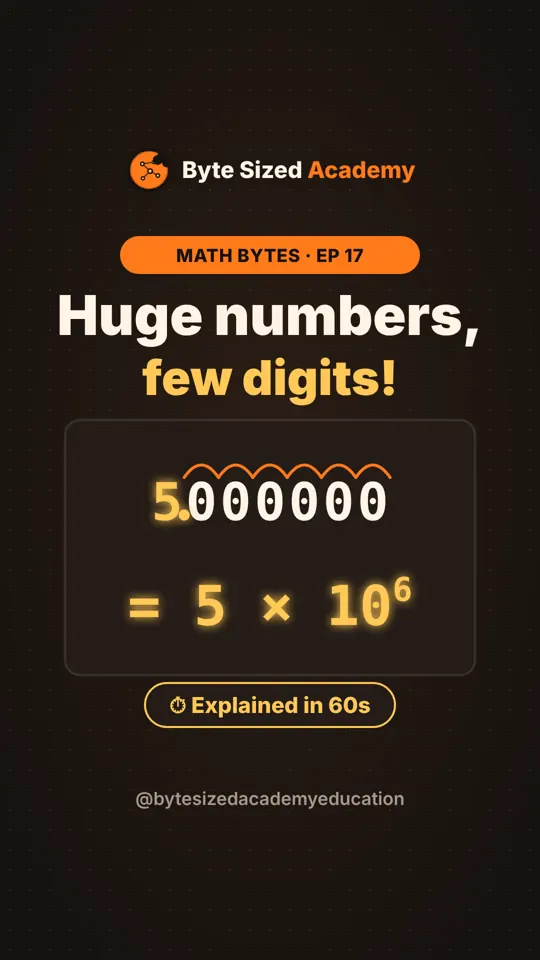 Algebra 1 · EP17
Scientific notation
Scientific notation writes a number as a first part from 1 up to (not including) 10, times a power of 10. The power counts how many places the decimal point hops left to land after the first digit, so 5,000,000 = 5 × 10⁶ and 300,000 = 3 × 10⁵.Quadratics and polynomials
1 lesson
More Math Bytes topics
All topics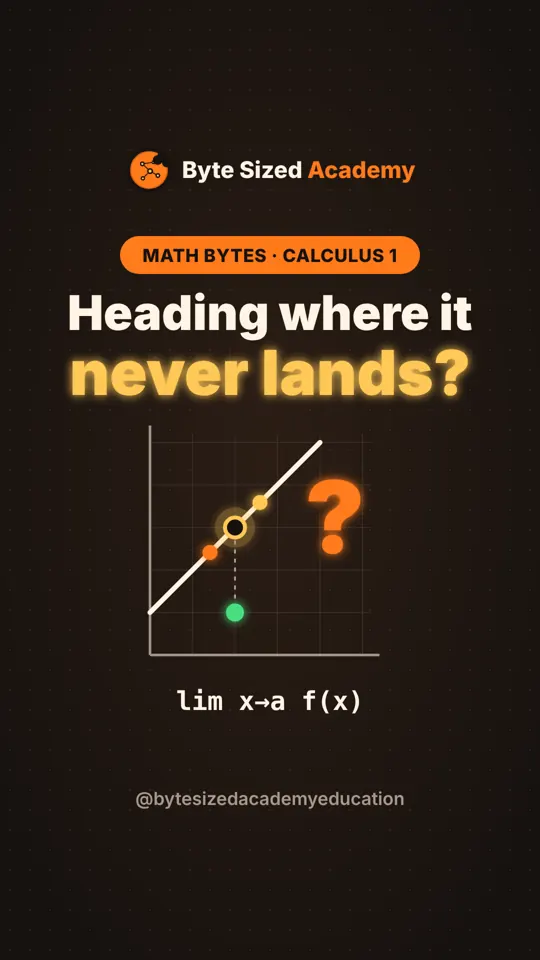 31 lessonsAP and college
Calculus
Limits and continuity · Derivatives: definition and basic rules · "Derivatives: definition and basic rules" · "Derivatives: chain rule and advanced topics" · Applications of derivatives · Analyzing functions · Integrals · Integration techniques · Differential equations (intro) · Applications of integrals · Parametric, polar and vector functions (BC) · Infinite sequences and series (BC) 8 lessonsAP and college
Multivariable calculus
Multivariable functions · Derivatives of multivariable functions · Applications of multivariable derivatives · Integrating multivariable functions · "Green's, Stokes' and the divergence theorems"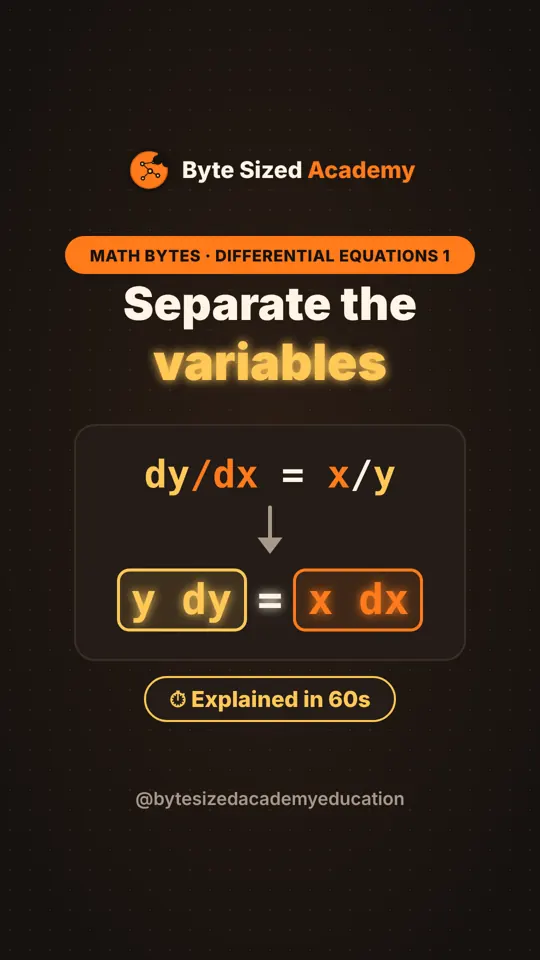 5 lessonsAP and college
Differential equations
First-order equations · Second-order linear equations · Laplace transform 6 lessonsAP and college