
Your one-minute classroom
Big topics, explained simply, in one minute or less.
Byte Sized Academy makes free, one-minute video lessons you can finish while your coffee cools. Every lesson has a page like this one, with a little more detail and the sources behind it.
 New · Algebra 1 EP18
Latest lessons
See all lessonsAlgebra 1 · EP18What a polynomial is
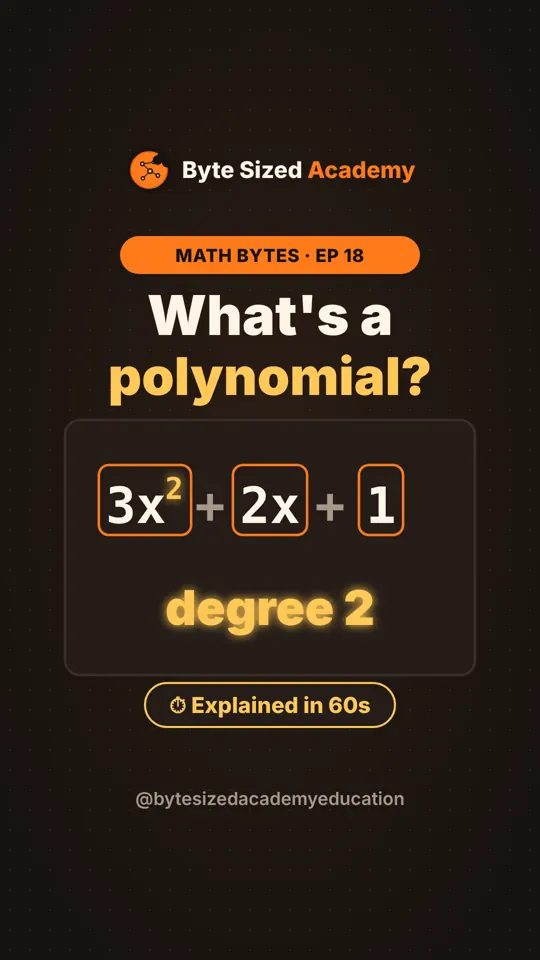
A polynomial is terms with powers, added up. Each term is a number times x to a whole-number power (0, 1, 2 and up), and the highest power is the degree, so 3x² + 2x + 1 has degree 2 and x³ − 4 has degree 3. 1/x = x⁻¹ is not a polynomial.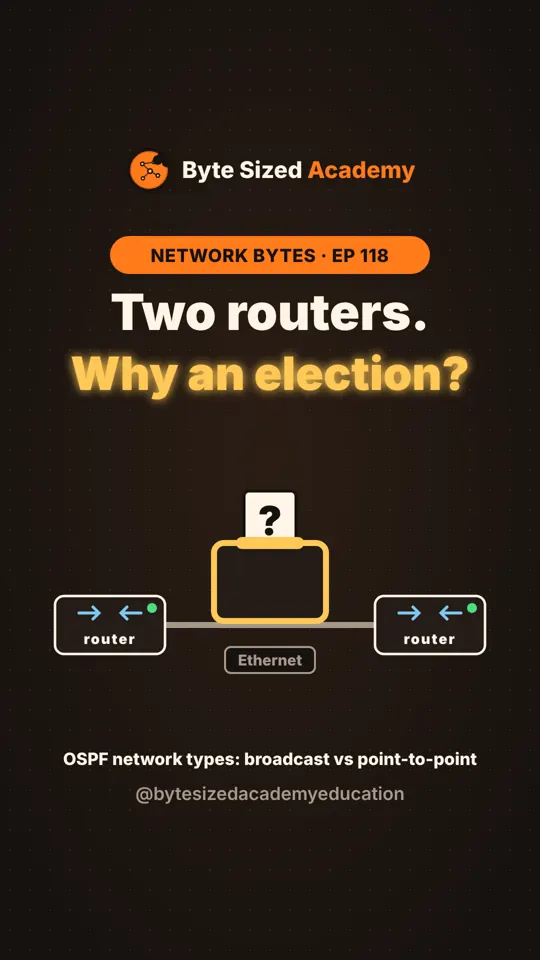 Network Bytes · EP118
"OSPF network types: broadcast vs point-to-point"
OSPF treats Ethernet as a broadcast network, so routers wait and then elect a designated router and a backup. On a link with only two routers that election just adds delay, so set the network type to point-to-point on both ends. Serial links are point-to-point by default.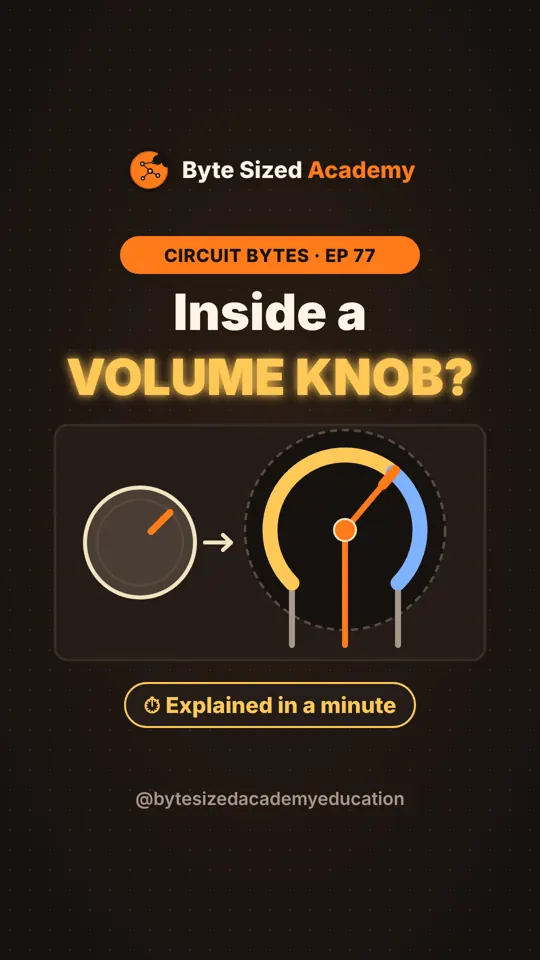 Circuit Bytes · EP77c
"Potentiometers: the volume knob"
A potentiometer is a resistor you adjust by turning. A curved resistive strip sits between two end pins, with a fixed resistance end to end, and the middle pin connects to a wiper that slides along the strip. Turning it shifts resistance from one side of the wiper to the other, and with a battery across the ends the wiper gives any voltage from zero up to the battery's.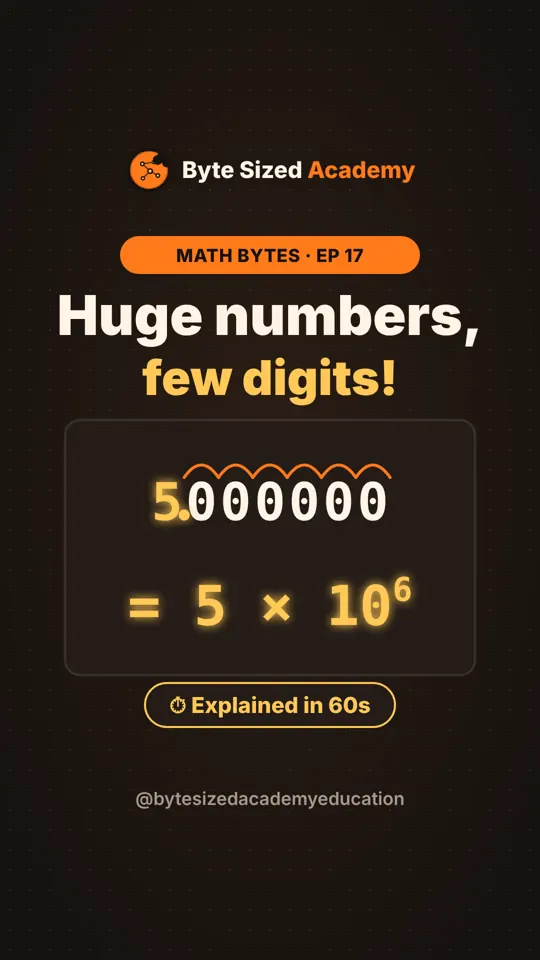 Algebra 1 · EP17
Scientific notation
Scientific notation writes a number as a first part from 1 up to (not including) 10, times a power of 10. The power counts how many places the decimal point hops left to land after the first digit, so 5,000,000 = 5 × 10⁶ and 300,000 = 3 × 10⁵.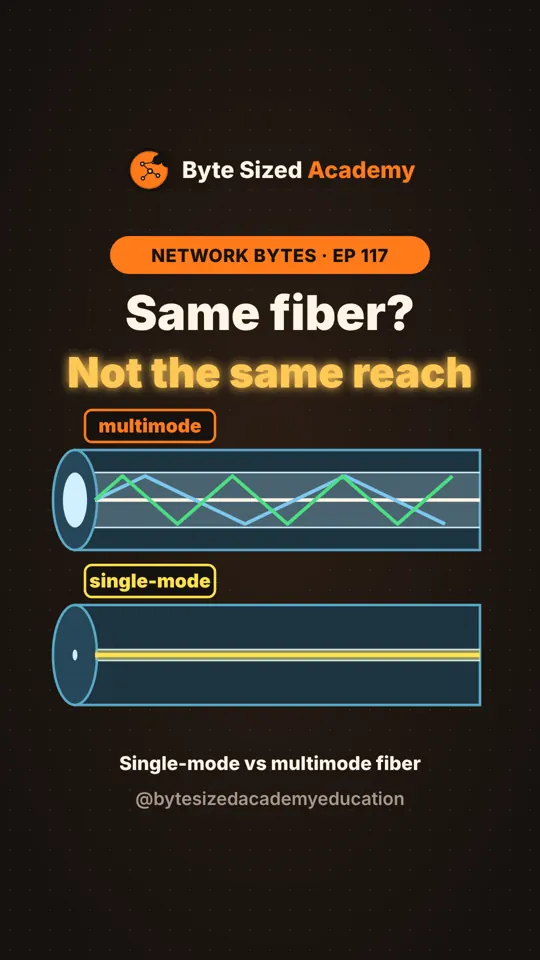 Network Bytes · EP117
"Single-mode vs multimode fiber"
Both kinds of fiber send light down a glass core. Multimode has a wide core where light takes many paths and pulses smear, so it reaches a few hundred meters; single-mode has a tiny core with one path, so it reaches 10 km and more.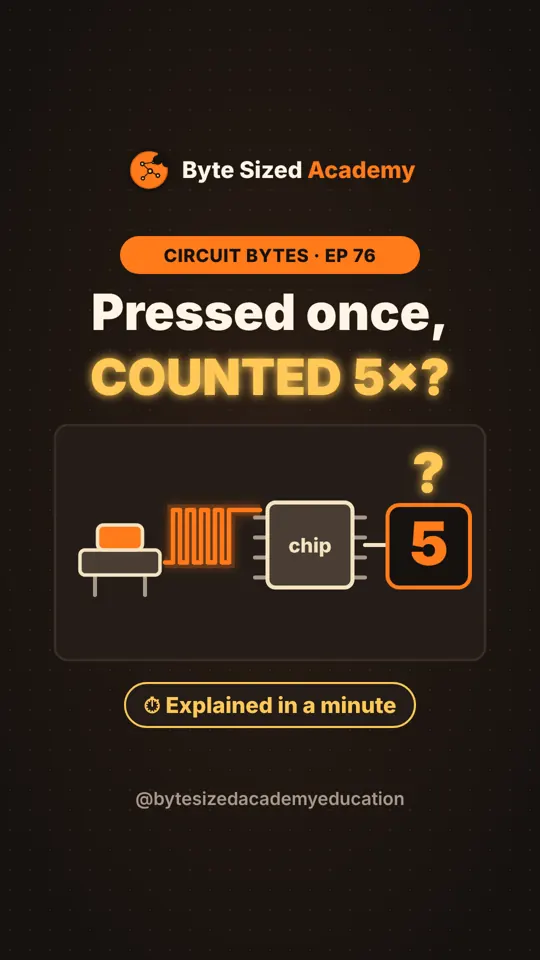 Circuit Bytes · EP76c
"Debouncing a button"
Inside a push button, two metal contacts bounce for a few milliseconds when they close, and a chip is fast enough to see every bounce, so one press can count as several. Debouncing fixes it: in code, wait about 20 ms and check again; in hardware, a resistor and capacitor smooth the bounces into one clean change.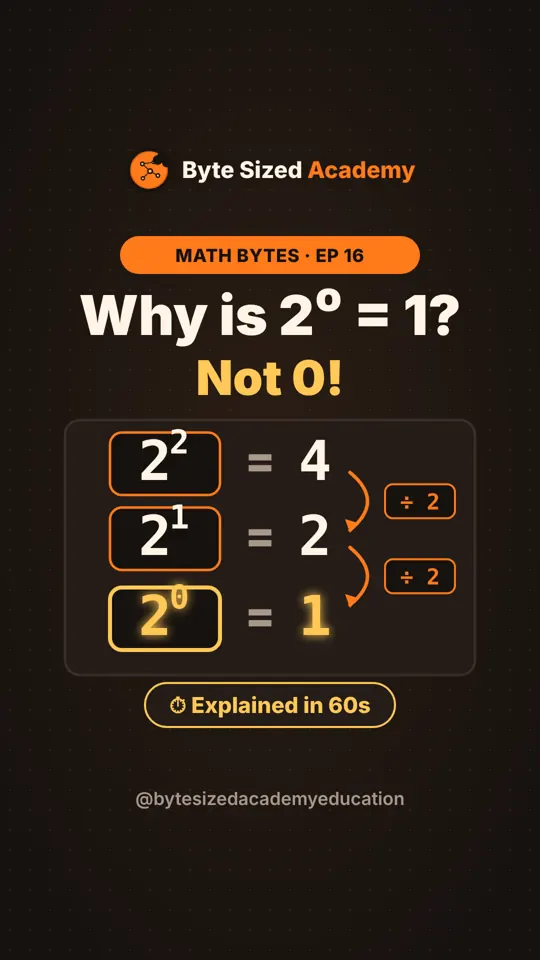 Algebra 1 · EP16
Zero and negative exponents
Each time an exponent drops by one, the value is divided by the base. Follow the pattern and 2⁰ = 1, 2⁻¹ = ½ and 2⁻² = ¼ = 1 / 2². Any nonzero base to the zero is 1, and negative exponents make fractions, not negative numbers.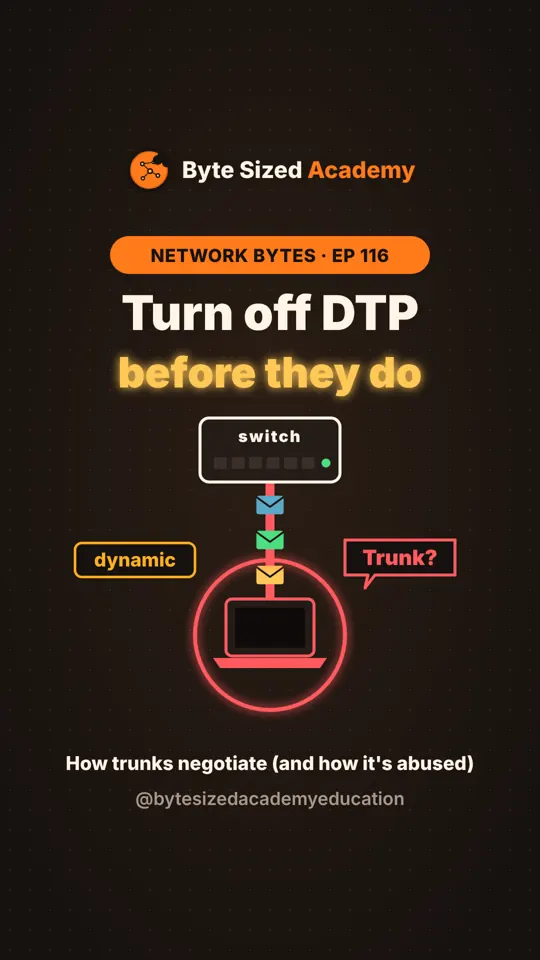 Network Bytes · EP116
"DTP: how trunks negotiate, and why to turn it off"
Cisco switches can negotiate a trunk on their own with DTP, the Dynamic Trunking Protocol. A dynamic desirable port asks, a dynamic auto port waits to be asked. Because an attacker's laptop can speak DTP too, set ports by hand and add switchport nonegotiate.How it works
Watch
One idea per video, about a minute long. Tiny topics stack up into big ones.Read
Each lesson's page goes a bit further, with the key terms and a quick thing to try.Check
Test yourself with a quick quiz, and follow the sources to dig deeper or double-check us.