
AP and college · 6 lessons
Linear algebra
One idea per video, in order. Start at the top and work your way across.
Vectors and spaces
2 lessons · swipe for more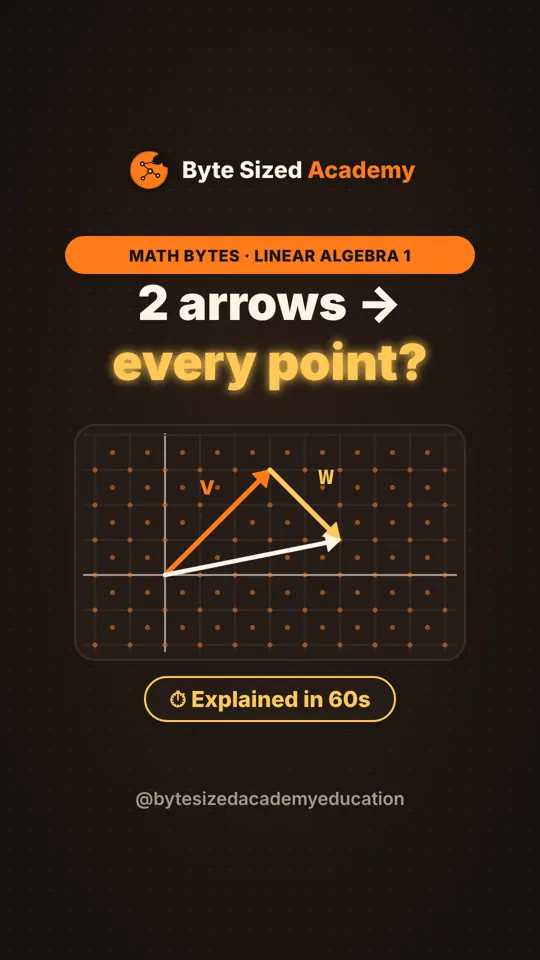 Linear algebra · EP1
Linear combinations and span
A linear combination of vectors v and w is av + bw, where a and b are numbers that stretch, shrink or flip each arrow before you add them tip to tail. The span is every point you can reach this way. With v = (1, 1) and w = (1, −1), 3v + 2w = (5, 1), and because v and w point along different lines their span is the whole plane. Linear algebra · EP2
Linear independence
Vectors are linearly independent when none of them is a linear combination of the others, so each one adds a new direction to the span. In a flat plane at most two vectors can be independent, and two vectors are dependent exactly when one is a multiple of the other.Matrix transformations
3 lessons · swipe for more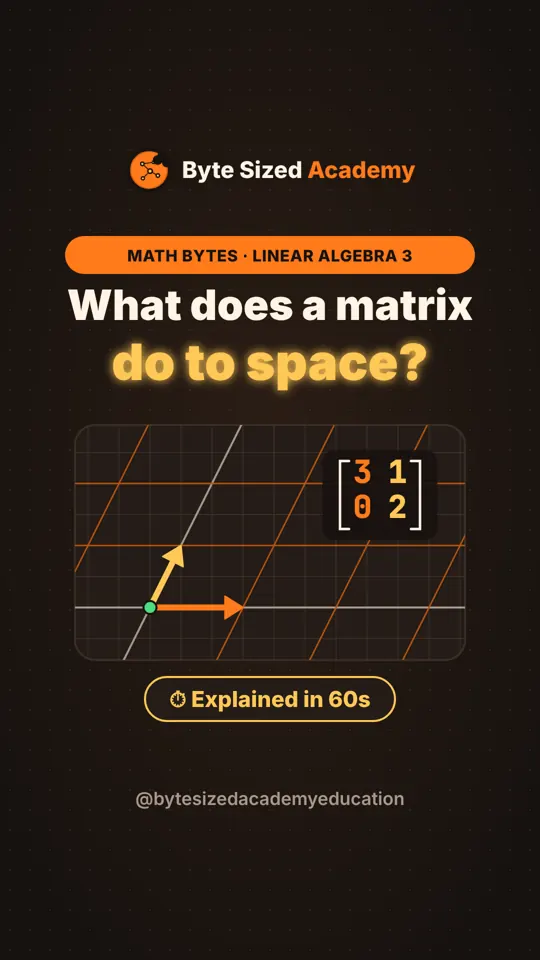 Linear algebra · EP3
A matrix moves space
A 2×2 matrix moves every point of the plane while keeping the origin fixed and the grid lines straight, parallel and evenly spaced. Its columns are where (1, 0) and (0, 1) land, so any point (x, y) lands at x times the first column plus y times the second. With columns (3, 0) and (1, 2), the point (2, 1) lands at (7, 2). Linear algebra · EP4
The determinant
The determinant of a 2×2 matrix is the factor by which it multiplies every area. The matrix with columns (3, 0) and (1, 2) turns the 1 × 1 square into a parallelogram with base 3 and height 2, so every area gets 6 times bigger, and ad − bc = 3 × 2 − 1 × 0 = 6. A negative determinant means the plane got flipped; zero means it got squashed onto a line, which happens when the columns are dependent.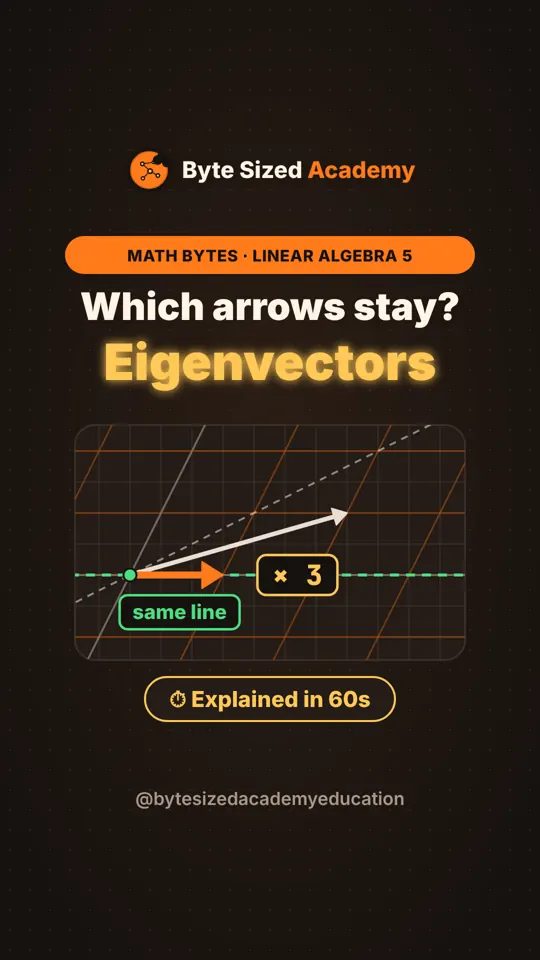 Linear algebra · EP5
Eigenvectors
When a matrix moves the plane, most arrows swing to a new direction, but a few stay on their own line through the origin and only get stretched. Those are eigenvectors, and the stretch factor is the eigenvalue. The matrix with columns (3, 0) and (1, 2) sends (1, 0) to (3, 0), eigenvalue 3, and (1, −1) to (2, −2), eigenvalue 2. In symbols, Av = λv.Alternate coordinate systems (bases)
1 lesson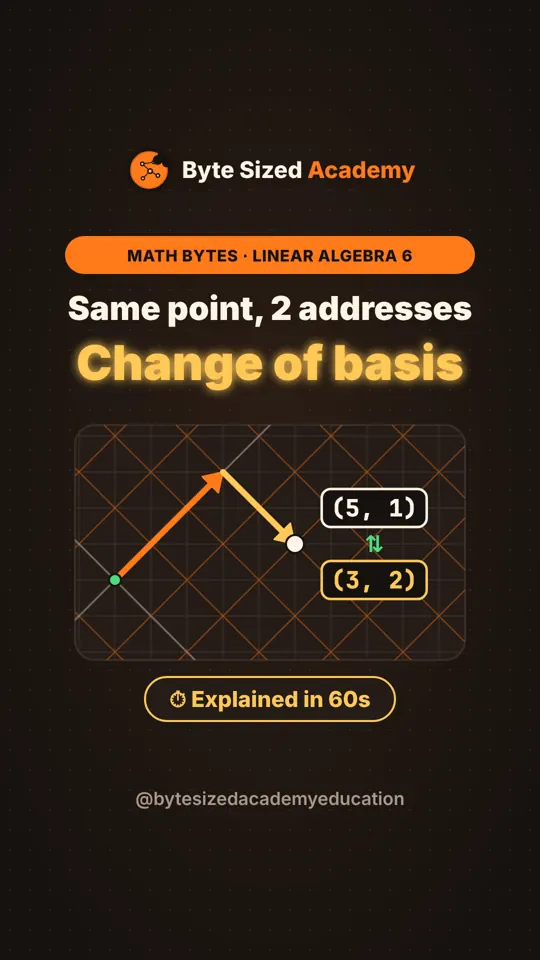
More Math Bytes topics
All topics 18 lessonsHigh school
Algebra 1
Foundations · Algebraic expressions · Linear equations and inequalities · Graphing lines and slope · Systems of equations · Expressions with exponents · Quadratics and polynomials 31 lessonsAP and college
Calculus
Limits and continuity · Derivatives: definition and basic rules · "Derivatives: definition and basic rules" · "Derivatives: chain rule and advanced topics" · Applications of derivatives · Analyzing functions · Integrals · Integration techniques · Differential equations (intro) · Applications of integrals · Parametric, polar and vector functions (BC) · Infinite sequences and series (BC) 8 lessonsAP and college
Multivariable calculus
Multivariable functions · Derivatives of multivariable functions · Applications of multivariable derivatives · Integrating multivariable functions · "Green's, Stokes' and the divergence theorems" 5 lessonsAP and college